
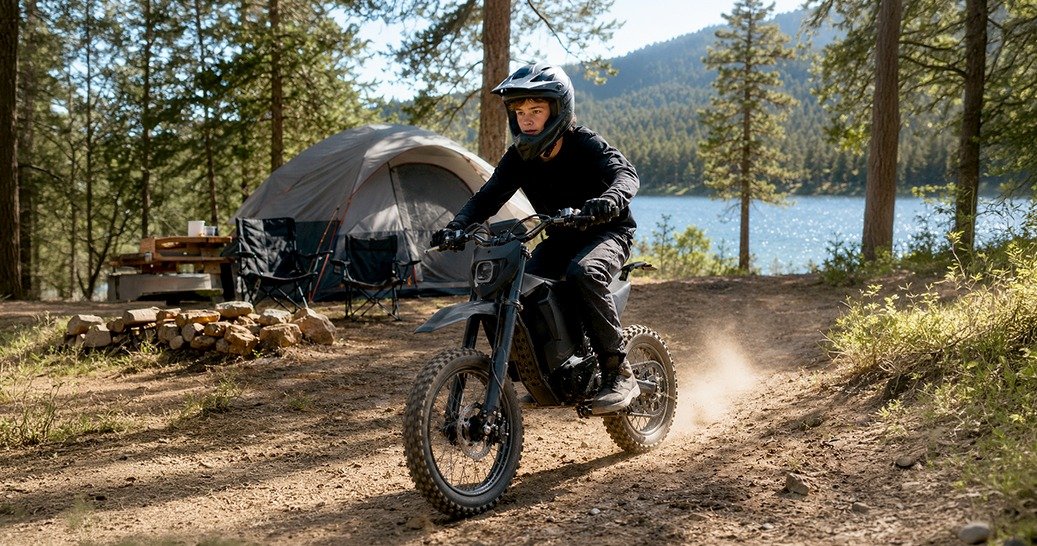
It is easy to understand why teenagers become interested in electric dirt bikes. They have a strong mechanical appeal and offer a way to step away from screens while learning route awareness, body control, and basic vehicle knowledge outdoors.
What families really need to consider is how to place that interest within clear rules. Electric dirt bikes are not ordinary road vehicles. Riding should be limited to permitted private land, closed training areas, or designated off-road zones where motorised vehicles are allowed. Without the right location, bike, training, and protective preparation, a healthy outdoor activity can quickly become difficult to manage.
Confirm Where Riding Will Take Place
Before choosing a bike, families should first find a legal and suitable place to practise.
Private land requires the owner’s permission, while public off-road areas may have rules covering vehicle type, rider age, opening times, and protective equipment. Public parks, cycle paths, and residential streets do not become suitable riding areas simply because the vehicle is electric.
A first practice area should be flat, open, and easy to see across, without continuous slopes, deep ruts, wet grass, or routes shared with pedestrians. Clear boundaries help teenagers understand where they may ride and when they must stop.
Match the Bike to the Rider’s Stage of Development
When choosing an electric dirt bike for a teenager, age should only be a starting point. Height, arm reach, leg strength, hand size, and previous riding experience all affect real control.
The rider should be able to reach the handlebars and brake levers naturally and support the bike steadily when stopping. If the rider cannot manage the bike when it begins to lean, a compact appearance will not automatically make it easier to control.
Wheel size, seat height, and overall proportions need to be considered together. Mini models may suit smaller riders who are beginning to learn basic control, but as height, strength, and experience increase, a bike that is too small may restrict standing position, steering, and weight movement.
For example, the Qronge X1 Spark L, designed as an electric dirt bike for teens, uses a 17-inch front wheel, a 14-inch rear wheel, and a minimum seat height of 29 inches. Compared with a mini model, it provides more room and ground clearance for teenagers who already have basic control skills and are approaching full-size proportions but are not yet ready to move directly to a larger off-road motorcycle.
The right bike is not the one with the strongest specifications. It is the one that suits the rider’s current ability while leaving reasonable room for the next stage.
Training Should Begin With Slow Movements
Electric power removes the need for a clutch and gear changes, but it does not make decisions for the rider. Throttle control, braking, vision, and body position still need to be learned step by step.
Early practice can begin with pushing the bike, mounting, dismounting, and switching the power off. Riders can then move on to straight starts, smooth stops, and wide turns. Only after these actions can be repeated consistently should they practise tighter turns, gentle slopes, and simple changes in terrain.
When first using an electric motorcycle, families should not treat willingness to accelerate as a sign of progress. Looking ahead, slowing down early, and stopping when uncertain show that the rider is developing sound judgement.
Each session should have a limited focus. Short practice with a clear goal makes it easier to identify problems and reduces the chance of fatigue affecting technique.
Riding Modes Cannot Replace Supervision
Some bikes offer different riding modes, but the meaning of each mode varies between manufacturers. Some mainly limit speed, while others also change power, torque, or range. The owner’s manual and official product information should always be checked.
A lower-output setting can help a rider become familiar with the bike’s response, but it cannot correct poor vision, sudden braking, or an unsuitable body position. Parents still need to observe whether the rider is operating smoothly and decide when settings should be changed.
Clear rules matter more: higher-output modes should not be selected without permission, the active mode should be checked before starting, and the power should be switched off when leaving the designated area. Electronic features can help manage the bike, but family rules determine how those features are used.
Protective Equipment Must Fit Properly
A helmet, goggles, gloves, off-road footwear, and suitable body protection should be included in the budget from the beginning.
Equipment that is too large may move out of place, while equipment that is too small can restrict movement. The helmet should fit securely, gloves should not interfere with braking, and footwear should provide enough ankle support. Once fully equipped, the rider should still be able to turn their head, hold the handlebars, and stand naturally.
Before riding, the tyres, brakes, chain, and fasteners should also be checked. The battery should be charged and stored in a dry, ventilated place according to the manufacturer’s instructions.
Parents Should Reduce Supervision Gradually
Supervision does not mean standing beside the bike and giving constant instructions. A better approach is to set clear limits first and then observe whether the teenager can follow them independently.
Before each session, the family can agree on the route, the practice goal, and the conditions for stopping. During riding, parents should pay attention to repeated mistakes, tiredness, or loss of concentration.
As skills improve, teenagers can gradually take responsibility for checking equipment, confirming the bike’s condition, and judging whether a route is suitable. Progress is not only about riding more confidently. It also includes knowing when to stop.
Turn an Outdoor Interest Into a Lasting Habit
Responsible riding also means learning how to care for equipment, respect the riding area, and judge personal ability.
Teenagers can take part in pre-ride checks, organising protective gear, and basic cleaning after each session. Parents should keep the rules consistent, avoid increasing the difficulty after one successful ride, and resist comparing progress with other riders of the same age.
When legal riding areas, suitable bikes, basic training, and family supervision become part of a stable routine, electric dirt bike riding becomes more than a short-lived interest. It can develop into a lasting outdoor activity that teaches teenagers preparation, judgement, and responsibility alongside vehicle control.
Choosing a bike that suits the rider’s stage of development, setting clear rules, and keeping every session focused on safety and ability will help that interest continue in the right direction.
