
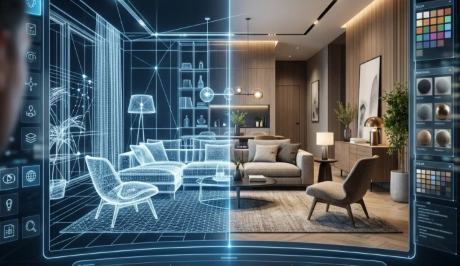
The interior design and furniture manufacturing industries are experiencing a profound technological shift. As consumer expectations for personalized living spaces increase, design firms and furniture retailers are under immense pressure to deliver highly customized, visually accurate room layouts in record time. Historically, visualizing a complex interior space required hours of painstaking labor using specialized drafting software. Renderings were static, and any minor adjustment to a sofa’s upholstery or a table’s dimensions necessitated a complete system recalculation. Today, the integration of advanced artificial intelligence into spatial rendering is eliminating these operational bottlenecks. By leveraging these modern computational systems, design agencies can automate interior 3D modeling workflows to produce interactive, physics-based digital environments instantly.
Leading this paradigm shift is Neural4D, a highly advanced geometric processing platform jointly developed by Nanjing University, DreamTech, Oxford University, and Fudan University. By deploying its sophisticated Spatial Sparse Attention (SSA) mechanisms alongside the Direct3D-S2 architecture, Neural4D allows furniture manufacturers to digitize their entire physical catalogs rapidly. Instead of building digital models vertex by vertex, creators can input standard two-dimensional photographs or brief video sweeps of a physical chair, and the AI algorithm will mathematically construct a highly accurate, fully textured digital twin within minutes.
The Evolution of Spatial Visualization
To comprehend the impact of automated 3D generation, it is necessary to examine the traditional limitations of interior visualization. For decades, interior designers relied on flat floor plans and fabric swatches to communicate their vision to clients. When computer-aided design eventually entered the mainstream, it brought the promise of virtual walkthroughs. However, the barrier to entry remained exceptionally high.
Building a photorealistic room required a technical artist to meticulously model every individual piece of furniture, apply appropriate bump maps to simulate textile textures, and configure complex global illumination settings. This labor-intensive process meant that interactive 3D visualization was reserved exclusively for high-budget commercial real estate projects or luxury residential builds.
Democratizing Design Through Algorithmic Generation
Generative AI fundamentally alters this dynamic by shifting the heavy lifting from the human operator to the deep learning network. Modern reconstruction algorithms can infer physical depth, structural mass, and material reflectance directly from standard imagery.
1. Rapid Catalog Digitization: Retailers can utilize AI platforms to process thousands of product photos, automatically generating an interactive 3D asset for every single SKU in their inventory.
2. Dynamic Material Processing: The neural networks automatically differentiate between a glossy polished oak finish and the matte texture of woven linen, baking these properties directly into the mesh’s material maps.
3. Optimized Polycounts: To ensure these digital assets load smoothly on consumer mobile devices for augmented reality viewing, the AI automatically decimates the internal geometry, reducing polygon counts while preserving the object’s visual silhouette.
Technical Constraints and Algorithmic Solutions in Material Optics
Accurately simulating how light interacts with complex furniture materials has always been a significant challenge for rendering engines. Different textiles and finishes require distinct computational approaches to appear photorealistic in a digital environment. The following matrix details how automated reconstruction resolves these historical optical challenges.
Interior Design Material Optic Constraints
| Material Classification | Traditional Rendering Challenge | AI Reconstruction Solution |
| Reflective Surfaces (Glass/Metal) | Manual adjustment of Index of Refraction (IOR) and environment maps is required to avoid visual anomalies. | Deep learning networks interpret light bounce from the source images to automatically calculate realistic metallic and roughness values. |
| Complex Textiles (Velvet/Bouclé) | Procedural generation of microfiber displacement maps is computationally heavy and often looks artificial. | AI extracts high-resolution normal maps directly from the physical fabric weave visible in the input photographs. |
| Organic Materials (Wood/Leather) | Seamlessly wrapping wood grain textures around complex, curved geometry often results in noticeable UV stretching. | Algorithmic texture baking maps the organic pattern onto the final mesh identically to its physical counterpart, preventing distortion. |
Enhancing Retail Engagement with Augmented Reality
The most immediate beneficiary of this automated modeling pipeline is the digital retail sector. When purchasing furniture online, the primary factor driving customer hesitation is spatial uncertainty. A consumer may appreciate the aesthetic of a mid-century modern credenza but remain unsure if it will fit within their specific alcove or clash with their existing decor.
High-fidelity 3D assets bridge this sensory gap. By generating optimized digital twins, retailers can deploy augmented reality applications directly on their mobile storefronts.
Consumers can use their smartphone cameras to project a mathematically accurate, true-to-scale virtual representation of the furniture directly into their living rooms. They can walk around the object, inspect the texture of the fabric under their home’s natural lighting, and verify spatial clearances before initiating the checkout process. This interactive transparency builds immense consumer confidence, directly correlating with higher conversion rates and a drastic reduction in costly freight returns.
Collaborative Fabrication and the Open Hardware Ecosystem
While massive retail conglomerates utilize these tools to overhaul their digital storefronts, the underlying technology is also fueling a resurgence in independent furniture design and collaborative fabrication. Independent makers, carpenters, and industrial designers are utilizing AI reconstruction to rapidly prototype bespoke hardware and ergonomic structural joints.
An independent designer can hand-carve a conceptual ergonomic chair seat, scan it using a smartphone, and let the AI generate the precise geometric mesh. This digital file can then be exported directly to a CNC router for mass fabrication.
This fluid transition between physical crafting and digital manufacturing has cultivated a highly active sharing ecosystem. Creators who design structurally verified, print-ready joints, brackets, or modular furniture connectors frequently distribute their digital files for public use. For designers looking to integrate specialized components into their custom builds without reinventing the wheel, exploring the DIY3D printable model catalog provides access to a wealth of community-tested, structurally sound geometric files. This open exchange of digital assets accelerates innovation, allowing creators to focus on aesthetic design while relying on crowd-sourced engineering for structural components.
Ensuring Structural Integrity in Digital Twins
It is vital to recognize that an AI-generated model intended for physical manufacturing requires different structural parameters than a model generated strictly for visual augmented reality.
When generating an asset for spatial computing or a web viewer, the algorithm prioritizes visual fidelity and low polygon counts. However, if an interior designer plans to 3D print a scaled architectural maquette or CNC mill a custom furniture leg, the digital twin must possess absolute geometric solidity.
Enterprise-grade AI platforms address this requirement by deploying secondary topological cleaning routines. These algorithms scan the generated mesh for non-manifold edges, self-intersecting polygons, and inverted normals. By mathematically sealing any microscopic holes in the geometry, the software guarantees that the final exported file is structurally robust and ready for physical fabrication.
The Next Era of Spatial Interaction
The intersection of generative artificial intelligence and interior spatial planning is redefining how humans interact with their living environments. The era of relying on flat, two-dimensional swatches and static renderings is concluding. By adopting automated geometric reconstruction, design professionals and furniture retailers acquire the agility to generate fully interactive, photorealistic environments on demand.
As these deep learning systems process larger datasets, their accuracy and generation speed will continue to compound. The foundational requirement for the incoming wave of spatial computing is a vast, easily accessible library of high-fidelity digital assets. Organizations that integrate these automated reconstruction workflows today are actively building the infrastructure required to dominate the immersive, interactive marketplaces of the future.
