
Own a BMW, Audi or Mercedes? Find out why premium German cars often fail their MOT for minor issues and how to stay ahead in Aldershot.
There is a common assumption that a premium German car practically drives itself through an MOT. The engineering is sharp, the build quality is exceptional, and the badge carries a reputation that feels almost bulletproof. Yet every year, owners of BMWs, Audis, and Mercedes-Benz vehicles walk away from test centres with a fail certificate in hand, often for issues that seem frustratingly small.
The truth is, the MOT does not grade cars on prestige. It applies the same set of standards to every vehicle on the road, regardless of what it cost. If you are due a MOT test soon, understanding why high-end German cars are vulnerable to these surprises could save you time, money, and a wasted trip. Booking proper car servicing in Aldershot ahead of your test is one of the smartest things you can do as a German car owner.
The MOT Does Not Care About Your Badge
The Ministry of Transport test is a standardised annual inspection. It checks safety and emissions against fixed criteria, and the tester has no room to give credit for a car being well-built or expensive. A worn tyre is a worn tyre whether it is on a ten-year-old hatchback or a nearly-new saloon.
What makes German cars particularly interesting here is the gap between how they feel to drive and how they actually perform under inspection. These are precision machines built to high tolerances, which means small amounts of wear can still exceed the limits set out under UK testing standards. A car that feels perfectly composed on the road can still register measurable play in a steering component or fall marginally short on an emissions reading.
Why German Cars Are Not as MOT-Proof as People Think
German manufacturers build to tight engineering standards, but those same standards create complexity. More complexity means more components that can drift out of specification. Here are the areas where premium German cars most commonly trip up.
1. Suspension Wear on M Sport and AMG-Style Setups
Firmer suspension setups, common across sporty trim levels, work harder on UK roads than standard configurations. Potholes, speed bumps, and the general condition of British tarmac accelerate wear on ball joints, control arm bushes, and anti-roll bar links. A driver may not feel a meaningful change in handling, yet on the ramp, a tester can identify measurable play that counts as a major defect.
2. Lighting Faults on Complex Electronic Systems
Blown bulbs are one of the most common reasons any car fails its MOT across the UK. On a modern German vehicle, the issue goes beyond simply replacing a bulb. LED and adaptive lighting systems are electronically monitored, and a fault or flicker in a daytime running light or indicator circuit can trigger a warning that the car’s own system has not flagged. Many owners only discover this during the test itself.
3. Tyre Condition on Low-Profile Fitments
Audi models in particular tend to use larger alloy wheels paired with low-profile tyres. The reduced sidewall means far less cushioning between the rim and the road surface, making these tyres more vulnerable to kerb damage, sidewall cuts, and accelerated tread wear. The legal minimum tread depth in the UK is 1.6mm, and a tyre that looks visually acceptable can still fall below that threshold.
4. Emissions and DPF Issues on Diesel Models
Since 2014, the MOT has included a physical check of the Diesel Particulate Filter on diesel vehicles. A blocked or missing DPF results in an automatic failure. German diesel models, particularly those used frequently on short urban journeys around towns like Aldershot and Fleet, are especially prone to DPF blockages because the filter never gets hot enough to complete a full regeneration cycle.
5. AdBlue System Faults on Newer Models
Many later Mercedes and BMW diesel models use AdBlue fluid as part of their exhaust after-treatment system. If the AdBlue level runs low or a sensor within the system fails, it can trigger an emissions-related fault that results in an MOT failure. Owners are sometimes unaware this system even needs attention until the test exposes it.
6. Steering Component Play
Wear in track rod ends, ball joints, and control arm bushings can develop gradually over time without announcing itself clearly to the driver. German chassis tend to be well balanced and absorb small amounts of degradation without a noticeable change in steering feel. That subtle play, however, is exactly what testers check for on the inspection ramp.
7. Windscreen Chips and Cracks in the Driver’s Line of Sight
A chip or crack in the swept area of the windscreen is a fail point. German cars often feature larger, more curved windscreens, and rock chips are common on motorway-heavy vehicles. The exact position and size of the damage determines whether it becomes a major defect.
The Complexity Problem: More Technology, More Risk
Premium German vehicles carry significantly more onboard electronics than mainstream cars. This adds genuine value in terms of safety and comfort, but it also increases the number of systems that can generate a fault code. A single failed sensor, a minor wiring issue, or a malfunctioning control module can cause a warning light to appear on the dashboard, which in certain cases counts as a failure point during the MOT.
This complexity also means that standard diagnostic tools are not always enough. Many German models require manufacturer-specific software to read fault codes accurately, which is why using a specialist garage rather than a general test centre makes a meaningful difference for these vehicles.
Common Faults by Model at a Glance
| German Brand | Common MOT Failure Areas |
| BMW | Suspension play, lighting faults, DPF blockage, battery condition |
| Audi | Front tyre wear, tyre sidewall damage, emissions readings |
| Mercedes-Benz | AdBlue system faults, DPF sensor wiring, steering play |
How German Car Owners in Aldershot Can Prepare
Preparing a premium German car for its MOT is not complicated, but it does require more attention than a basic walk-around check. The following steps reduce the risk of a surprise failure considerably.
- Check all exterior lights including indicators, daytime running lights, number plate lights, and reverse lights before the test date.
- Inspect tyre tread depth with a gauge, paying particular attention to the front axle on front-wheel-drive models.
- Check for any chips or cracks in the windscreen and assess whether they fall within the driver’s sightline.
- Confirm that the DPF warning light is not present and, if the car is a diesel, take it for a sustained motorway run to encourage a regeneration cycle before the test.
- Top up AdBlue if the system is fitted and the level is showing low.
- Listen for any knocking or creaking over bumps, as this can indicate suspension or steering wear.
- Have the car scanned for any stored fault codes that may not have triggered a visible warning light.
Reading through common MOT failure codes ahead of your appointment is also a practical way to understand what testers are looking for before you arrive.
Does Premium Mean Better MOT Pass Rates?
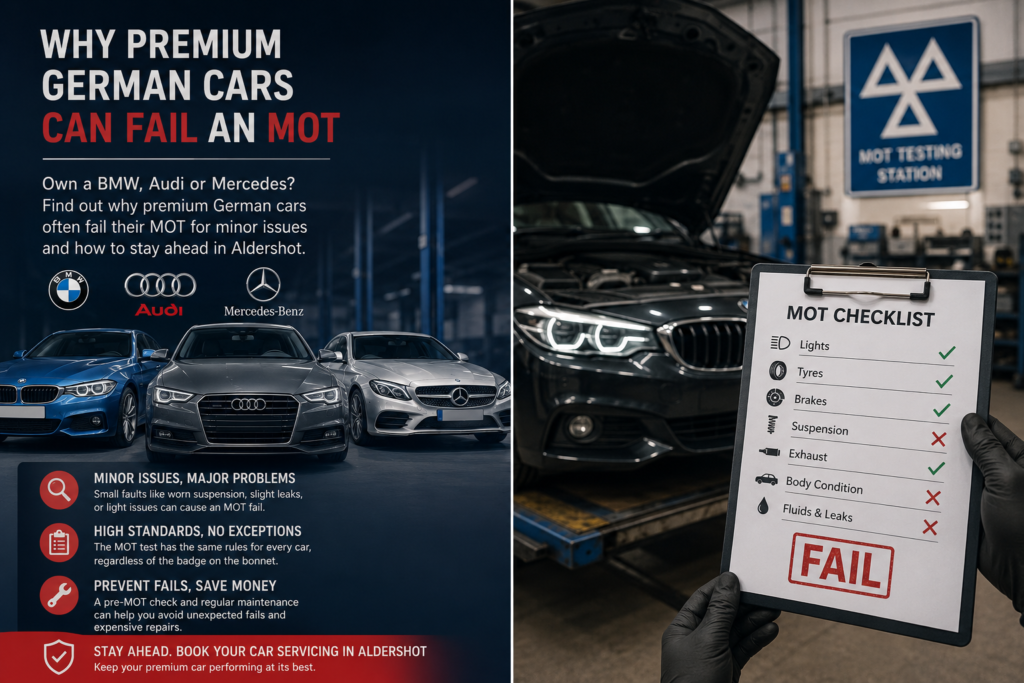
It is worth addressing this directly. According to publicly available DVSA data analysed across millions of test records, BMW sits at an 84.4% pass rate, Audi at 83.9%, and Mercedes at 82.0%. These are genuinely strong figures compared to many other brands, but they are not perfect. Roughly one in six German cars still fails.
The failures that do occur tend to be concentrated in the areas outlined above, not dramatic mechanical breakdowns. These are wear items and sensor faults, the kind of issues that a pre-MOT check would catch before they become a problem on test day.
| MOT Pass Rate by Brand | Approximate Pass Rate (DVSA Data) |
| BMW | 84.4% |
| Audi | 83.9% |
| Mercedes-Benz | 82.0% |
The Case for a Pre-MOT Check
A pre-MOT inspection is not about finding dramatic faults. On a well-maintained German car, it is about identifying the small things that accumulate quietly between service intervals. A tyre that has worn unevenly, a bulb that flickers occasionally, a ball joint that has developed a fraction of play. None of these feel urgent, but any one of them can result in a failed test and the cost and inconvenience of a retest.
For drivers in Aldershot, Farnborough, Fleet, and the surrounding areas of Hampshire, having a pre-MOT check carried out by a team familiar with German vehicles is a straightforward way to arrive at the test with confidence. The fee for a check is modest, and it is far cheaper than dealing with an unexpected failure and the repairs needed before a retest. You can also review our guide on how to avoid an unexpected MOT failure for a full checklist.
Conclusion
A premium German car is one of the better vehicles you can own from a reliability standpoint. The engineering is genuinely impressive, and the data supports that. But impressive engineering does not mean immune to the MOT process, and the very features that make these cars feel special, the complex electronics, the performance-oriented suspension, the low-profile tyres, are often the same features that create vulnerability at the test.
Staying ahead of the process means regular servicing, attention to the details most drivers overlook, and using a garage that understands what these vehicles actually need. If your MOT is coming up, do not leave it to chance. Take the time to prepare properly and your German car will give you exactly what it was built to deliver.
Frequently Asked Questions
Why do German cars fail MOT tests despite being well built? German vehicles are built to precise engineering tolerances, which means even small amounts of wear can push a component outside the limits required to pass. Complex electronics, performance suspension setups, and low-profile tyres all add points of vulnerability that simpler cars do not have.
What is the most common reason a BMW fails its MOT? Suspension wear is one of the most frequently cited failure areas for BMWs in the UK. The firmer suspension setups found on sport-trim models work harder on British roads and develop measurable play in ball joints and control arms over time.
Can a DPF fault cause an MOT failure? Yes. Since 2014, MOT testers carry out a visual inspection of the Diesel Particulate Filter on diesel vehicles. A blocked, damaged, or removed DPF will result in a failure.
How can I prepare my German car for its MOT? Check all lights, tyre condition, and tread depth. If the car is a diesel, take it for a sustained run to help the DPF regenerate. Check for any stored fault codes and consider a pre-MOT inspection at a specialist garage.
Do Audi cars have specific MOT failure issues? Audi models frequently fail on front tyre condition. The combination of front-wheel drive, more weight over the front axle, and low-profile tyres on large alloy wheels accelerates tyre wear and makes sidewall damage more likely.
Is it worth getting a pre-MOT check for a German car? Absolutely. A pre-MOT inspection catches the minor issues that accumulate between services. For premium German vehicles with their added complexity, it is one of the most cost-effective things you can do before test day.
