
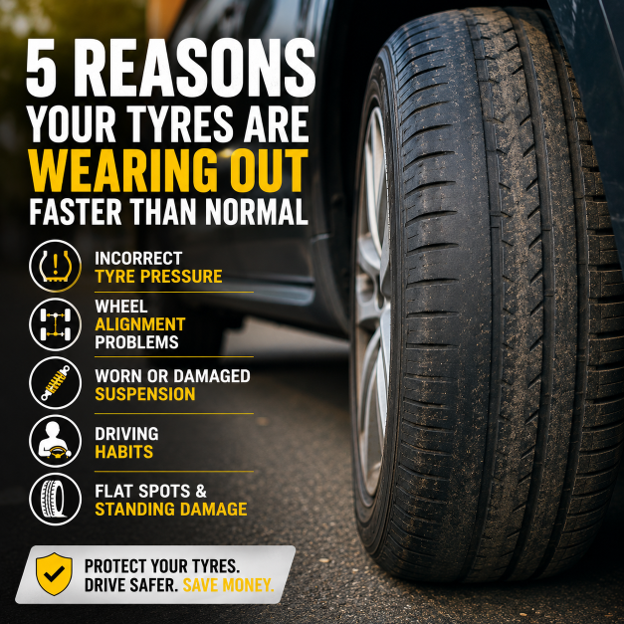
Tyres wearing out too quickly? Discover the 5 most common causes of fast tyre wear and what you can do to protect your tyres and your wallet.
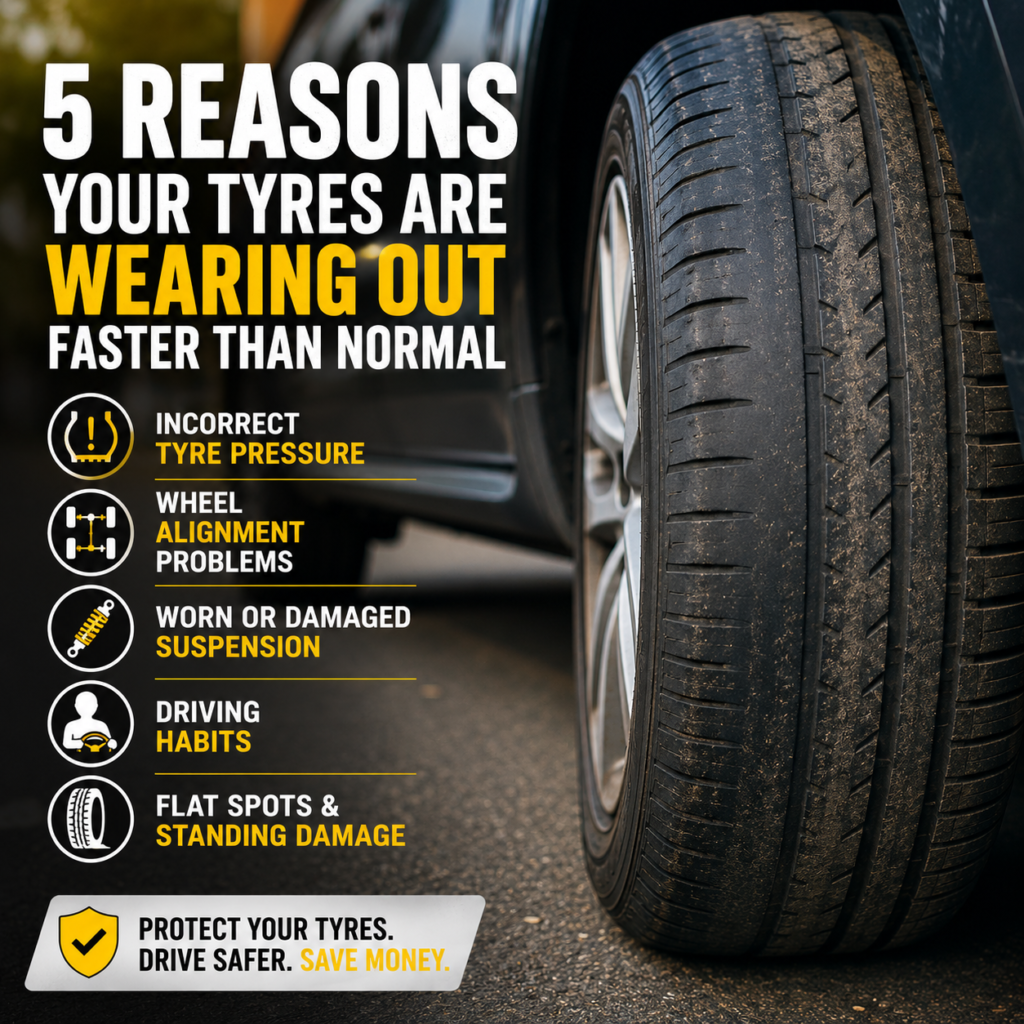
Replacing tyres is one of the more significant costs drivers face, so when a set starts wearing down noticeably faster than expected, it is frustrating at best and potentially unsafe at worst. Most drivers assume tyre wear is simply a result of mileage, but the truth is far more specific than that. Two identical cars covering the same distance can have completely different tyre lifespans depending on a handful of factors that are largely within your control.
Tyres that wear prematurely are not just a financial issue. They affect grip, braking distance, fuel economy, and your ability to pass an MOT. Understanding what is causing the wear means you can address the root problem rather than simply replacing tyres and watching the same thing happen again. Drivers looking for professional tyre advice, inspections, and vehicle maintenance support can rely on G Force Tyres for expert guidance and quality automotive services across Hampshire. For drivers across Aldershot, Farnborough, Farnham, Tongham, Ash Vale, and North Camp, this guide covers the five most common reasons tyres wear faster than they should.
What Normal Tyre Wear Looks Like
Before examining what goes wrong, it is worth understanding what normal wear actually looks like. A new tyre typically starts with around 7 to 8mm of tread depth. In the UK, the legal minimum is 1.6mm across the central three quarters of the tyre’s width around its entire circumference. Most tyre safety experts and manufacturers recommend replacing tyres at 3mm rather than waiting for the legal limit, because braking distances in wet conditions increase significantly as the tread wears below that point.
Under normal conditions, with correct tyre pressure, good wheel alignment, and sensible driving habits, a set of tyres should last somewhere between 20,000 and 40,000 miles. Front tyres typically wear faster than rears because they carry more of the braking load and handle the demands of steering. When tyres wear down noticeably faster than this, or when the wear pattern is uneven across the tyre surface, something else is at play.
The 20p test is a quick way to check your tread at home. Push a 20p coin into the tread groove. If you can see the outer band of the coin, your tread depth is approaching 3mm and replacement should be planned soon.
Reason 1: Incorrect Tyre Pressure
This is the single most common cause of premature tyre wear, and it is also the easiest to prevent. Tyre pressure that is either too high or too low causes the tyre to make uneven contact with the road surface, concentrating wear in specific zones rather than distributing it evenly across the full tread width.
Underinflated Tyres
When a tyre is underinflated, the sidewalls flex excessively and the outer edges of the tread press harder against the road than the centre. The result is accelerated wear on both shoulders of the tyre, while the centre tread remains relatively untouched. Underinflated tyres also run hotter than normal due to increased flexing, which degrades the rubber compound more rapidly and increases the risk of a blowout, particularly on motorway driving where sustained speed generates additional heat.
Overinflated Tyres
An overinflated tyre sits too rigidly, reducing the contact patch with the road. The centre of the tread bears the full load while the outer edges barely touch the road surface. This produces accelerated wear down the middle of the tyre, leaving the shoulders relatively fresh even as the centre wears thin.
Both patterns shorten tyre life significantly and, left unchecked, result in tyres that need replacing far earlier than they should.
How to avoid it: Check your tyre pressure at least once a month and before any long journey. The correct pressures for your vehicle are shown on a sticker inside the driver’s door jamb or inside the fuel filler flap, and in the owner’s manual. Note that pressures often differ between front and rear tyres and change depending on the load being carried. Tyre pressure also drops naturally in colder weather, so checking more frequently through autumn and winter is good practice.
Reason 2: Wheel Alignment Problems
Wheel alignment refers to the angles at which your tyres meet the road surface. When these angles drift away from the manufacturer’s specification, even slightly, the tyres begin to scrub against the road rather than rolling cleanly. The result is accelerated and often very specific wear patterns that are easy to identify if you know what to look for.
Misalignment most commonly affects the inner or outer edge of the tyre, depending on the direction and nature of the alignment fault. A tyre with heavy wear on just the inner edge, while the rest of the tread looks relatively fresh, is a classic sign of incorrect camber, the angle at which the wheel leans inward or outward when viewed from the front. Wear across one edge combined with the car pulling to one side when driving straight is a common indicator of toe misalignment, where the front of the tyres point inward or outward rather than sitting parallel.
Wheel alignment can be knocked out by everyday events that drivers often dismiss:
- Hitting a pothole, which is a particular hazard on the roads around Aldershot and Farnborough where road surfaces can be uneven
- Clipping a kerb during parking
- Minor road traffic collisions, even at low speed
- Gradual wear in suspension and steering components over time
Even a small alignment deviation causes continuous scrubbing that wears tyres far faster than normal driving would. Getting alignment checked regularly, and always after any significant impact or kerb strike, is one of the most cost-effective maintenance steps a driver can take. An alignment check during a routine car service ensures any drift is caught and corrected before it costs you a set of tyres.
Reason 3: Worn or Damaged Suspension Components
The suspension system does far more than simply absorb bumps in the road. It keeps each tyre in consistent, even contact with the road surface across a huge range of conditions. When suspension components wear or become damaged, that contact becomes inconsistent, and the tyres pay the price.
Shock absorbers, struts, springs, ball joints, and rubber bushings all contribute to how the tyre sits on the road. When any of these wear down or fail, the tyre can bounce, wobble, or sit at an incorrect angle rather than maintaining stable, even contact. The wear pattern that results from worn shock absorbers is often called scalloping or cupping, where irregular dips or hollows appear around the tyre surface. It looks almost like someone has scooped out small sections of the tread at intervals around the circumference.
Scalloped tyres are a clear sign that the suspension is not keeping the wheel firmly planted. Beyond the tyre wear itself, worn suspension also affects ride quality, handling, braking stability, and the ability of the car to respond predictably in an emergency.
Worn suspension components are also a common MOT failure point. If you notice any of the following alongside unusual tyre wear, the suspension system should be inspected promptly:
- The car bouncing or pitching more than usual over speed bumps
- A knocking or clunking noise from a wheel arch over rough ground
- The steering feeling vague or slow to respond
- The car sitting unevenly, with one corner visibly lower than the others
Reason 4: Driving Habits
How you drive has a direct and measurable impact on how long your tyres last. This is not about being a cautious driver versus a confident one. It is about the specific behaviours that place unnecessary stress on the tyre contact patch and accelerate wear.
Hard braking is one of the most damaging habits for tyres. Every time you brake sharply, the tyre scrubs against the road surface under high force. Repeated hard braking concentrates wear on the front tyres, which take the majority of the braking load due to weight transfer. It is also worth noting that the relationship between brakes and tyres is closely linked. Tyres that squeal under gentle braking may indicate both brake and tyre wear concerns. The guide on why brakes squeak at low speed covers this in detail.
Aggressive cornering stresses the outer edge of the tyre as lateral forces push the vehicle’s weight to one side. Repeated sharp cornering, particularly through roundabouts and tight bends, causes one-sided shoulder wear over time.
Fast acceleration from a standstill generates wheelspin that burns rubber from the driven wheels. Even brief wheelspin events, short of full tyre-spinning acceleration, generate significantly more tyre wear than smooth, progressive acceleration.
Late braking into junctions is a pattern that many drivers fall into without realising it, particularly in town driving. Carrying speed to the last moment before braking sharply places concentrated stress on the front tyres repeatedly throughout a journey.
Smooth, anticipatory driving makes a genuine difference. Drivers who read the road ahead, coast to slow down before applying the brakes, and accelerate progressively will consistently get more miles from a set of tyres than those who drive reactively.
Reason 5: Flat Spots and Tyre Standing Damage
This cause is less often discussed but affects a significant number of UK drivers, particularly those who have experienced periods of low or no use, sudden hard braking events, or emergency stops. Flat spotting occurs when a portion of the tyre tread wears down in one localised area rather than uniformly around the circumference.
There are two main types. Permanent flat spots develop when a tyre sits stationary under the vehicle’s weight for an extended period, causing the contact patch area to distort and harden. This is more likely with tyres that have aged rubber compounds or vehicles stored for weeks or months without moving. Temporary flat spots are more common after hard braking, where the tyre scrubs heavily on one spot during the stop. These sometimes resolve themselves over a few miles of driving as the rubber warms up, but in more pronounced cases, the flat spot remains and produces a rhythmic vibration at road speed.
If you feel a thumping or vibrating sensation at certain speeds that was not present before, particularly after an emergency stop or after the car has been standing for a prolonged period, flat spotting may be the cause. The guide on tyre flat spotting explains the causes and how to assess whether the tyre can continue in service or needs replacing.
Reading Your Tyre Wear Pattern: What the Wear Is Telling You
Tyre wear patterns are one of the most useful diagnostic tools available. Rather than simply noting that tyres are worn, looking at where and how they have worn provides direct information about the underlying cause.
| Wear Pattern | Where the Wear Appears | Most Likely Cause |
| Centre wear | Down the middle of the tread | Overinflation |
| Edge wear (both sides) | Both outer shoulders of the tread | Underinflation |
| One-sided wear | Inner or outer edge only | Wheel misalignment or camber fault |
| Scalloping or cupping | Irregular dips around the circumference | Worn shock absorbers or suspension components |
| Feathering | Tread blocks rounded on one side and sharp on the other | Toe misalignment |
| Flat spot | One localised section significantly more worn | Hard braking event or prolonged stationary standing |
Identifying the pattern before replacing tyres is important. Fitting new tyres without addressing the underlying cause simply means the same pattern will repeat on the new set, often in a shorter timeframe because the problem has not been resolved.
The MOT Implications of Worn or Uneven Tyres
Tyres are one of the most rigorously checked elements of any MOT inspection. A tyre below 1.6mm of tread depth anywhere across the central three quarters of its width is an automatic major fault and a fail. Bulges, cuts, exposed cords, and significant sidewall damage also result in a fail. Uneven wear patterns are noted by testers and will often generate an advisory, flagging the need to investigate the underlying cause.
The fine for driving on illegal tyres in the UK is up to £2,500 and three penalty points per tyre. With four illegal tyres, those penalties multiply very quickly. Beyond the legal consequences, worn tyres in wet conditions dramatically extend braking distances. At 50mph in the wet, the difference in stopping distance between a tyre at 3mm and one at 1.6mm is approximately two car lengths.
If your MOT is approaching and you have any concern about tyre condition or wear patterns, having your vehicle inspected at a trusted MOT centre in Aldershot ahead of the test date gives you the opportunity to address any issues before they become a formal failure.
How to Make Your Tyres Last Longer
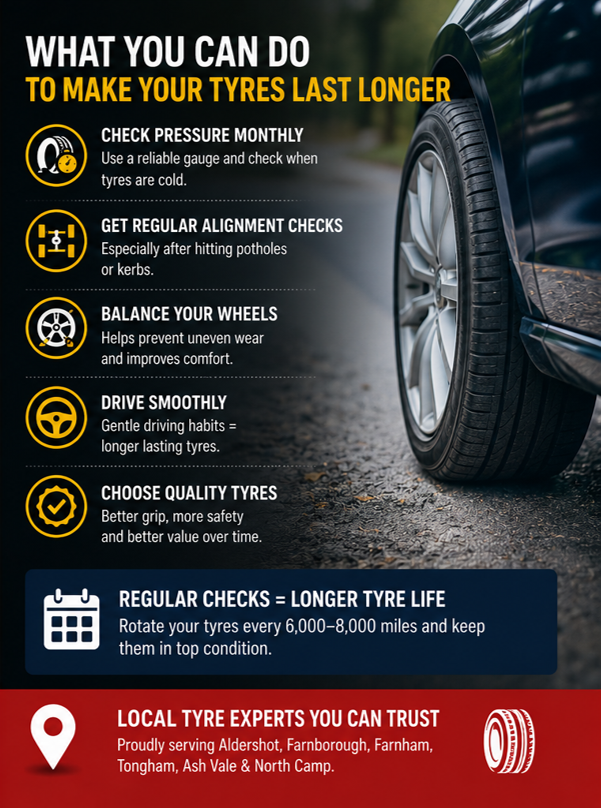
The good news is that most causes of premature tyre wear are preventable. Building these habits into your routine maintenance makes a measurable difference to how long a set of tyres lasts:
- Check tyre pressure monthly. Use the correct pressures for your specific vehicle and load, not a generic figure. Check cold, before driving, for the most accurate reading.
- Have wheel alignment checked annually. Include it as part of your regular service or check it after any significant impact. Alignment drifts gradually and silently until the tyre wear becomes visible.
- Rotate your tyres every 5,000 to 8,000 miles. Moving tyres between positions evens out wear across the set and extends overall lifespan.
- Drive smoothly. Brake earlier, accelerate progressively, and give yourself more space in traffic. These habits extend tyre life and reduce fuel consumption simultaneously.
- Have the suspension inspected if the car feels different. Changes in ride quality, handling, or unusual vibrations through the steering wheel are worth investigating promptly.
- Do not ignore tyre advisories on your MOT. An advisory about tyre wear or condition is an instruction to act before the next test, not a note to file and forget.
Conclusion
Premature tyre wear is rarely just bad luck. In the vast majority of cases, it comes down to one or more of five identifiable and addressable causes: incorrect tyre pressure, wheel misalignment, worn suspension components, driving habits, and flat spotting. Each one is manageable once identified, and each one can be prevented from recurring by addressing the root cause rather than simply fitting replacement rubber.
For drivers across Aldershot, Farnborough, Farnham, Ash Vale, Tongham, Ash, and North Camp, getting ahead of tyre wear means safer driving, fewer unexpected bills, and the confidence that your car will handle predictably when it matters most.
Frequently Asked Questions
Why are my tyres wearing unevenly?
Uneven tyre wear is usually caused by incorrect tyre pressure, wheel misalignment, worn suspension components, or a combination of all three. The specific wear pattern tells you a great deal about which cause is most likely. Centre wear points to overinflation, edge wear to underinflation, and one-sided wear to an alignment or camber issue.
How often should I check my tyre pressure?
At least once a month and before any long journey. Tyre pressure drops naturally in cold weather, so checking more frequently in autumn and winter is sensible. Always check pressures when the tyres are cold for the most accurate reading.
Can wheel alignment really affect how fast my tyres wear?
Yes, significantly. Even a small deviation from the correct alignment angle causes continuous scrubbing as the tyre rolls. This can cut tyre life by a third or more compared to a correctly aligned vehicle covering the same mileage.
What does scalloped or cupped tyre wear mean?
Scalloping, sometimes called cupping, refers to irregular dips or hollows around the tyre surface at intervals. It is almost always caused by worn shock absorbers or other suspension components that are allowing the wheel to bounce rather than maintaining consistent road contact.
How do I know if my tyres will fail my MOT?
Any tyre with less than 1.6mm of tread depth across the central three quarters of the width, or any tyre with bulges, cuts, or exposed cords, will result in an MOT failure. If you are unsure, a pre-MOT inspection will identify any tyre issues before the formal test.
What is the recommended tyre replacement depth in the UK?
The legal minimum is 1.6mm, but most tyre safety experts and manufacturers recommend replacing at 3mm. Below 3mm, wet weather braking distances increase substantially and handling becomes less predictable.
How long should a set of tyres last?
Under normal driving conditions with correct pressures and alignment, most tyres last between 20,000 and 40,000 miles. Town driving, aggressive habits, and mechanical issues can reduce that figure significantly.
