
Low coolant can destroy your engine. Find out what happens when levels drop, the warning signs to spot, and what Guildford drivers should do next.
Most drivers know to keep an eye on their oil. Coolant, on the other hand, tends to get overlooked until something goes very wrong. It sits quietly in a small reservoir under the bonnet, doing one of the most important jobs in the vehicle, and when levels drop too low, the consequences can escalate quickly from a warning light to a repair bill that runs into thousands of pounds.
So, can low coolant cause serious engine damage? Yes, it absolutely can. For drivers in Guildford and the surrounding areas, understanding what coolant does, what happens when there is not enough of it, and how to stay on top of it could save your engine entirely.
What Coolant Actually Does
Coolant, also referred to as antifreeze, is a mixture of water and a glycol-based fluid that circulates continuously through your engine. Its job is to absorb heat generated by combustion, carry that heat away from critical engine components, and release it through the radiator. Without coolant doing this job effectively, engine temperatures rise rapidly and unchecked.
Beyond temperature regulation, coolant also protects your engine from corrosion, prevents freezing in cold weather, and helps your cabin heater work properly. It is not simply topped up and forgotten. It degrades over time, loses its protective properties, and must be maintained at the correct level to function as intended. You should check your coolant level at least twice a year, ideally in early summer and winter.
What Happens When Coolant Levels Drop Too Low
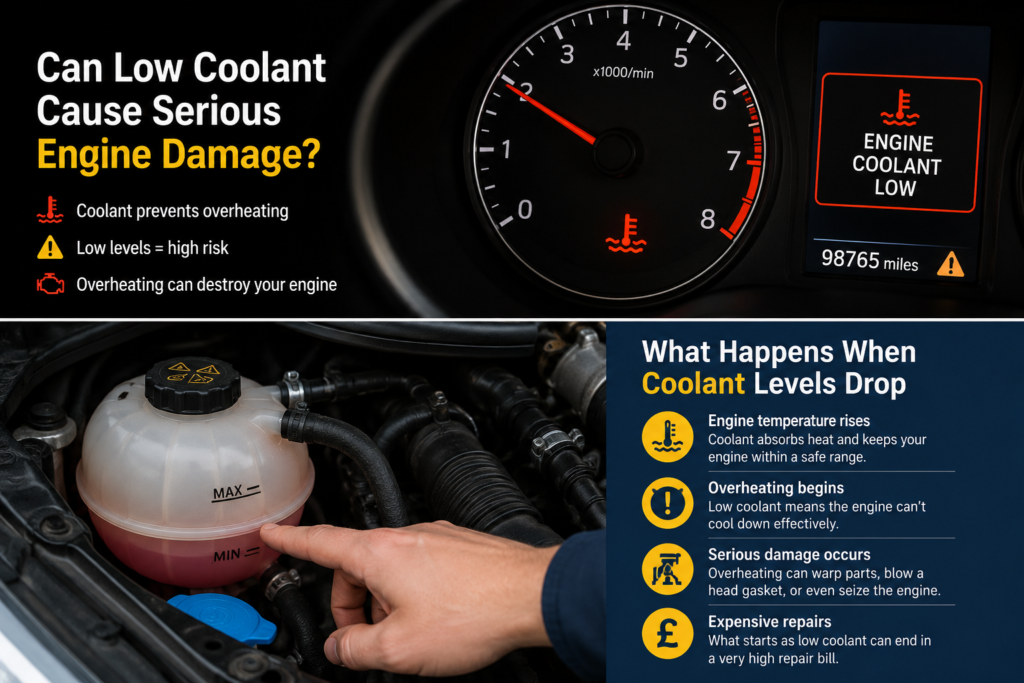
This is where things get serious. When coolant levels drop or the cooling system fails, it can quickly escalate into severe engine damage, costly repairs, or even total engine failure.
The process is straightforward but brutal. As coolant drops below the minimum level, there is not enough fluid to absorb and transfer heat away from the engine. Temperatures begin to climb. Metal components that are designed to operate within a specific temperature range start to expand beyond safe limits. From that point, the damage compounds quickly.
Driving with a coolant leak can cause serious damage to your vehicle, including engine overheating and head gasket problems. If coolant drops below the minimum required level after the engine heats up, there will not be sufficient fluid to cool the components, which could result in overheating and ultimately engine failure.
The Warning Signs You Should Never Ignore
Low coolant does not always announce itself dramatically. In many cases, the early warning signs are subtle, and drivers either miss them or dismiss them as minor. Catching them early is the difference between a simple top-up and a full engine rebuild.
The signs to watch for include:
- A rising temperature gauge, particularly if it climbs faster than normal or enters the red zone
- A dashboard warning light, often shown as a thermometer symbol sitting in liquid
- A sweet, slightly chemical smell coming from the engine bay or through the vents
- Reduced performance from your cabin heater, as coolant is what generates warm air inside
- White or steam-like smoke rising from under the bonnet
- Visible pooling of brightly coloured fluid beneath the car after parking
If left unchecked, low coolant can cause head gasket failure, piston damage, or complete engine seizure.
Coolant issues are often noticed too late because drivers assume the car will give more warning than it actually does. If any of the above signs appear, act immediately. Do not assume the problem will resolve itself or that a short journey is safe.
The Specific Engine Damage Low Coolant Can Cause
Blown Head Gasket
The head gasket sits between the cylinder head and the engine block, sealing combustion gases, coolant, and oil into their separate channels. When engine temperatures rise due to insufficient coolant, this seal is placed under extreme stress. A blown head gasket can cause coolant to mix with engine oil, resulting in contaminated oil. This mixture leads to poor lubrication of engine parts, causing increased friction and potentially severe engine damage. The oil will often appear milky or frothy.
Head gasket replacement is one of the more expensive mechanical repairs a car can require, and it is almost entirely preventable with proper coolant maintenance.
Warped Cylinder Head
Overheating commonly leads to warped valves. The valves get so hot they can warp and no longer seat properly. This reduces compression and causes poor engine performance. Warped valves require a full cylinder head rebuild or replacement. The cylinder head itself can also warp under sustained heat, requiring machining or complete replacement.
Cracked Engine Block
Thick white smoke coming from the exhaust pipe is a classic sign that coolant is leaking into the engine’s combustion chambers. If this happens, the problem is already severe. It usually means a blown head gasket, cracked cylinder head, or damaged engine block. A cracked engine block is one of the most catastrophic and expensive outcomes of sustained overheating.
Complete Engine Seizure
In the most severe cases, extreme heat causes moving metal parts inside the engine to expand to the point where they fuse together. Once an engine seizes, it is typically beyond economic repair. The vehicle may need a full engine replacement, which can cost more than the car itself is worth.
Common Causes of Low Coolant
If your coolant level keeps dropping, simply topping it up is not the answer. The level drops for a reason, and identifying that reason is essential.
- Cooling system leaks are the most frequent cause. Hoses, the radiator, the water pump, or seals can develop cracks or holes over time, allowing coolant to escape.
- A failing head gasket can cause coolant to burn off internally, meaning you lose fluid without any visible external leak.
- A faulty radiator cap that cannot maintain proper system pressure allows coolant to escape as vapour.
- Simple evaporation over a long period, particularly in older vehicles, can gradually reduce levels without any leak being present.
- Using the wrong coolant mixture can reduce the fluid’s boiling point, causing it to evaporate more quickly under normal operating conditions.
Simply topping up coolant should never be used as a stop-gap remedy to leaks. If coolant level drops, always visit a mechanic to get it repaired.
How to Check Your Coolant Level Safely
Checking your coolant is one of the quickest maintenance tasks you can do, and it takes no more than a few minutes. The key rule is that the engine must be completely cold before you open anything.
Here is how to do it:
- Park on a level surface and allow the engine to cool for at least two hours after use.
- Locate the coolant reservoir, which is typically a translucent plastic tank near the radiator with a coloured cap.
- Check the fluid level against the minimum and maximum markers on the side of the reservoir without removing the cap.
- If the level is below the minimum marker, top it up using the correct coolant specification for your vehicle, as listed in your owner’s manual.
- Never remove the coolant cap while the engine is hot. The system may be under pressure and hot coolant can spray out, causing serious burns.
- Avoid overfilling. The level should sit between the minimum and maximum marks, not above the maximum.
If you find yourself needing to top up repeatedly over a short period, that is a clear signal that something in the cooling system needs professional attention. A routine inspection as part of a full car service will cover coolant levels, hoses, and seals as standard, catching any developing issues before they become costly ones.
What to Do If Your Engine Overheats While Driving
If the temperature gauge suddenly spikes or a warning light appears while you are on the road, the steps you take in the next few minutes matter enormously.
- Switch off the air conditioning immediately to reduce the load on the engine.
- Turn the cabin heater to its highest setting to help draw heat away from the engine.
- Pull over somewhere safe as soon as possible.
- Switch off the engine and do not restart it.
- Wait for the engine to cool completely before opening the bonnet or touching anything near the coolant system.
- Do not attempt to remove the radiator cap or coolant reservoir cap while the engine is still warm.
- Call for assistance and arrange for the vehicle to be inspected before driving it further.
Continuing to drive an overheating engine, even for a short distance, dramatically increases the risk of catastrophic internal damage. The repair cost for a seized engine far exceeds what a tow and an inspection would cost.
How Coolant Maintenance Connects to Your MOT
Low coolant alone will not cause your car to fail its annual test. However, the knock-on effects of neglecting your cooling system absolutely can. An overheating engine, a blown head gasket, or white smoke from the exhaust are all issues that will flag during an inspection and may result in failure. Beyond the test itself, a vehicle with unresolved cooling system problems is not roadworthy in any practical sense.
Staying on top of your vehicle’s condition throughout the year through a car service in Guildford ensures your car is not only prepared for its annual test but is genuinely safe to drive every day. Understanding how much a car service costs in the UK can also help you budget for routine maintenance before small issues develop into serious and expensive faults.
How Often Should Coolant Be Replaced Entirely?
Topping up is not the same as replacing. Coolant degrades over time, loses its anti-corrosion properties, and can become contaminated. A coolant flush involves draining the old fluid entirely and refilling the system with fresh coolant to the correct specification and mixture ratio.
Most manufacturers recommend a full coolant flush every two to five years, though this varies depending on the vehicle and the type of coolant used. Your owner’s manual will give the specific interval for your car. If the coolant in your reservoir appears brown, rusty, or contains debris rather than being a clear, bright colour, a flush is overdue regardless of mileage.
Your garage will carry out this check as part of a full service and can advise on the correct schedule for your specific vehicle.
Can Low Coolant Affect Other Systems?
Yes, and this is something many drivers do not consider. One of the most significant engine problems drivers might face is overheating. An overheating engine can lead to severe damage, including warped cylinder heads and even engine failure. Issues with the cooling system can arise from low coolant levels, a malfunctioning thermostat, or a clogged radiator.
The cooling system is also connected to your transmission in many modern vehicles. Symptoms of low coolant can include a rising temperature gauge, a sweet odour, problems with the car’s heater, or increased fuel consumption. Fuel consumption rising unexpectedly is a sign many drivers associate with other causes, when in fact it can point directly to the engine working harder than it should due to thermal stress from insufficient coolant.
For drivers with automatic gearboxes, it is also worth knowing that your transmission fluid can be affected by cooling system issues. You can read more about how transmission health connects to overall vehicle maintenance in this guide on car transmission services.
Conclusion
Low coolant is not a minor inconvenience. Left unaddressed, it sets off a chain of events that can damage some of the most expensive components in your vehicle, from the head gasket to the cylinder head, and in the worst cases, cause complete engine failure. The good news is that it is also one of the most preventable causes of serious engine damage, requiring nothing more than a quick check every few months and prompt action when levels drop.
For drivers in Guildford and the surrounding areas, keeping your cooling system in good condition is one of the simplest ways to protect your engine, avoid unexpected breakdowns, and keep your car running reliably year after year. If you are unsure about your coolant level or suspect a leak, do not delay. Get it looked at before the engine makes the decision for you.
Frequently Asked Questions
Can low coolant cause my car to break down? Yes. If coolant drops to a critical level and the engine overheats, your car may cut out automatically as a protective measure, or it may sustain damage severe enough that continuing to drive becomes impossible.
How quickly can low coolant damage an engine? It depends on the severity of the loss and driving conditions. In stop-start traffic on a warm day, even a few miles with critically low coolant can be enough to cause overheating damage. In cooler conditions and at higher speeds, the engine may tolerate low levels slightly longer, but the risk is still significant.
Is it safe to top up coolant myself? Yes, provided the engine is completely cold. Check your owner’s manual for the correct coolant specification, fill between the minimum and maximum markers, and never remove the cap on a warm engine. If levels keep dropping after topping up, book a professional inspection.
Will low coolant cause a failed MOT? Low coolant alone will not fail your MOT, but it may be noted as an advisory. However, the damage caused by persistent low coolant, such as white exhaust smoke or a failing head gasket, can result in a failure.
How do I know if my coolant is leaking internally? Internal leaks often show as milky or frothy oil on the dipstick, white smoke from the exhaust, or coolant loss with no visible puddle underneath the car. These are signs that coolant may be mixing with engine oil or burning in the combustion chamber, both of which require urgent professional attention.
How often should I check my coolant? At a minimum, check it twice a year, before summer and before winter. It is also good practice to check it before any long journey or if you notice any of the warning signs described above.
