
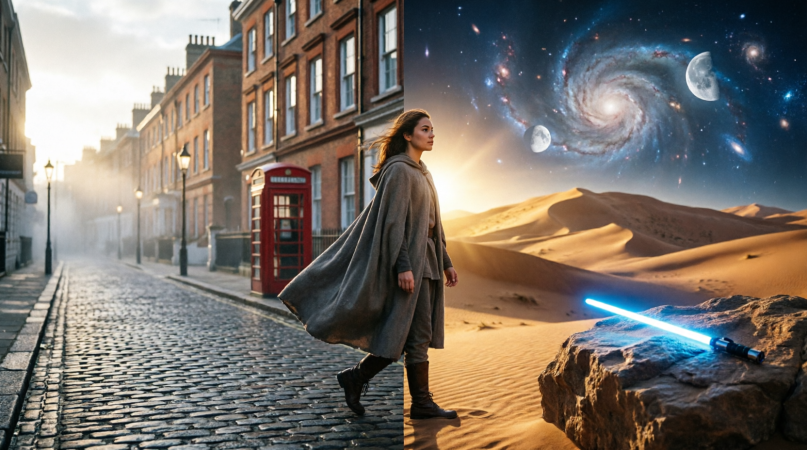
Daisy Ridley’s career is easy to reduce to one role, but that would miss the more interesting story. She became famous through Star Wars, yet her path into acting was not built around blockbuster planning, celebrity training, or a family campaign to make her a screen star. She arrived in public life suddenly, almost violently, when the world learned that a little-known London actress would lead the return of one of cinema’s most watched franchises.
Her full name, Daisy Jazz Isobel Ridley, already sounds as if it belongs to a performer, but her early life was not shaped by fame. She was born in Westminster, London, on 10 April 1992, and grew up in Maida Vale. Her father, Christopher Ridley, worked as a photographer, while her mother, Louise, worked in internal communications for a bank. Daisy was the youngest of three daughters, with older sisters Kika Rose and Poppy Sophia. She also has two older half-sisters. Her family had some artistic links, most notably through her great-uncle Arnold Ridley, who became known to British audiences as Private Godfrey in Dad’s Army. Still, Daisy Ridley did not grow up as the obvious next member of an acting dynasty.
Her childhood contained the usual mixture of imagination, restlessness, and trial. She has said that Matilda was her favourite film when she was young, and that the character mattered to her. That detail is useful because it tells us something about the young Ridley before the lightsabers, premieres, and online arguments. She was drawn to a story about a clever girl who felt out of place, learned to use her strength, and refused to stay small. Years later, audiences would connect her with another young woman who came from nowhere and discovered power she did not fully understand.
Ridley attended Tring Park School for the Performing Arts in Hertfordshire, a school known for training actors, dancers, and musical theatre performers. This gave her technical grounding, but it did not hand her a career. After leaving school, she worked through the early uncertainty that most actors know well. Small parts came first. She appeared in television series including Youngers, Toast of London, Silent Witness, Mr Selfridge, and Casualty. These were not star-making appearances. They were short, practical credits, the sort that teach an actor how to behave on a set, hit a mark, listen to direction, and leave without making the day about themselves.
Her early work also included short films and interactive projects. She appeared in Blue Season, a short film made for the Sci-Fi-London 48-Hour Film Challenge, and took the lead in one part of Lifesaver, an interactive film project that received BAFTA recognition. She also appeared in the music video for Wiley’s “Lights On”. These credits matter because they show the scale of the leap that followed. Ridley did not move from one major franchise into another. She moved from modest British screen work into the centre of a global machine.
The Door That Opened Without Warning
Daisy Ridley’s casting as Rey was announced in April 2014, when Lucasfilm revealed the new cast for Star Wars: The Force Awakens. At that point, she was not a recognisable name to most filmgoers. The announcement placed her alongside actors with established reputations, including Harrison Ford, Carrie Fisher, Mark Hamill, Oscar Isaac, Adam Driver, John Boyega, Andy Serkis, and Domhnall Gleeson. The contrast was sharp. Ridley had a few small screen credits. Ford, Fisher, and Hamill carried the history of the original trilogy. Driver and Isaac already had serious dramatic profiles. Ridley was the newcomer at the centre of the storm.
The secrecy around the project made the change even stranger. Star Wars auditions are not ordinary job interviews. Actors often read under guarded conditions, with limited knowledge of the full script or character arc. Ridley had to prove she could carry emotional weight, physical action, and stillness, all while entering a world whose fans studied every rumour. She was cast in February 2014, before the public knew her name. For several months, she carried knowledge that would soon alter her life.
Rey was introduced in The Force Awakens as a scavenger on Jakku, living alone among the wreckage of other people’s wars. The role needed a performer who could look tough and unguarded at the same time. Ridley gave Rey a directness that worked well on screen. She did not play her as polished or noble from the start. Rey was hungry, wary, practical, and quick to anger when cornered. Her first scenes told the audience almost everything without heavy explanation. She cleaned scrap, protected a droid, refused easy money, and resisted being handled by people who thought they knew better.
The character became important because Rey carried the burden of both story and symbolism. She was a new lead in a franchise that had often placed men at the centre of mythic destiny. Young viewers saw a woman holding the lightsabre. Older fans argued about lineage, training, canon, and whether the character’s abilities were earned. Ridley had to act inside that pressure while also learning how fame worked in real time.
Her performance in The Force Awakens had a clear physical quality. Rey ran as if survival had been her daily exercise. She fought without elegance at first, using the staff like a tool rather than a weapon of ceremony. When she later touched the Force, Ridley played the moment not as instant mastery, but as shock mixed with instinct. That choice made the role work for many viewers. Rey was not a calm chosen one. She looked frightened by what she could do.
Rey and the Weight of a Franchise
Ridley returned as Rey in The Last Jedi in 2017, a film that split opinion and pushed her character into more difficult territory. Rey was no longer only a mystery. She became a person looking for instruction, belonging, and a reason to trust her own power. Her scenes with Mark Hamill’s Luke Skywalker gave the trilogy some of its sharpest tension. Rey wanted answers. Luke wanted distance. Ridley had to hold her ground opposite an actor carrying decades of audience attachment.
The Last Jedi also placed Rey in an intense psychological connection with Kylo Ren, played by Adam Driver. Their scenes worked because Ridley did not soften Rey into easy sympathy. She showed curiosity, anger, loneliness, and suspicion. The bond between Rey and Kylo became one of the sequel trilogy’s most debated elements. Some viewers saw emotional complexity. Others disliked the direction. Ridley had to keep the character coherent while the films invited conflicting responses.
By the time The Rise of Skywalker arrived in 2019, Rey had become one of the most argued-over characters in modern blockbuster cinema. The film revealed her connection to Emperor Palpatine and pushed her towards a final confrontation with inherited darkness. The choice remains controversial, partly because it changed how some viewers understood her earlier story. Ridley’s job was not to solve the debate in interviews. Her job was to make Rey’s fear, fatigue, and determination believable inside the film she had been given.
The physical work behind Rey was demanding. Ridley trained for fight scenes, running, staff work, and lightsabre choreography. She had to make the action look urgent without losing the emotional line of the character. Her best action scenes are not simply about speed. They show Rey thinking with her body. She strikes when cornered, retreats when unsure, and pushes too hard when anger takes over.
The public response to Ridley during those years was intense. She became a role model to some fans, a target for others, and a constant subject of online discussion. That kind of attention can distort an actor’s life. It also shapes how future casting directors see them. The same role that made Ridley famous risked trapping her inside one image. After Star Wars, she had to prove she could exist beyond Rey while knowing that Rey would always follow her.
The Cost of Becoming Known Overnight
Ridley’s experience of fame was not a slow climb. Many actors spend years becoming familiar to the public before leading major films. Ridley became internationally known almost at once. That speed matters. Sudden celebrity gives a person visibility before they have had time to build defenses. Every interview, outfit, comment, and facial expression becomes material for strangers.
She later spoke about the pressure of the Star Wars years and the difficulty of navigating online attention. Her relationship with social media became part of that story. She stepped back from platforms after experiencing the harsher side of public response. For an actor in her twenties, this was not a minor matter. Social media can make admiration feel loud, but it can make criticism feel permanent. A performer can finish a day’s work and then walk into a second stage where strangers judge their body, politics, talent, voice, and personality.
Ridley has also been open about health issues. In 2016, she discussed being diagnosed with endometriosis and polycystic ovary syndrome as a teenager. She later said that these conditions affected her confidence, including through skin problems. More recently, she has spoken about being diagnosed with Graves’ disease in 2023, after symptoms including fatigue, weight loss, and a racing heart rate. These details should not be treated as celebrity trivia. They show the private strain that can exist behind a polished public career.
Her health story also complicates the image of the blockbuster heroine. Audiences often see action leads as bodies trained for spectacle. Ridley’s public comments remind us that an actor’s body is not only a professional tool. It is also where stress, illness, exhaustion, and self-consciousness live. That is especially true for women in franchise cinema, where expectations around strength and appearance often collide.
The years after The Rise of Skywalker brought a different challenge. When an actor becomes strongly identified with one role, every later project is judged through that shadow. If the film is small, people ask why the star has stepped down. If the film is large, people ask whether the actor can carry anything else. Ridley’s choices after Star Wars show an attempt to test different rooms rather than chase only the loudest one.
Roles That Showed Another Side
Ridley’s non-Star Wars career began taking shape even while the sequel trilogy was still active. In Kenneth Branagh’s Murder on the Orient Express, released in 2017, she played Mary Debenham. The role placed her in a large ensemble with Branagh, Judi Dench, Michelle Pfeiffer, Penélope Cruz, Willem Dafoe, Josh Gad, and Johnny Depp. She did not need to dominate the film. Instead, she had to fit into a controlled, stylised mystery where restraint mattered more than spectacle.
In Ophelia, released after its festival run, Ridley took on a literary figure usually seen through Hamlet’s tragedy. The film re-centred the story through Ophelia’s perspective, giving Ridley a role built on intelligence, romantic risk, and political danger. It was a useful step because it placed her in period drama rather than science fiction. It also asked her to carry a film without the armour of a franchise.
Her voice work added another layer. She appeared in Peter Rabbit and later lent her voice to the video game Twelve Minutes. Voice acting can be overlooked, but it demands control. Without facial expression or movement, an actor has to communicate through timing, breath, and tone. For someone known for a physical role like Rey, this kind of work gave Ridley space to use a different set of tools.
Chaos Walking, released in 2021, paired Ridley with Tom Holland in a science-fiction story based on Patrick Ness’s novels. The film had a troubled path to release and received mixed responses. Still, Ridley’s role as Viola gave her another action-driven character who had to survive in a hostile environment. The problem was that the film arrived under the weight of delays and expectations. It did not become the clean post-Star Wars reset that a publicist might have wanted.
Sometimes I Think About Dying offered something more interesting. The film, which premiered at Sundance in 2023, placed Ridley in a quiet, internal role as Fran, a socially isolated office worker whose life begins to shift through a tentative connection with a colleague. The part sits far from Rey. There are no heroic gestures, no mythology, no destiny. Ridley’s performance depends on small movements, deadpan pauses, and the difficulty of speaking when silence has become a habit. For viewers willing to follow a restrained film, it revealed a subtler actress than the blockbuster machine had allowed.
The Marsh King’s Daughter gave her a darker thriller role. Ridley played Helena, a woman forced to confront the father who once held her and her mother captive in the wilderness. The film asked her to carry trauma, physical survival, and family conflict. It did not become a major cultural event, but it added to her run of roles about women shaped by isolation and pressure.
Young Woman and the Sea may be one of her most important post-Star Wars performances. In the film, Ridley played Gertrude “Trudy” Ederle, the American swimmer who became the first woman to swim across the English Channel. The role demanded serious physical commitment. Ridley had to train as a swimmer and perform open-water sequences. She said she was frightened of deep water before the shoot, yet completed days of open-sea swimming in the Black Sea for the film.
That part suits Ridley because Ederle’s story is not about glamour. It is about endurance, discipline, and being underestimated. Ridley’s best screen quality is often her refusal to look decorative when the role calls for strain. She can look tired, annoyed, stubborn, and physically uncomfortable without trying to protect her image. That matters in a sports drama, where the body must show effort rather than only achievement.
Small Facts and Human Details
Ridley’s public image has often mixed brightness with guardedness. She can appear cheerful in interviews, yet she has also shown a clear instinct to protect her private life. That balance is understandable. Her career gave her global attention before she had the long professional runway that helps some actors adjust. She had to learn where to be open and where to keep the door shut.
Her relationship with actor Tom Bateman began after they met while making Murder on the Orient Express. Ridley later confirmed during the Sundance Film Festival in 2023 that they had married. The relationship has stayed relatively private, which fits her wider approach to fame. She gives enough for the public record without turning her marriage into content.
One lesser-known part of Ridley’s career is her work as an executive producer and narrator on The Eagle Huntress, the documentary about Aisholpan Nurgaiv, a Kazakh girl in Mongolia who trains as an eagle hunter. Ridley became involved with the film in 2016, after The Force Awakens had made her famous. Her participation helped bring extra attention to a story about a young woman entering a tradition often associated with men.
She also performed on Barbra Streisand’s 2016 album Encore: Movie Partners Sing Broadway, joining Streisand and Anne Hathaway on “At the Ballet” from A Chorus Line. This is the sort of career detail that can surprise people who know Ridley only from Rey. It points back to her performing arts background and reminds us that she trained in a broader field than screen combat and franchise acting.
Ridley’s personality in interviews often comes through in practical details. She has spoken about training, fear, anxiety, food, illness, and the strange routines of press tours. She does not tend to speak in grand theories about art. She often sounds more grounded than mystical, even when discussing a role in one of cinema’s most myth-heavy franchises. That makes her easier to believe when she describes the difficulty of being watched.
Her style of fame also differs from performers who enjoy constant exposure. Ridley does not appear to have built her identity around being endlessly visible. That may have cost her some momentum in an industry that rewards constant self-promotion, but it has also preserved a degree of mystery. She can disappear between projects and return with work rather than noise.
There is also an ordinary London quality to her story that fame has not erased. Before Star Wars, she was working through small credits like many British actors. After Star Wars, she did not become a permanent Hollywood spectacle. One can picture her more easily in a quiet café, sitting among wooden tables and cafe chairs, than at the centre of a red-carpet circus. That contrast is part of her appeal.
Why Rey Still Follows Her
Ridley’s return as Rey has been one of the most discussed parts of her recent career. Lucasfilm announced plans for a new film focused on Rey after the events of The Rise of Skywalker, with Sharmeen Obaid-Chinoy attached to direct. The project has been reported and discussed for some time, although the wider Star Wars film schedule has shifted repeatedly. As of recent reporting, the next major theatrical Star Wars release is The Mandalorian & Grogu, scheduled for May 2026, while the Rey project remains closely watched by fans.
The idea of Ridley returning to Rey is interesting because it changes the meaning of the role. During the sequel trilogy, Rey was a newcomer carrying the future of the franchise. In a later film, she would be older, more experienced, and possibly responsible for rebuilding the Jedi in some form. That gives Ridley a chance to play the character from a different position. Rey would no longer be the abandoned scavenger asking where she belongs. She would be a person others look to for direction.
A return also carries risk. Some actors struggle when they revisit career-defining parts. The audience may want nostalgia, while the actor wants growth. The studio may want a recognisable symbol, while the story needs conflict. Ridley would have to make Rey feel changed without losing the qualities that made the character matter. That is not a simple task.
The strongest version of Ridley’s future career would not depend only on Star Wars. Her recent choices suggest she understands that. A smaller drama like Sometimes I Think About Dying, a thriller like Magpie, and a physically demanding biographical film like Young Woman and the Sea all point towards an actress trying to widen the frame. She may never fully escape Rey, but escape may be the wrong goal. The better goal is ownership.
Daisy Ridley’s career has already passed through several lives. She was the London theatre-school graduate taking small television parts. She was the unknown actor suddenly placed at the front of Star Wars. She was the young celebrity learning the cost of public attention. She is now an actress testing quieter, stranger, and more adult material while still carrying one of modern cinema’s most recognisable characters.
Her story works because it is not tidy. Fame arrived before she could prepare for it. Her biggest role gave her power and pressure at the same time. Her post-Star Wars years have included uneven films, strong performances, health challenges, and deliberate attempts to build a career beyond one myth. That is more interesting than a smooth rise. It gives the audience something human to follow.
Ridley’s best work may still be ahead of her. That is not because she needs to prove she deserved Star Wars. She already carried that role under conditions few actors would handle easily. The next stage is different. It asks whether she can keep choosing roles that let her be specific, flawed, quiet, forceful, and unexpected. The answer will not come from one film. It will come from the pattern she builds over time.
