
Introduction
In the development of cutting-edge aerospace components, complex medical implants, and high-performance automation equipment, engineering leaders and project managers face a frustrating paradox: the more innovative the design, the harder it is to manufacture. Traditional multi-operation, multi-fixture machining leads to uncontrollable cumulative errors, lengthy production cycles, and ultimately, severe budget overruns and project delays. This “manufacturing bottleneck” traps brilliant concepts, preventing them from reaching the market.
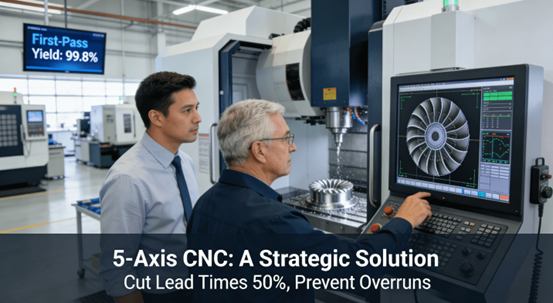
The root cause is forcing three-dimensional, complex designs into traditional, discrete manufacturing processes. Each additional fixture, each part transfer between machines, introduces new errors and coordination costs, making precision, efficiency, and cost an “impossible triangle.” This article will analyze how 5-axis CNC machining technology fundamentally reconstructs this manufacturing paradigm. It will be presented not just as a “more flexible machine,” but as a strategic tool for systematic error elimination and process compression. The article provides a framework demonstrating how complex geometries can be completed in a single setup, locking in precision, drastically compressing the supply chain, and achieving predictable project cost and timelines.
What is the True Cost of Multi-Setup Machining Beyond Just Labor Hours?
Multi-setup machining imposes a significant “hidden tax” far beyond direct labor hours. Each time a part is re-clamped, a new datum reference is established, introducing potential misalignment and compounding errors that increase scrap risk. Furthermore, the “work-in-progress” spends considerable time waiting and moving between workstations, inflating lead times. To compensate for these cumulative errors, engineers may over-specify tolerances, driving up unnecessary machining and inspection costs. Research confirms that reducing setups is a core lean manufacturing principle that directly lowers variation, improves quality, and shortens lead time, which is the central advantage of 5-axis machining.
1. The Compounding Effect of Datum Error and Scrap
Every setup is a potential source of error. In 3-axis machining, a part might be machined on the top, then flipped to machine the bottom. Even with a precision fixture, minute misalignments occur. For a part with ten features requiring five setups, these micro-errors stack, potentially pushing the final part out of tolerance. The result is not just a single bad part; it can scrap an entire expensive billet of material like Inconel or titanium after dozens of hours of machining. A single-setup 5-axis process eliminates these interfaces, machining all features relative to one unchanging datum, which is the foundation of high-tolerance machining consistency.
2. The Hidden Timeline Cost of Handling and Queuing
Time spent not cutting metal is wasted time. In a multi-operation process, a part is loaded, machined, unloaded, inspected, transported, queued, and reloaded repeatedly. This handling and queuing can account for 50-70% of the total lead time. Each handoff also risks damage or contamination. 5-axis machining consolidates these disparate steps. The part is loaded once, and all operations milling, drilling, tapping at compound angles are completed sequentially. This “one-and-done” approach collapses the timeline, reducing the part’s journey from raw material to finished component from weeks to days, a direct driver of faster time-to-market.
3. The Economic Burden of Over-Engineering for Tolerance Stack-Up
Anticipating the errors from multiple setups, designers may specify tighter tolerances than functionally necessary, hoping the final stack-up will still be acceptable. This“over-tolerancing” has an exponential cost. A tolerance of ±0.025mm may require slow, precise finishing passes and 100% CMM inspection, whereas ±0.05mm could be achieved with a faster roughing tool. By guaranteeing feature relationships through kinematics rather than successive setups, 5-axis machining allows engineers to specify functional tolerances confidently, often relaxing non-critical dimensions to reduce CNC machining service cost without compromising the part’s performance.
How Does “Simultaneous 5-Axis Motion” Unlock Geometries Previously Considered “Unmachinable”?
Simultaneous 5-axis motion represents a qualitative leap from “multi-sided machining” to true “contour following.” It solves specific engineering nightmares by dynamically orienting the cutting tool to maintain the optimal angle relative to a complex surface. This capability allows the machining of negative draft angles (undercuts) without special fixtures, enables flank milling with the side of the tool for efficient material removal, and permits the use of shorter, more rigid tools to machine deep cavities without chatter. This transforms the approach from machining a series of discrete planes to sculpting a continuous, organic form in a single, fluid operation, unlocking unprecedented design freedom.
- Conquering Undercuts and Complex Contours: Features like the dove-tail root of a turbine blade or internal gearing were once considered strictly “unmachinable” in a monolithic part, requiring assembly. With simultaneous 5-axis motion, the tool can tilt to access these negative angles, machining them as a continuous extension of the adjacent surface. This is not just about access; it’s about toolpath optimization. The CAM software can calculate a path where the tool’s cutting edge maintains constant engagement with the material, preventing gouging and ensuring a smooth, accurate finish on the most challenging contours, which is a key benefit for complex part machining.
- Optimizing Tool Engagement for Finish and Longevity: On complex sculpted surfaces, a 3-axis machine using a ball-nose end mill must take tiny, incremental steps. The very tip of the ball, where cutting speed is zero, often rubs and burns the material, degrading surface finish. In 5-axis machining, the tool can be tilted, presenting its more effective side-cutting edge to the surface. This “cutting with the side” technique provides higher cutting speeds, better chip evacuation, and a superior surface finish. It also distributes wear along a longer section of the tool’s edge, dramatically extending tool life and reducing cost per part, especially in hard materials.
- Enabling Efficient Deep-Cavity and Thin-Wall Machining: Deep pockets or tall, thin-walled features are prone to vibration when machined with long-reach tools. 5-axis technology mitigates this by allowing the workpiece to be tilted, presenting the side wall to the spindle in a more favorable orientation. This allows the use of a much shorter, stiffer tool to reach the bottom of a cavity, enabling higher feed rates and eliminating chatter. For example, machining an airfoil-shaped cooling channel inside a mold becomes a stable, precise operation instead of a gamble with a long, whipping tool, showcasing the profound benefits of 5-axis CNC for stability and precision.
From Aerospace Blades to Medical Implants: Where Does 5-Axis CNC Deliver Maximum ROI?
The maximum return on investment for 5-axis CNC machining is realized in applications where complexity, performance, and integration are paramount. In aerospace, it enables the manufacture of monolithic blisks (bladed disks), consolidating dozens of individually machined and assembled blades into a single, lighter, more reliable component. In medical device manufacturing, it produces patient-specific titanium implants with porous surfaces for bone integration and surgical tools with intricate internal channels. These cases highlight its role in enabling part consolidation, weight reduction, and functional integration that are impossible with traditional methods. Understanding these applications is fundamental to effectively leveraging 5-axis CNC machining services. A comprehensive guide on the subject serves as a critical starting point for engineers evaluating project suitability.
1. Aerospace: Weight Reduction and Performance Integration
Aerospace engineers relentlessly pursue weight savings and reliability. A blisk for a jet engine, machined from a single forging of titanium, eliminates the need for dovetails, pins, and brackets, reducing part count and potential failure points. 5-axis machining is the only practical way to create the complex, aerodynamic contours of the blades and the integral hub in one setup. Furthermore, structural aircraft components with complex internal lattice structures for stiffening can be machured, optimizing strength-to-weight ratios in ways that additive manufacturing is only beginning to match for certain high-load applications.
2. Medical: Personalization and Bio-Complexity
The medical field demands both extreme precision and the ability to create organic, patient-specific shapes. 5-axis machining produces cranial implants or spinal cages that perfectly match a patient’s CT scan data. It can also create micro-scale textures and pores on implant surfaces to promote osseointegration. For surgical robotics, it manufactures tiny, complex gears and housings with tolerances in the microns. The ability to work with biocompatible materials like titanium and PEEK, and to achieve the required surface finishes and sterility, makes 5-axis a cornerstone of advanced custom part production in medtech.
3. Automotive & Energy: Efficiency Through Design Freedom
In high-performance automotive and energy sectors, 5-axis machining creates complex conformal cooling channels in injection molds, drastically reducing cycle times. It manufactures intricate fuel injector nozzles and turbine housings where fluid dynamics are critical. The technology allows for the design of parts that are not just containers, but highly efficient functional systems. By enabling these optimized designs, 5-axis machining contributes directly to end-product performance, whether it’s a more efficient engine, a longer-lasting mold, or a more powerful generator.
Why is the “Digital Thread” from CAD to CMM Critical for 5-Axis Success?
The success of complex 5-axis machining is critically dependent on a seamless digital thread that connects every stage from design to verification. This integrated digital flow prevents the translation errors that are catastrophic for intricate parts. It begins with the 3D CAD model, which is used by advanced CAM software to generate optimized, collision-free toolpaths that fully utilize the machine’s kinematics. This program is then validated in a digital twin simulation before any metal is cut. Finally, the finished part is measured with a CMM or 3D scanner, and the resulting data is compared directly to the original CAD model, completing the quality assurance loop. This end-to-end digital process is a practical embodiment of smart factory technology.
1. Advanced CAM: The Brain of Complex Toolpath Generation
Programming a 5-axis machine is exponentially more complex than 3-axis. Advanced CAM software is non-negotiable. It doesn’t just plot points; it calculates the continuous, synchronized movement of all five axes to maintain the correct tool orientation. It employs strategies like tool axis tilting to avoid collisions with the holder and smooth interpolation to prevent jerky movements that cause poor finish. The software acts as a translator, converting design intent into a safe, efficient machine language that leverages the full potential of simultaneous 5-axis motion, which is the core of precision 5-axis machining.
2. Simulation: The Virtual Prove-Out That Prevents Disaster
Given the complexity and cost of 5-axis parts, a physical “prove-out” is prohibitively risky. Virtual simulation software creates a digital twin of the machine, tooling, fixture, and part. The entire program is run in this virtual environment to detect potential collisions between the toolholder and the part or fixture, verify that the toolpath matches the design, and even simulate material removal. This step is the ultimate insurance policy, preventing tens of thousands of dollars in damage to both the part and the machine, and is a critical component of modern industrial automation solutions.
3. Metrology: Closing the Loop with Data-Driven Verification
The final, critical link in the digital thread is precision metrology. A part with complex free-form surfaces cannot be verified with calipers. A CMM with a scanning probe captures millions of data points from the physical part, creating a point cloud. This cloud is then statistically compared to the nominal CAD model, generating a color-map that visually shows deviations, often within microns. This report provides objective, data-driven proof that the part conforms to specification, fulfilling quality requirements and providing the confidence needed forhigh-stakes applications. This closed-loop process turns manufacturing from an art into a verifiable engineering science.
How to Accurately Assess the Cost-Benefit of 5-Axis Machining for Your Project?
A true assessment of 5-axis machining’s value requires looking beyond the higher hourly machine rate to analyze the Total Cost of Ownership (TCO) and Total Project Timeline. The evaluation must account for eliminated secondary operations, reduced fixture costs, lower scrap rates, and the strategic value of a compressed time-to-market. A project with high “complexity density” where many challenging features are packed into a single component will almost always see a favorable cost-benefit ratio with 5-axis, as the consolidation savings outweigh the initial process cost. A pragmatic framework involves quantifying these often-overlooked savings to build an accurate business case.
- Quantifying the Savings from Consolidation and Elimination: The most direct savings come from eliminating process steps. List every operation a traditional approach would require: milling top, fixture design #1, milling side A, fixture design #2, milling side B, deburring, etc. Each step has a cost in programming, setup, machine time, and labor. 5-axis machining consolidates these into one (or significantly fewer) steps. Furthermore, it can eliminate the need for complex custom fixtures, as the part’s orientation is achieved through machine rotation. The cost of designing and machining these fixtures can be substantial and is entirely saved.
- Factoring in Quality Gains and Risk Reduction: Improved first-pass yield is a major financial benefit. Reduced setups mean fewer chances for error, leading to lower scrap rates. Higher accuracy and better surface finish from optimized tool paths can also reduce or eliminate secondary bench work (hand finishing, polishing). This not only saves money but also reduces project risk. A predictable, high-yield process prevents the budget overruns and schedule delays caused by unexpected quality issues, making financial forecasting more reliable. This reliability is a hidden but critical component of the overall 5-axis CNC machining quote value.
- Valuing Time-to-Market and Design Flexibility: The accelerated timeline delivers strategic advantage. Being first to market can define a product’s success. The weeks saved by 5-axis machining translate directly into revenue opportunity. Additionally, the design freedom it enables can lead to a superior product lighter, stronger, more efficient which commands a market premium. When evaluating partners, a custom CNC parts manufacturer with deep 5-axis expertise becomes a strategic enabler, not just a vendor. Their ability to provide a rapid, accurate contact for CNC quote that reflects these holistic savings is the first indicator of this partnership value.
What Should You Look for in a 5-Axis Machining Partner Beyond the Machine Spec Sheet?
When selecting a partner for custom 5-axis machining for mechanical parts, evaluate their integrated engineering system, not just machinery. The right partner offers deep expertise in complex toolpath planning and operates within a rigorous, application-specific quality framework (like AS9100D or ISO 13485) to ensure process control. Crucially, they engage proactively in DFM, provide transparent communication, and act as a collaborative extension of your team. This holistic integration of expertise, certified processes, and a quality-focused culture is what transforms complex designs into reliable, traceable, and scalable mechanical parts.
1. Depth of Process Engineering and Problem-Solving
A partner’s true value is revealed in their engineering team’s depth. Can they discuss the trade-offs between a tilt-rotary table and a trunnion machine for your part? Do they have a library of proven strategies for machining specific challenging features in your material? Look for evidence of complex project experience case studies, whitepapers, or a willingness to walk you through a similar past challenge. Their engineers should act as an extension of your team, asking “why” a feature is designed a certain way to suggest a more manufacturable (and cost-effective) alternative, solidifying their role as a true 5-axis CNC supplier.
2. A Certified and Lived Quality Culture
Certifications are a baseline, but a true quality culture is lived daily. Inquire about their First Article Inspection (FAI) process, their in-process inspection protocols, and how they manage corrective actions. A partner invested in quality will be transparent, readily sharing sample inspection reports and explaining how their metrology equipment (CMMs, surface testers) is integrated into their workflow. For regulated industries, their understanding and adherence to standards like AS9100D is non-negotiable. This systemic approach to quality is what guarantees that the tenth part is identical to the first, which is the essence of precision manufacturing.
3. Collaboration, Communication, and Strategic Partnership Fit
Finally, assess the collaborative dynamic. Is their communication proactive? Do they provide a single point of contact? The best partners view the relationship strategically. They should be capable of guiding you from prototype to production, offering insights on design for manufacturability, material selection, and post-processing. Their goal should be to make your project succeed, as your success fuels their reputation. This partnership model, built on trust, transparency, and shared technical goals, is ultimately what transforms a complex design into a reliably manufactured, high-performance component, fulfilling the promise of a true development partnership.
Conclusion
5-axis CNC machining is more than an advanced manufacturing technology; it is a strategic methodology for managing complexity through process compression and error elimination. By integrating multiple operations into a single setup, enabling the fabrication of previously “unmachinable” geometries, and relying on a robust digital thread for verification, it provides a new pathway to optimal solutions in the classic trade-off between precision, time, and cost. For teams committed to innovation and reliability, mastering and strategically implementing this capability is a decisive step in building a core manufacturing advantage and bringing groundbreaking products to market faster and more predictably.
FAQs
Q: What types of parts benefit the most from 5-axis CNC machining?
A: Parts with complex 3D contours, deep cavities, undercuts, or multi-angle features benefit most. This includes turbine blades, impellers, aerospace structures, molds, and medical implants. Any part that would require multiple setups on a 3-axis machine, introducing alignment errors and delay, is a prime candidate for 5-axis consolidation into a single, accurate operation.
Q: Is 5-axis machining always more expensive than 3-axis machining?
A: Not on a total project cost basis. While the hourly rate is higher, 5-axis can be more cost-effective for complex parts. It eliminates multiple fixtures, reduces handling/setup time, minimizes errors between operations, and often achieves a better finish faster. For simple parts, 3-axis is cheaper. The benefit shifts when geometry reduces secondary operations and improves overall manufacturing efficiency.
Q: What file format and information are needed for a 5-axis machining quote?
A: Provide a 3D CAD model in STEP or Parasolid format and a detailed 2D PDF drawing. The drawing must specify critical dimensions, geometric tolerances (GD&T), material, and surface finishes. Complete information, including target quantities and industry standards, enables a faster, more accurate assessment of manufacturability and cost.
Q: How is accuracy maintained and verified in 5-axis machining?
A: Accuracy is maintained via high-precision machines, calibration, and in-process verification with touch probes. Final verification uses Coordinate Measuring Machines (CMM) to compare the finished part directly to the original 3D CAD model, generating a comprehensive deviation report that validates all dimensions and complex surfaces.
Q: Can 5-axis machining be used for both prototyping and production?
A: Absolutely. It is invaluable for both. For prototyping, it creates high-precision, functional prototypes from production materials rapidly. For production, it enables efficient manufacturing of complex end-use parts, especially in low to medium volumes where hard tooling is too expensive. The same digital workflow ensures a seamless transition from prototype to production.
H3: Author Bio
The author is a specialist in precision multi-axis machining applications, with over 12 years of experience helping clients solve high-complexity, high-tolerance component challenges. Their expertise is applied within the framework of LS Manufacturing, a precision engineering partner dedicated to providing end-to-end advanced manufacturing solutions from rapid prototyping to volume production. The team operates under a certified management system encompassing ISO 9001, IATF 16949, and AS9100D, ensuring systematic quality and full traceability. For a professional DFAM analysis and a precise 5-axis machining quote on your next complex component, explore their comprehensive 5-axis CNC machiningcapabilities and submit your 3D CAD files for a customized engineering assessment.
