
Introduction
In hardware product development, one of the most frequent frustrations for engineering and procurement teams is the “quoting black box.” After sending RFQs to multiple CNC machining suppliers, they receive wildly divergent, difficult-to-interpret quotes with unclear delivery timelines. This makes it nearly impossible to lock down the project budget, creates uncertainty in critical path planning, and consumes weeks of team time in endless clarifications and technical briefings, all while leaving the true final cost and risk unknown.
The root of this problem lies in the inherent flaws of the traditional manufacturing quoting model: heavy reliance on manual experience for process assessment, opaque cost structures, and a lack of standardized data exchange. This information asymmetry makes it difficult for buyers to effectively compare prices and assess risks, while sellers may quote inaccurately due to misunderstandings. This article reveals the three key “opaque points” in the traditional CNC quoting process. It explains how an instant quoting system, powered by digital tools and standardized data, can transform these gray areas into clear, comparable, and predictable data. This shift not only controls cost but elevates supply chain responsiveness to a new level.
Why Do Quotes for the “Same” Part Vary Wildly Between Different Suppliers?
Quotes for the “same” part can vary dramatically due to a combination of technical and commercial assumptions that are often invisible to the buyer. On the technical side, different process planning strategies (e.g., 3-axis vs. 5-axis approaches), tooling selections, and estimates for material utilization (blank size) create significant cost differences. Commercially, variations arise from how suppliers allocate overhead costs, their profit expectations, and subjective premiums added for perceived project risk or complexity. The core issue is the lack of a standardized benchmarking baseline, making an apples-to-apples comparison impossible. Achieving cost predictability starts with process standardization, a principle recognized in manufacturing economics as foundational for accurate estimation and comparison.
1. Technical Divergence: The Hidden Logic of Process Planning
Two suppliers can look at the same CAD model and see two different manufacturing journeys. One might plan a multi-setup 3-axis approach, requiring custom fixtures and introducing alignment risks. Another might propose a more efficient 5-axis strategy in a single setup. The choice of cutting tools (standard vs. premium coated), the sequencing of operations, and the estimated machining time for each feature are all judgment calls. A supplier with older machines may quote longer cycle times, while one with advanced, high-speed machining centers might be faster but at a higher hourly rate. These technical decisions, rarely detailed in a quote, are primary drivers of price variation for CNC machining services.
2. Commercial and Operational Cost Structures
Beyond the machine, costs are bundled differently. A large factory with significant facility overhead may distribute these costs differently than a smaller workshop. The markup for profit is not standardized. Furthermore, a supplier with a full order book may quote a higher price or longer lead time to manage capacity, while another seeking work might be more aggressive. The perceived risk of a complex, thin-walled part might lead one estimator to add a contingency buffer, while another does not. These commercial factors, embedded in the final price, are completely opaque without a detailed breakdown.
3. The Critical Importance of a Standardized Baseline
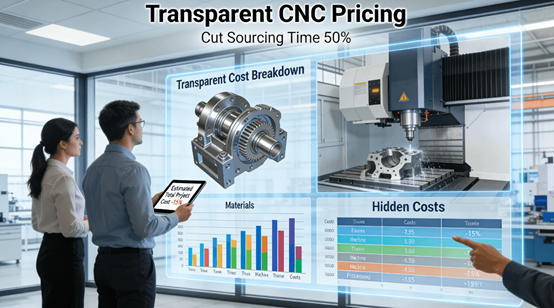
The only way to cut through this variation is to demand a baseline of standardized data. This involves suppliers providing quotes that separate material cost, machine time, setup time, and tooling into discrete line items. When costs are aggregated into a single unit price, comparison is futile. A transparent model allows teams to ask specific questions: Why is your estimated machining time 30% higher? Does your quote include all required fixtures? This shift from comparing bottom-line numbers to comparing the underlying cost drivers is the first step toward true supply chain efficiency and cost control.
What Are the “Hidden Costs” That Lurk Behind a Seemingly Low Unit Price?
A temptingly low unit price can be a mirage, masking significant hidden costs that inflate the total project expenditure. These are expenses not always explicitly listed in initial quotes but which critically impact the Total Cost of Ownership (TCO). They include high one-time Non-Recurring Engineering (NRE) or setup charges, restrictive Minimum Order Quantities (MOQs), costs for special packaging or expedited logistics, and substantial price differences between standard and premium surface finishes or secondary operations. Shifting focus from “price per piece” to “total project cost” is essential, and requires proactively defining these variables during the RFQ process.
- Non-Recurring Engineering and Setup Charges: For prototypes or low-volume production, NRE costs can dominate. This includes the time for CAD/CAM programming, designing and manufacturing custom fixtures, and process development. A supplier may offer a low piece price but attach a 1,500setupfee.Foranorderof10parts,thisadds150 to each unit. Another supplier might have a higher piece price but a minimal setup fee, resulting in a lower total cost for the batch. Understanding and comparing these one-time costs is crucial for an accurate financial assessment, especially in the rapid prototyping phase.
- Minimum Order Quantities and Material Procurement: Suppliers often have MOQs for material purchases. You may need 5 parts, but the supplier must buy a full 12-foot bar of titanium. You will be charged for the entire bar, plus the material waste. This cost is either buried in the unit price or listed as a separate material line item. Furthermore, if your design uses a non-standard plate thickness, the supplier may need to purchase a full sheet, dramatically increasing material cost. Clarifying how material is sourced and billed and designing around standard stock sizes — is a direct lever for cost control in custom parts production.
- Post-Processing, Finishing, and Logistics: Surface finishing is a major cost variable. A note that says “anodize” is insufficient. Type II anodizing is standard; Type III (hard coat) is more expensive. Media blasting, electropolishing, or special coatings add cost and time. These are often quoted as add-ons. Similarly, packaging for delicate parts or expedited shipping costs are frequently excluded from initial quotes. A complete RFQ must specify all required finishes and delivery terms to ensure the quote encompasses the true cost of receiving a finished, usable part, which is the ultimate goal of precision manufacturing.
How Can an “Instant Quote” Engine Possibly Account for Complex Manufacturing Nuances?
Modern instant CNC milling quote engines transform cost estimation from an art to a science by using AI-driven geometry analysis, material databases, and historical machining data. They automatically identify design features, calculate material volume, and apply dynamic pricing based on tolerances and surface finish selections. This provides rapid, data-driven insights crucial for early-stage planning. To experience this algorithmic transparency, advanced platforms let you upload a 3D model and receive a detailed quote in minutes.
1. AI-Powered DFM and Feature Recognition
The core of the system is software that acts as a first-pass manufacturing engineer. It analyzes the uploaded 3D CAD model to identify features that are expensive or problematic to machine, such as deep cavities with small corner radii or features requiring long-reach tools. It can flag these for review and may even suggest automatic, cost-optimizing modifications. This automated DFM analysis provides immediate, objective feedback that helps designers understand the cost implications of their choices before any human interaction, fostering design for cost principles from the outset.
2. Integration with Dynamic Cost Databases
The quote engine is not a static calculator. It is connected to live or frequently updated databases for raw material prices, ensuring quotes reflect current market conditions. It also draws from a vast repository of standardized machining times derived from thousands of past jobs. When you select “Stainless Steel 316,” the system doesn’t just apply a higher material cost; it automatically increases the estimated machining time per feature because it knows 316 machines slower than 6061 aluminum. This integration of material science and process knowledge is what creates a reliable cnc milling instant quote, not just a guess.
3. Dynamic Configuration and Process Mapping
When you adjust parameters in the quoting interface tightening a tolerance, adding a finish, or changing the material the system recalculates everything. A tighter tolerance might trigger a shift from a standard end mill to a precision grinding operation in the backend process map. Adding hard anodizing introduces a new post-processing step with its associated cost and time. This dynamic configuration shows the direct financial impact of each specification, empowering teams to make informed trade-offs between performance, cost, and lead time, a key capability enabled by industrial automation and smart software.
Does Faster Quoting Mean Compromises on Quality or Engineering Support?
Faster quoting, powered by automation, does not equate to lower quality or the elimination of engineering expertise; rather, it redefines the collaboration model. The instant quote serves as a powerful pre-screening and baseline tool. It efficiently filters out fundamental mismatches in capability or price range, ensuring that subsequent, valuable human collaboration is focused on high-value, complex technical challenges rather than basic price discovery. This model actually elevates the quality of engineering dialogue by ensuring all parties start from a clear, data-informed foundation, thereby increasing overall project efficiency and outcomes.
1. The Instant Quote as a Collaborative Starting Point
The instant quote provides an objective, data-driven starting point for discussion. It answers the initial questions of “Is this in the right ballpark?” and “What are the major cost drivers?” This allows the procurement and engineering teams to engage with the supplier’s application engineers from a position of knowledge. The conversation can immediately advance to, “Your system flagged this deep pocket as a cost driver. We need that for function; what tooling strategy do you recommend to machine it efficiently?” This transforms the interaction from a negotiation to a technical problem-solving session.
2. The Irreplaceable Role of Human Expertise for Complexities
Automation handles the standard, the repetitive, and the rule-based. Human experts handle the exceptions, the innovations, and the nuanced judgments. For parts with unprecedented geometries, exotic materials, or extreme tolerances, the instant quote provides a preliminary framework. A seasoned manufacturing engineer will then perform a manual review, applying years of experience to validate the automated plan, suggest optimizations, and identify potential risks the software may not catch. The speed of the initial quote frees up this expert to spend more time on these high-value activities.
3. Enhanced Quality Through Process Standardization and Clarity
Paradoxically, automation can enhance quality. Instant quoting systems are built on standardized process libraries and best practice guidelines. This means every quote is generated using the same, vetted set of assumptions and time standards, reducing the variability and human error inherent in manual estimation. This consistency leads to more reliable promises. When the shop floor executes a job that was quoted using the same standardized data it operates with, the result is a higher degree of predictability and a better match between quoted and actual outcomes, which is a cornerstone of reliable manufacturing technology.
How Does Transparent Pricing Reshape the Buyer-Supplier Relationship?
Transparent, data-driven pricing fundamentally transforms the buyer-supplier dynamic from an adversarial cost negotiation to a strategic value-creation partnership. When cost structures are clear, conversations shift from haggling over a lump sum to collaboratively analyzing and optimizing each cost component. Teams can rationally evaluate the premium for a faster lead time or discuss how a minor design tweak could significantly reduce machining time. This fosters a relationship built on shared data, mutual trust, and aligned incentives, which is the foundation for building an agile, resilient, and innovative supply chain.
- From Price Takers to Value Co-Creators: In an opaque model, the buyer is often a passive “price taker.” In a transparent model, both parties become active “value co-creators.” With a clear breakdown, an engineer can ask, “I see the deep hole drilling is a major cost. If I allow a slightly larger corner radius, can we use a standard drill and reduce this cost by 20%?” The supplier’s engineer can provide an immediate, quantifiable answer. This collaboration directly improves the design for manufacturability and cost-effectiveness of the part, benefiting both parties: the buyer gets a better part for the budget, and the supplier gets a more efficient, profitable job.
- Building Trust Through Radical Transparency: Trust in a supply chain is built on predictability and fulfilled promises. Opaque pricing is a source of constant doubt. Transparent pricing, by revealing the “why” behind the cost, builds tremendous trust. It demonstrates that the supplier’s pricing is fair, reasoned, and based on tangible factors, not arbitrary markup. This trust reduces friction, speeds up decision-making, and encourages longer-term partnerships. It allows both sides to focus on strategic goals like innovation and quality, rather than transactional guarding, directly enhancing supply chain efficiency.
- Enabling Risk-Sharing and Advanced Planning: With a mutual understanding of cost drivers, more sophisticated commercial models become possible. For example, a supplier might offer a lower price in exchange for a commitment to a certain annual volume, sharing the benefit of predictable throughput. Transparent data also enables better capacity planning and inventory management across the supply chain. The buyer gains true insight into lead time components, allowing for more accurate project scheduling. This level of integration and planning is only possible when the foundational element cost is understood and agreed upon by all stakeholders.
What Should Teams Look for Beyond Price in a Digital-First Manufacturing Partner?
Selecting a digital-first manufacturing partner requires evaluating a holistic system of technology, processes, and people. Beyond a slick quoting tool, scrutinize whether the digital front-end is deeply integrated with backend production execution and quality systems to ensure quote-to-delivery consistency. Assess the maturity of their quality management system (certified to standards like ISO 9001) as the guarantor of reliability. Crucially, verify that their engineering team possesses the depth to provide value-optimizing insights, not just execute automated instructions. The ultimate efficiency gain comes from partnering with experts whose digital prowess is matched by substantive manufacturing excellence. A trustworthy partner’s digital capabilities should be built on a solid quality foundation, as adherence to international standards ensures consistency and reliability from quote to delivery.
1. Integration of Digital and Physical Workflows
The quote you receive online should not be a separate entity from the work order on the shop floor. Look for a partner whose instant quote platform feeds directly into their Manufacturing Execution System (MES). This integration ensures that the estimated machining times, tooling, and processes defined in the quote are the same ones scheduled and used in production. It enables real-time tracking and provides a digital thread for your order, preventing discrepancies between the promised and the produced, which is the essence of a true cnc milling manufacturing service.
between the promised and the produced, which is the essence of a true cnc milling manufacturing service.
2. A Certified and Proactive Quality Culture
A digital quote is a promise; a quality system is the guarantee it will be kept. Certifications like ISO 9001:2015 are not just badges; they represent a framework for process control, corrective action, and continuous improvement. Ask how quality is measured and assured. Do they provide First Article Inspection (FAI) reports from CMMs? Is there full material traceability? A partner that is transparent about their quality processes in the same way they are about pricing is demonstrating a commitment to reliability that protects your project from costly defects and delays.
3. The Depth of Engineering Collaboration Available
Finally, test the engineering partnership. After you receive an instant quote, engage with their application engineers. Do they provide unsolicited, insightful DFM feedback that goes beyond the automated flags? Can they discuss alternative materials or processes to meet your performance needs at a lower cost? The ideal partner uses technology to handle the routine with blinding speed, thereby freeing their most valuable asset human expertise to focus on solving your unique challenges. This combination of digital efficiency and human ingenuity is what defines a superior custom CNC milling services provider and transforms them from a vendor into a strategic extension of your team.
Conclusion
Transparent CNC pricing and instant quoting are far more than mere convenience tools; they represent a fundamental paradigm shift in supply chain collaboration — from an “art” based on experience and relationships to a “science” grounded in data and standards. By embracing this transparency, teams can eliminate budget uncertainty, compress sourcing time from weeks to days, and elevate supplier interactions from cost-centric negotiations to value-driven co-creation. This data-first approach is the key to building predictable, agile, and innovative hardware development cycles in a competitive market.
FAQs
Q: How accurate are instant online quotes for CNC machining compared to a manual quote?
A: For standard parts and common materials, sophisticated instant quote engines are highly accurate, often within ±10-15% of a final manual quote. This stems from vast historical machining data and standardized calculations. The largest variances occur with highly complex features flagged for manual review. They provide an excellent budgetary estimate for fast comparison, with a final price confirmed after a brief engineering review.
Q: What file format should I upload to get the best instant quote?
A: Upload a 3D CAD file in a neutral solid format like STEP (.stp). This format preserves precise geometry for reliable feature recognition and accurate material calculations. Ensure your model is a “watertight solid” with no errors. While other formats are accepted, STEP files yield the most reliable and accurate instant quote results.
Q: Can I get an instant quote for parts requiring very tight tolerances or special surface finishes?
A: Yes. Advanced platforms allow you to specify critical tolerances and select surface finishes from a menu. The system will adjust the recommended process (e.g., suggesting grinding) and apply appropriate cost modifiers. For extremely specialized needs, the instant quote provides a strong baseline, and a note may recommend a quick follow-up with an engineer to finalize details.
Q: How does the instant quote process handle different materials like aluminum vs. stainless steel?
A: The quoting engine integrates with real-time material cost databases. Selecting “6061 Aluminum” vs. “316 Stainless Steel” accounts for the raw material cost difference. More importantly, it applies different machining time estimates based on the material’s machinability rating, adjusting for factors like cutting speed and tool wear, which greatly impact the final price.
Q: Is an instant quote suitable for very low-volume or prototype orders, or only for production?
A: Instant quoting is exceptionally valuable for prototypes and low-volume orders. These are often time-sensitive, and the traditional RFQ process is disproportionately slow. An instant quote provides immediate clarity on cost and lead time for fast decisions. The model accurately accounts for setup costs that dominate low-volume pricing, making it highly suitable for one-off parts.
Author Bio
The author is a specialist in digital manufacturing and supply chain management, with over 10 years of experience helping hardware companies achieve agile and controllable supply chains through technical tools and process optimization. Their expertise is applied within the framework of JS Precision, a precision engineering partner dedicated to providing integrated manufacturing solutions from instant quoting to volume production. The team operates under a certified management system encompassingISO 9001 and IATF 16949, ensuring systematic quality and reliability. For an instant, transparent quote and manufacturability feedback on your latest design, explore their comprehensive CNC millingcapabilities and upload your 3D CAD file to receive a detailed online assessment.
