
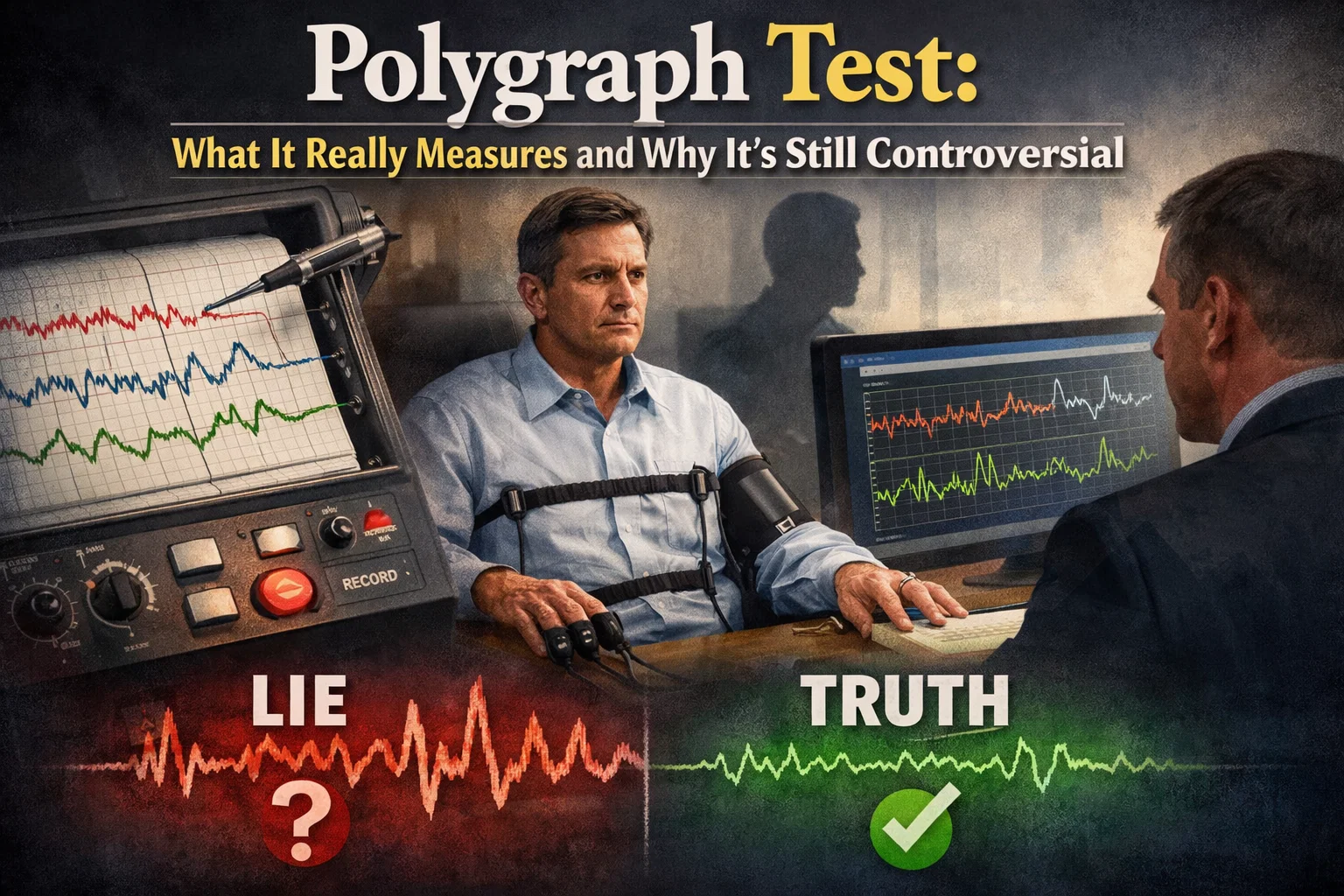
You’ve probably seen it in movies. Someone hooked up to a machine, a needle dancing across paper, tension in the room thick enough to cut. One question. A pause. Then the verdict: deception.
It’s a compelling image. Clean. Decisive. Almost cinematic in how truth seems to reveal itself.
Real life isn’t that neat.
Polygraph tests often called lie detector tests sit in a strange place between science, psychology, and performance. They’re widely used, widely debated, and widely misunderstood. And if you ever find yourself facing one, it helps to know what’s actually going on behind the wires.
What a Polygraph Test Actually Measures
Let’s clear up the biggest misconception first: a polygraph doesn’t detect lies.
It detects physiological responses.
That includes things like heart rate, blood pressure, breathing patterns, and skin conductivity (basically how much you sweat). The idea is simple: when people lie, they feel stress or anxiety, and that shows up in their body.
Sounds reasonable at first. But here’s the catch those same signals show up for a lot of reasons.
Nervous about being accused? Your heart rate spikes.
Afraid of not being believed? Your breathing changes.
Uncomfortable in the setting? You start sweating.
None of those mean you’re lying.
The machine just records changes. The interpretation comes from the examiner.
The Human Element Changes Everything
This is where things get interesting.
A polygraph test isn’t just about the machine it’s about the person running it. The examiner decides which questions matter, how to interpret responses, and ultimately whether your reactions suggest deception.
Two different examiners can look at the same data and walk away with different conclusions.
That’s not a small detail. It’s the core issue.
Imagine two job candidates taking the same test. One examiner is strict and suspicious. The other is more flexible and context-driven. The outcome could shift based on those attitudes alone.
Now, to be fair, trained examiners follow structured methods. There are protocols. Standard question formats. Scoring systems.
But it’s still not a purely objective process. And that’s why polygraphs are controversial, especially in legal settings.
Why People Still Trust Polygraph Tests
If polygraphs are so shaky, why are they still used?
Because they work—just not in the way people think.
The real power of a polygraph is psychological.
Sitting in that chair, connected to sensors, being told the machine can detect lies it puts pressure on people. A lot of pressure. Enough that some people confess before the test even begins.
Others slip up during questioning, not because the machine “caught” them, but because the environment got to them.
Think of it like this: the polygraph is less of a lie detector and more of a truth coaxer.
Interrogators know this. Employers know this. Even reality TV producers know this.
And to be honest, sometimes that’s enough.
The Questions Matter More Than You Think
A polygraph test isn’t just a series of random questions. There’s a structure behind it, and it’s surprisingly strategic.
Typically, you’ll see three types of questions:
Relevant questions — directly about the issue being investigated
Control questions — broader, uncomfortable questions meant to trigger a reaction
Neutral questions — harmless baseline questions
Here’s a quick example.
An examiner might ask:
“Have you ever lied to get out of trouble?” (control)
“Did you take the missing money?” (relevant)
The idea is to compare your reactions. If you react more strongly to the relevant question than the control one, that’s seen as suspicious.
But here’s where it gets messy.
Most people react to both.
Because let’s be honest almost everyone has lied to get out of trouble at some point. That question alone can spike your stress levels.
So now the examiner is comparing stress against stress and trying to read meaning into the difference.
It’s not exactly a clean science.
Can You “Beat” a Polygraph?
This is one of the most common questions, and the answer is… complicated.
Yes, some people try to manipulate their responses.
They might control their breathing, tense muscles during certain questions, or use mental tricks to stay calm. The goal is to blur the difference between reactions so nothing stands out.
And sometimes it works.
But it’s not foolproof. Examiners are trained to look for these tactics. If they suspect manipulation, that alone can influence the outcome.
There’s also a simpler truth: staying perfectly calm under pressure is harder than it sounds.
Even people who believe they’re prepared can find themselves reacting unexpectedly. The setting, the stakes, the feeling of being watched it all adds up.
So while it’s possible to influence the results, it’s not something you can reliably control.
Where Polygraphs Are Used Today
Despite the controversy, polygraphs haven’t gone away.
They’re still used in several areas, though often with limitations.
In law enforcement, they’re commonly used during investigations. Not as definitive proof, but as a tool to guide questioning or encourage confessions.
Some government agencies use them for security screenings. This is especially common in intelligence roles where trust is critical.
Private employers occasionally use them too, though laws in many places restrict this heavily.
And then there’s the more public side talk shows, reality TV, even online content. In those cases, the polygraph is more about drama than accuracy.
The key thing to remember: in many courts, polygraph results aren’t admissible as evidence.
That alone says a lot.
What It Feels Like to Take One
People often imagine the test itself is the hardest part. Surprisingly, it’s usually the lead-up.
Before the actual test begins, there’s a long pre-test interview. The examiner explains the process, reviews questions, and tries to establish a baseline.
This is also when they build rapport and sometimes, subtle pressure.
By the time you’re hooked up to the machine, you’ve already been thinking about the questions for a while. That anticipation can shape your reactions more than the questions themselves.
During the test, you’re expected to sit still, answer clearly, and avoid unnecessary movement. Even small shifts can interfere with the readings.
It’s a controlled environment. Quiet. Focused. A little intense.
Afterward, the examiner reviews the results and may ask follow-up questions.
For some people, that’s when the real stress kicks in especially if the examiner suggests something doesn’t look right.
The Big Debate: Science or Pseudoscience?
This is where opinions split sharply.
Supporters argue that, when done properly, polygraphs can be a useful tool. Not perfect, but helpful. They point to cases where tests led to confessions or clarified investigations.
Critics take a harder stance.
They argue that polygraphs lack consistent scientific validity. That physiological responses are too unreliable to measure deception accurately. That the results depend too heavily on interpretation.
And there’s research backing that skepticism.
False positives—where truthful people are labeled deceptive do happen. So do false negatives.
That uncertainty is a problem, especially in high-stakes situations like criminal cases or job screenings.
Here’s the uncomfortable truth: a confident liar can sometimes pass, and an anxious truth-teller can fail.
That’s not a system you want to rely on blindly.
A Quick Real-World Scenario
Picture this.
Two employees are suspected of leaking confidential information. Both agree to take a polygraph.
One is calm, composed, maybe even a bit detached. The other is nervous, worried about being falsely accused.
The results come back.
The calm one shows minimal reaction. The nervous one shows strong physiological responses.
If you’re relying on the polygraph alone, who looks guilty?
That’s the problem.
The test doesn’t measure truth it measures response. And those aren’t always the same thing.
So, Should You Trust a Polygraph?
Here’s the balanced take.
A polygraph can be useful as part of a larger process. It can prompt conversations, highlight inconsistencies, and sometimes lead to important breakthroughs.
But it shouldn’t be treated as definitive proof.
If you’re ever in a situation where a polygraph is involved whether for a job, an investigation, or anything else it’s worth understanding its limits.
Don’t assume it’s infallible. Don’t assume it’s meaningless either.
It’s a tool. A flawed one.
The Takeaway
Polygraph tests carry a kind of mystique. They feel authoritative, almost scientific in a way that suggests certainty.
But once you look closer, that certainty fades.
What you’re left with is a mix of biology, psychology, and interpretation held together by a process that works sometimes, fails other times, and sparks debate almost every time.
If there’s one thing to remember, it’s this: the machine doesn’t know when you’re lying.
It only knows when your body reacts.
And that’s a very different thing.
