
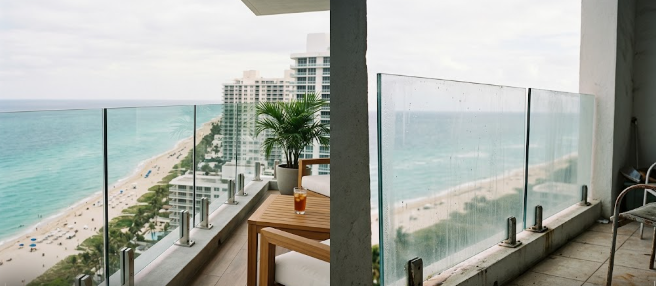
Glass railings have become one of the more consistent design choices in high-end South Florida residential projects for reasons that are specific to the region rather than just aesthetic preference. The indoor-outdoor relationship that defines how well-designed Florida homes actually function — the visual continuity between interior spaces and pool areas, water views, and outdoor living — is preserved by glass in a way that solid baluster systems simply don’t allow. A railing that lets light and sightlines pass through contributes to that continuity. One that blocks them undermines it.
This is the practical case for glass railings in Boca Raton and the surrounding area, and it holds across a wide range of architectural styles. The complication is that glass railing installations vary significantly in quality — in the glass specification, the hardware design, the installation precision, and ultimately in how the result reads against the architecture it’s supposed to serve.
Glass railings Boca Raton homeowners consider range from frameless systems with minimal hardware to semi-frameless designs with post supports, to full-framed options where the glass fills panels between structural posts. Each produces a different visual effect and serves different architectural contexts. Luxury Staircase Railings fabricates custom glass railing systems across South Florida, with design and fabrication calibrated to the specific project rather than selected from a standard product line. lsrailings.com is where that conversation starts.
What the Glass Specification Actually Determines
The quality difference in glass railing installations is often most visible in the glass itself — and most overlooked during the selection process because glass looks similar across specifications until it’s installed and the differences become permanent.
Tempered laminated glass — the appropriate specification for structural railing applications — differs from standard tempered glass in how it behaves under impact. Standard tempered glass shatters into small pieces when broken. Laminated glass holds together at the interlayer, which matters considerably in a railing application where the glass is a structural element rather than just a visual one. The thickness specification — typically 1/2 inch for most residential railing applications — affects both the structural performance and the visual quality of the installed panel.
Low-iron glass produces a dramatically clearer result than standard glass in railing applications, particularly noticeable in the edge color. Standard glass has a green tint at the edge that becomes visible in thick panels. Low-iron glass eliminates this tint, producing edges that read as clear rather than colored — which matters for installations where the glass edge is visible and where visual clarity is part of the design intent.
Hardware finish and profile affect the railing’s visual relationship to the surrounding architecture. Brushed stainless reads differently from polished chrome, which reads differently from matte black. The profile of the base channel, the standoff hardware, and the handrail all contribute to whether the railing feels minimal and considered or heavy and generic. Getting these decisions right requires understanding the material palette already present in the home.
Where Glass Railing Installations Most Commonly Fall Short
The installation precision required for frameless and semi-frameless glass railing systems is higher than most standard railing work because the glass panels have no tolerance for misalignment that a baluster system can absorb. Panels that aren’t plumb, base channels that aren’t level, gaps between panels that aren’t consistent — these are immediately visible in a material that’s transparent and that draws the eye precisely because of its clarity.
Ross, their owner, oversees custom glass railing fabrication and installation at Luxury Staircase Railings, ensuring the precision the material requires is present from panel fabrication through final installation. For Boca Raton homeowners and the architects and designers working with them, that level of direct involvement is what produces a glass railing that enhances the architecture rather than compromising it.
