
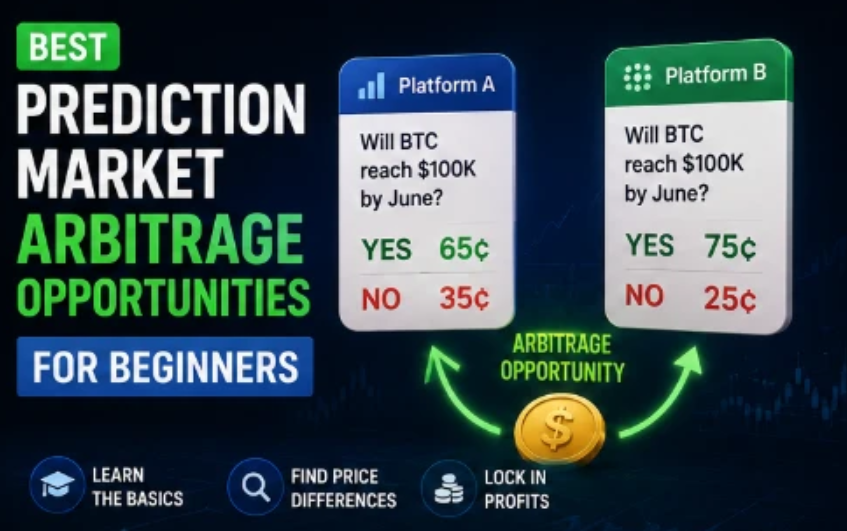
Prediction markets let people trade on real-world outcomes ‒ elections, Fed decisions, sports results ‒ using contracts that pay $1.00 if an event happens and $0.00 if it doesn’t. Because the same event often gets priced differently across platforms, prediction market arbitrage has become one of the few corners of trading where a beginner can, in theory, lock in a profit regardless of which way an event actually resolves. Academic researchers documented more than $40 million in arbitrage profit extracted from Polymarket alone over a single year, drawn from an analysis of 86 million individual bets ‒ proof that the mispricings are real, even if capturing them consistently takes more discipline than the phrase “risk-free profit” suggests. Platforms built for tracking cross-market pricing, like Zephyr, exist precisely because spotting these gaps manually across multiple exchanges is slow and easy to miss.
This guide walks through the arbitrage types most accessible to beginners, real examples of how the math works, and the tools serious traders use to catch opportunities before they disappear.
How Prediction Market Arbitrage Actually Works
Every prediction market contract trades between $0.01 and $0.99, with the price reflecting the market’s implied probability. A YES share at $0.65 implies traders think there’s a 65% chance the event happens. In a perfectly efficient market, YES and NO prices always sum to exactly $1.00. They rarely do. Information asymmetry, fragmented liquidity, and differences in each platform’s user base create small, temporary mispricings ‒ and those gaps are where arbitrage opportunities live.
A simple example: if a market’s YES trades at $0.55 and its NO trades at $0.40 on the same platform, buying both costs $0.95 total. Since one side always pays out $1.00 at resolution, that $0.05 gap is locked-in profit regardless of the outcome, before fees.
Four Arbitrage Types Worth Knowing
| Arbitrage Type | How It Works | Beginner Friendliness | Typical Edge |
| Spread arbitrage | YES + NO on the same platform total less than $1.00 | Easiest ‒ no market timing needed | 2-5% |
| Cross-platform arbitrage | Same event priced differently on two platforms (e.g., Kalshi vs. Polymarket) | Moderate ‒ needs funded accounts on both sides | 3-15% |
| Temporal arbitrage | One platform updates slower after breaking news | Harder ‒ requires fast execution | Up to 25%+, briefly |
| Multi-contract arbitrage | Regional/sub-outcome shares priced below the combined main contract | Advanced ‒ needs careful math | Varies |
1. Spread Arbitrage (Best Starting Point)
Spread arbitrage happens when YES and NO prices on a single platform don’t add up to $1.00. It’s the most mechanical and lowest-risk entry point for beginners because it doesn’t require moving funds between platforms or racing a news cycle ‒ just comparing two numbers on the same screen.
2. Cross-Platform Arbitrage
This is the classic form: the same event is priced differently on two separate platforms. If Kalshi prices “Fed holds rates” YES at $0.56 and Polymarket prices the equivalent NO at $0.38, buying both sides costs $0.94 for a guaranteed $1.00 payout ‒ a 6.4% return. The catch is needing funded accounts on both platforms ahead of time, since deposit and withdrawal friction is exactly what keeps these gaps from closing instantly.
3. Temporal Arbitrage
Different platforms update prices at different speeds after breaking news. A March 2026 Fed announcement showed this clearly: one platform’s order book repriced a rate-cut market within 30 seconds of the statement, while a market-maker-driven platform took roughly three minutes to catch up ‒ a window wide enough to trade a double-digit percentage spread. These windows are typically measured in minutes, not hours, which makes temporal arbitrage the least beginner-friendly of the four types despite the largest potential edge.
4. Multi-Contract Arbitrage
Some events offer both a broad outcome contract and several narrower regional or sub-outcome contracts covering the same underlying event. When the combined cost of the smaller contracts is cheaper than the main contract, buying the smaller pieces can lock in a profit once the market settles. It requires more careful math than the other three types and tends to suit traders already comfortable with the mechanics.
A Real Numbers Example
Take a hypothetical market on whether Bitcoin closes above $150,000 by a set date. Platform A prices YES at $0.42; Platform B prices NO on the same event at $0.53. Buying both costs $0.95 total. Whichever way the event resolves, one of the two contracts pays out $1.00 ‒ meaning a locked-in $0.05 profit, or roughly a 5.3% return on capital, before accounting for platform fees and any slippage between placing the two trades.
Why These Gaps Exist in the First Place
- Different user bases ‒ crypto-native traders and traditional-finance participants price the same event differently based on different information and biases.
- Deposit friction ‒ moving funds between platforms takes time, so not everyone can close a gap the moment it appears.
- News lag ‒ breaking news reaches one platform’s order book before another, especially around Fed statements, elections, and live sports.
- Thin liquidity ‒ smaller markets update more slowly and are more prone to mispricing than high-volume flagship markets.
Getting Started as a Beginner
- Start with spread arbitrage on a single platform before attempting cross-platform trades ‒ it removes the timing and transfer-friction problems entirely.
- Keep small amounts of capital pre-funded on each platform you plan to use, so you’re not waiting on a deposit when a gap appears.
- Track prices for the same event across platforms side by side rather than checking one at a time ‒ tools built for cross-market monitoring exist specifically because manual checking is too slow.
- Log every trade, including fees, so you can see your real net return rather than the theoretical spread.
- Treat any single opportunity as small and short-lived ‒ realistic per-trade edges usually run in the low single digits to low teens, not the dramatic numbers seen around major news events.
Frequently Asked Questions
Is prediction market arbitrage really risk-free?
Not entirely, despite the name. The two legs of a trade rarely execute at the exact same instant, so prices can move between them (slippage). Platforms can also resolve the same event differently based on different rules, which has caused real losses even in trades that looked risk-free on paper.
How much capital do I need to start?
Testing the mechanics is possible with as little as $100, but meaningful dollar returns typically require $1,000-$5,000, since per-trade edges are usually a few percentage points and order book depth limits how large a single arbitrage trade can be.
How often do arbitrage opportunities appear?
A systematic approach might surface somewhere in the range of 5-20 qualifying trades per month, though this varies heavily with market volatility and how many platforms and events you’re actively monitoring.
Is cross-platform prediction market arbitrage legal?
Using each platform individually needs to be legal in your jurisdiction ‒ for example, Kalshi is regulated for US retail traders while some other platforms restrict US access. Cross-platform trading itself isn’t separately regulated, but each leg still has to comply with that platform’s own terms and eligibility rules.
What’s the biggest mistake beginners make?
Assuming a spread is guaranteed profit without checking each platform’s resolution criteria first. Markets covering the same real-world event can settle differently due to different source data or timing rules, which turns an apparent arbitrage into a directional bet with real downside.
Final Thoughts
Prediction market arbitrage is one of the more approachable ways to start trading event contracts, precisely because spread arbitrage requires no forecasting skill ‒ just careful comparison and fast execution. The trade-off is that opportunities are small, fleeting, and increasingly competed away by automated systems, so beginners get the most value by starting on a single platform, understanding fees and resolution rules in detail, and only scaling into cross-platform trades once the mechanics feel routine.
