
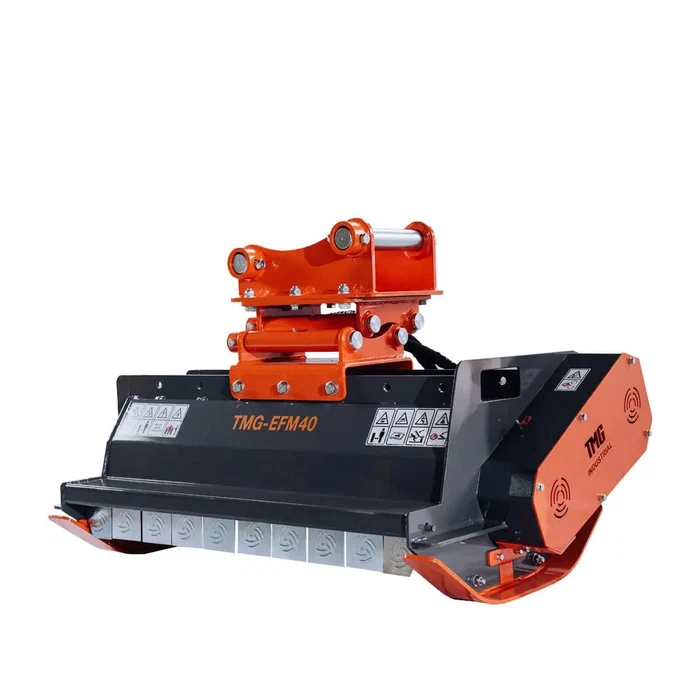
By late summer the shoulders and the ditches have both closed in
By the end of an American summer, county road shoulders carry a season of growth and the ditches behind them have narrowed to a green channel. Crews hired to open both again arrive with an excavator flail mower on the boom rather than a deck behind a tractor. The work sits below the pavement edge, where a tractor cannot follow.
What separates a profitable roadside contract from a slow one is rarely cutting power. It is the rhythm of the day, meaning how far the machine travels, how often it stops, and how much falls from each stationary position. Those decisions are settled before the first pass.
Roadside work is paid by the hour but bid by the mile
Agencies generally pay for machine time, yet the bid behind that contract assumes a rate of progress along the route. A crew that promised a mile of shoulder and ditch per shift has to know where the hours go. Tracking and waiting on traffic consume more of them than cutting does.
So the working question with an excavator flail mower is not how quickly the rotor recovers under load. It is how much of the profile the arm can finish before the tracks move again. Every reposition costs a minute, and that minute repeats several hundred times.
One position should finish everything the arm can honestly reach
Steady operators work a complete arc from each stop instead of chasing whichever growth looks worst. The head starts on the far bank, comes down the back slope, crosses the invert, and finishes nearest the pavement. Nothing is deliberately left for a second visit.
Stretching for the last few feet at the outer limit of reach is the common fault. It slows the head, loads the boom awkwardly, and leaves a ragged line an inspector will notice. Crews running an excavator flail mower settle on a station spacing early and hold to it.
Live traffic decides which way every pass runs
Vegetation work in the United States nearly always happens alongside moving vehicles. That single fact governs which way the carrier faces, which side the discharge points, and where the flagger and shadow vehicle sit. Technique is arranged around the traffic plan rather than the reverse.
Most crews travel with the flow. The operator keeps approaching vehicles in view and throws material away from the lane. An excavator flail mower suits that arrangement, because the carrier stays on the pavement edge while the head works out in the ditch.
Waterway maintenance runs on a shorter calendar than the verges
Ditches, culvert approaches, and small drainage channels are usually cut inside a permitted window rather than whenever a crew is free. Late summer is the common opening, after nesting season and before autumn rain refills the channel. Missing it can mean waiting a year.
That compression explains why coverage per day matters so much on drainage work. A channel that must be finished inside three weeks leaves no room for a return visit. So an excavator flail mower is chosen for the profile it clears in one pass rather than for headline capacity.
Habits that keep a roadside crew out of trouble
• Clear the throw zone: nobody below or beside the head
• Travel with the flow: keep approaching vehicles in sight
• Probe the growth: guardrail posts and cable hide inside
• Reset the shadow vehicle: every single time tracks move
None of that is unique to one attachment, but a boom-mounted head puts a spinning rotor several feet from the cab and often above eye level. Material leaves the housing with real energy, and the crew on the ground carries the risk. Distance is the entire safety plan.
Where the boom format pays a contractor and where it charges him
• Gain: ditch and back slope without leaving pavement
• Gain: one carrier covers verges, banks, culverts
• Cost: slower than a deck across open level ground
• Cost: every reposition interrupts the cutting rhythm
Set against a tractor with a side arm, the tracked option surrenders road speed between sites. In exchange it gives stability on soft or steeply cut ground. For a crew whose route is a string of short awkward stretches rather than long open verges, that trade settles quickly.
Agencies increasingly want vegetation and drainage from one crew
Public works departments have begun awarding mowing and ditch cleaning as a single package. Splitting them between two contracts is falling out of favor. Contractors answered by carrying attachments that handle both from one carrier, which lowers mobilization cost and shortens the lane closure.
That direction is why the roadside maintenance equipment supplied by TMG Industrial is built around attachments a small crew can move between machines and between jobs.
