
There is always a primary obligation of any company within the field that it operates in, concerning the welfare of its employees. Such an obligation is implemented in a Health & Safety Management System, a systematic approach that involves identifying hazards and risks and implementing appropriate controls for the purpose of compliance. Nevertheless, manual construction and implementation of HSMS by using spreadsheets, paper documents, and communication tools can result in certain gaps and inconsistencies. This is exactly where Health & Safety Management Software steps in, introducing automation to deliver enhanced value across the entire framework. In this article, we explore how Health & Safety Management Software optimizes an organization’s HSMS while addressing key queries frequently raised by decision-makers throughout the transition.
What Is the Connection between an HSMS and Health & Safety Management Software?
Health & safety management system is the entire framework set of policies, goals, responsibilities, and processes developed by an organization for managing workplace hazards. Health & Safety Management Software, however, is the technical means that help implement the said framework. To put it differently, HSMS is the blueprint, while health & safety management software is the mechanism that implements the blueprint. In the absence of the latter, the former tends to function manually, which makes it a cumbersome, inaccurate, and inefficient process. But when supported by the right software, an HSMS becomes a streamlined, visible, and efficient process.
How Is the Process of Hazard Identification and Risk Assessment Improved through Software?
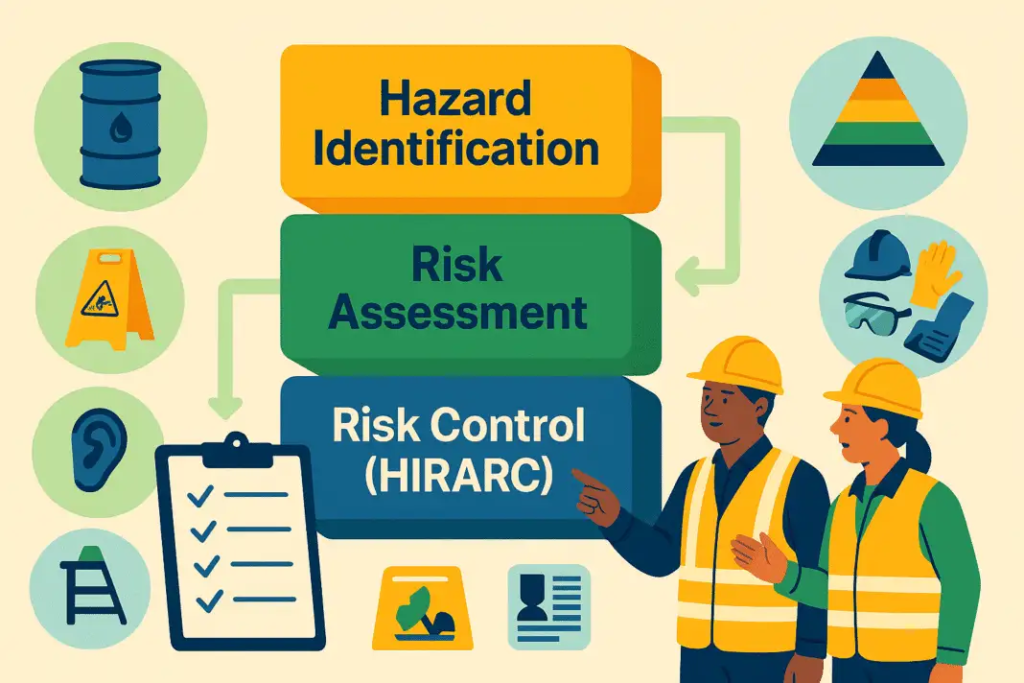
One of the key components of every HSMS system is the ability to detect any hazard and perform the risk assessment procedure before an incident occurs. Health & safety management software simplifies this task through providing digital forms, mobile reports and standardized forms which help employees report about detected hazards in real time, regardless of their location. Instead of reporting about an observation by hand through filling out a form on paper and passing it to the manager who would enter the information into the database, workers can now fill out the form from anywhere on their smart devices, and the report is processed accordingly.
Is Automation a Solution to Human Error in Compliance Monitoring?
Compliance with regulations is a challenging part of health and safety management, where there is a need to monitor multiple issues at the same time such as certification, training renewal, equipment inspection, and audit schedule. Manually doing this is bound to have oversight especially for large organizations that may be working with hundreds or thousands of people. H&S Management Software solves this problem by using automation. It gives reminders to the administrator about expiring certification, pending inspection, or unaddressed correction issues. This will minimize chances of non-compliance that might lead to regulatory action, or worse still prevent accidents from occurring. The inclusion of these automated checks in the HSMS makes the software a tool of protection against human error.
Why Is Data Centralization Important for an HSMS?
Over time, a health & safety management system accumulates a vast amount of data, including incident forms, training histories, audit results, near miss forms, and other records. When there is no system that can centralize these forms of data, then the task is done haphazardly, making it hard to derive any kind of analysis from it. The Health & Safety Management Software does all this for you, centralizing all your data into one place. With the data centralized in one place, patterns will emerge that may have otherwise been missed by you, including incidents that occur in a particular department or shift.
This centralization feeds directly into real-time reporting tools, allowing safety managers to gain immediate insight into the organization’s current safety status. Rather than waiting for monthly or quarterly reports to reveal critical trends, decision-makers can constantly monitor safety indicators to address issues before small problems escalate into major incidents. For instance, if a specific piece of equipment generates multiple near misses within a short period, the centralized software can immediately flag this trend, allowing for prompt corrective action.
How Do Real-Time Reporting Tools Facilitate Faster Decision Making?
In many cases, timeliness means the difference between a little problem and a big one. The real-time dashboards offered by Health & Safety Management Software allow safety managers to have insight into the present situation regarding workplace safety. Instead of having to wait until the monthly or quarterly report reveals any trend, decision makers can keep a constant eye on the indicators in order to act before little problems become big ones. If, for instance, a certain device creates a number of near misses in a short span of time, then the software will be able to notice this trend straight away and take corrective action.
How Important is the Engagement of Employees in the Implementation of Safety Through Software Solutions?
The effectiveness of a Health & Safety Management System lies in its engagement among the employees of the organization. Employees are generally the first people to identify hazards, but conventional methods of reporting may seem tedious or intimidating to the employees. Health & Safety Management Software reduces this problem by providing user-friendly interfaces, making it easy for employees to report on anything. In addition to that, some software solutions have anonymous reporting systems as well, which motivate employees to report any issue without the fear of getting into trouble. Safety training through the software becomes more efficient because of the availability of various modules and quizzes.
Does Integration with Other Business Systems Create Value?
Modern H&S Management Systems frequently interface with various other corporate applications, including ERP solutions, asset management systems, and human resources software. Integration makes it possible for the safety information to move effortlessly through different departments, thus minimizing the efforts needed for its duplication and increasing its accuracy. For example, if the information on one’s certification is maintained in the human resources management system and also in the health and safety software, integration will make sure that these pieces of information stay connected and do not need to be manually updated in two different systems.
How is Continuous Improvement in Safety Practices Achieved Through Software?
A comprehensive HSMS system is not fixed in nature but involves constant review and adaptation through analysis of performance data and changing situations. Health & Safety Management Software allows for continuous improvement through provision of analytical data showing how effective existing policies and procedures are. It becomes easy to conduct trend analysis, investigate root causes, and compare an organization’s practices with industry standards through specialized software packages. The results obtained from this process will then guide the organization to change its training program, procedure, and allocation of resources in risky areas.
Conclusion
Health & Safety Management Software is not a substitute for the basic tenets of Health & Safety Management System as it increases the ability of the system to be able to function optimally in the current, fast-paced business setting. By enhancing hazard detection capabilities, streamlining compliance, centralizing information and motivating employees, software turns an HSMS from a passive system into a proactive one. Those organizations who embrace the proper software solution will not only comply with relevant regulations, but ensure the safety of their workers and mitigate potential risks in the process. Given the continuous development of industry and increasing safety standards, the application of appropriate software into HSMS will increasingly become a requirement as opposed to a competitive edge.
