
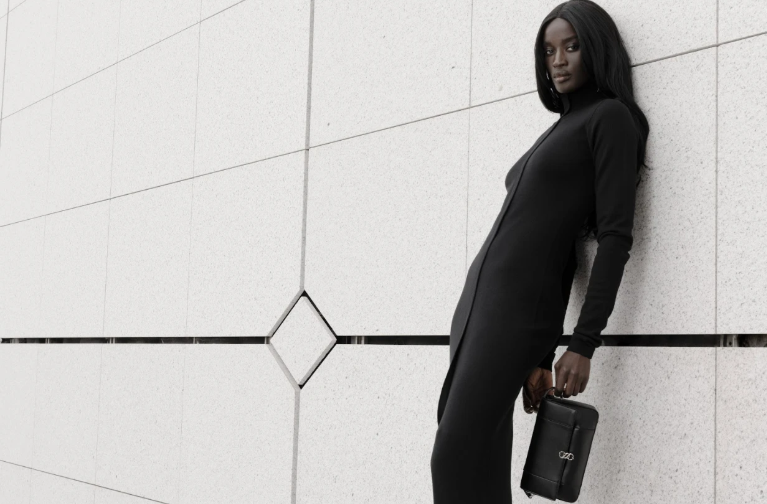
The case for spending more is usually made emotionally and lost on arithmetic. It should be the other way round. Whether expensive women dresses are worth their price is a calculation with three variables ,how long the garment survives, how long it stays relevant, and how many different days it can absorb ,and the answer changes completely depending on which dress you are describing.
Variable one: how long it physically lasts
Garments rarely fail structurally. They fail cosmetically: the surface pills, the colour shifts unevenly, the waistband softens, the shoulder line drops half a centimetre. The dress stays intact and stops being worn, which is a more expensive outcome than a hole would be.
Most of this is decided by fabric density and internal construction ,interfacing at the points that take strain, a lining cut generously enough to move independently, seams finished so they hold their line. Online these appear as fibre composition, weight, and any mention of lining or internal finishing. Their absence from a product page is itself informative.
Variable two: how long it stays relevant
This is the variable people underestimate. A dress can survive a decade and stop being worn in eighteen months, because it was legible as a specific season.
What dates a garment: a sleeve shape belonging to a moment, a neckline that was briefly everywhere, a colour with a year attached to it. What lasts is proportion. A dress built on a clean vertical line and a resolved waist placement is doing something structural, and structure ages far more slowly than detail.
Variable three: how many days it can absorb
The third variable is the one that actually dominates the arithmetic. A dress worn once a season is expensive at any price; a dress worn weekly is cheap at almost any price.
Absorption capacity depends on whether the dress announces an occasion. One that reads as evening can only be worn in the evening. One built on proportion changes register with shoes and outerwear: flat leather and a jacket for a working day, boots and a knit for travel, heels and different jewellery for dinner. Each of those configurations reads as deliberate.
Running the numbers
A dress at four hundred euros worn two hundred times over five years costs two euros per wear. A dress at a hundred and twenty worn twenty-five times before it looks tired costs nearly five. The cheaper garment was the more expensive decision by a factor of two, and it also occupied a hanger for eighteen months while failing to be useful.
The figures here are illustrative ,the point is which variable dominates. Wear count dominates, and wear count follows from construction and proportion.
What this means when buying
Read the composition and the measurements before the styling photographs. Look for a shoulder measurement in centimetres. Check whether the dress is lined and whether the description says anything about how it is finished. Then ask the harder question: can you picture this on an ordinary Tuesday as readily as at the event you are currently thinking about.
A dress that survives that question is usually the one designed around the body. SAGIO works from exactly that starting point ,sculptural tailoring intended to support natural form and posture, so that a garment holds its line across years of ordinary wear.
