
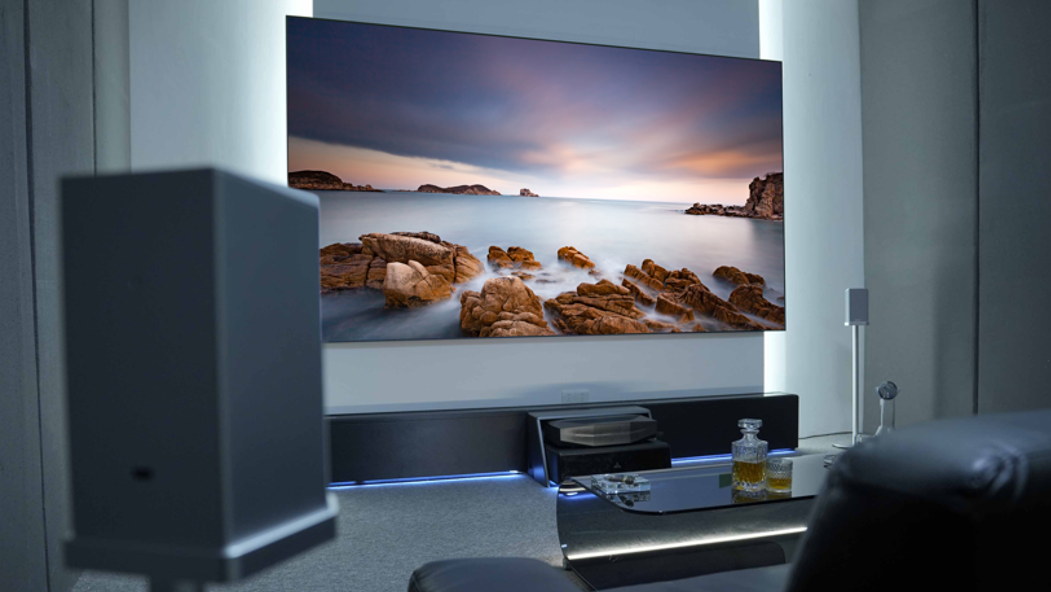
A family movie night should begin with choosing a film, not clearing an obstacle course of stands and cables. In a busy living room, the most successful entertainment features are often the ones that disappear when no one needs them. A retractable screen, carefully planned storage, and a simple lighting routine can bring a large picture into a familiar space without making the room look like a theater every day.
Decide what should remain visible
Walk into the living room on a normal morning and identify which surfaces matter for family life. Perhaps the wall carries artwork, the cabinet stores games, or a play area needs to stay open. The goal is not necessarily to conceal every device. It is to decide which objects can stay in place and which should be brought out only for watching. That choice determines the best screen and furniture strategy.
Try a five-minute furniture exercise before spending money. Mark the intended screen corners with removable tape, sit at each family member’s normal place, and walk the path toward the kitchen and door. If an image position blocks ordinary circulation or forces several people into uncomfortable neck angles, adjust the layout. A picture that works for the tallest adult should not be the only standard for the household.
Consider a screen that retracts
A motorized ALR projector screen offers two potential benefits: a surface suited to certain ambient-light conditions and a mechanism that stores it away. These qualities are separate; verify the optical geometry and suitability for the intended projector before purchasing. Measure the housing, extension height, nearby outlets, and any furniture that could obstruct movement. Keep children and pets clear while the mechanism operates.
Screen terminology can conceal important distinctions. A screen that rejects some ambient light does not necessarily suit every projector type, and a retracting mechanism does not guarantee a flat surface under all circumstances. Check the manufacturer’s throw compatibility and surface tensioning. Examine what happens when the screen is fully extended and verify that the casing is stable and clear of other furniture.
Plan projector placement carefully
The right position depends on throw distance, cabinet dimensions, ventilation, and the screen location. When looking at premium home theater projectors, remember that optical designs vary widely, so a single mounting approach will not fit every model. Make a side-view drawing before purchasing furniture. Confirm that the projector is secure and that routine adjustments do not require moving it each time the family wants to watch.
Do not base placement on a generic drawing of a projector. Use the exact model’s throw chart and instructions, including any optical offset, clearance for exhaust vents, and power-cord routing. A seemingly minor difference in console height can move a large projected picture significantly. It is easier to raise a paper template than to replace a cabinet after everything has arrived.
Make the room comfortable for everyone
Children may sit lower than adults, and guests may watch from the far end of the couch. Choose an image height and size that remain easy to view from those places. Keep snack tables from blocking sightlines and maintain a clear route to the door. A family space should be welcoming rather than arranged solely around one ideal central seat.
Choose a film with dialogue and subtitles for the seating test. A large image can look dramatic in a photograph but prove tiring to watch from a short distance. Children may sit on cushions while adults lean back on a sofa. Check the apparent screen height from both positions. A slightly smaller but comfortable picture is more likely to become part of the weekly routine.
Build lighting and sound into the routine
A dimmable lamp behind the sofa can help people find snacks without shining on the screen. Curtains control unwanted glare during early evening. Dialogue clarity matters more than sheer volume when children and adults watch together. Test sound at an everyday listening level, and keep controls straightforward enough that anyone in the household can start the movie.
Lighting works best when it serves two jobs: protecting the picture and helping people move safely. Instead of switching every light off, try a low lamp behind the seating and curtains over the brightest window. Keep its beam away from the screen. Store a small flashlight where it can be found if someone needs to look for a misplaced remote without disrupting the film.
Give accessories a home
Remote controls, charging cables, streaming devices, and game controllers tend to spread across the living room. A dedicated drawer or small tray can keep them available without leaving everything on display. Use cable routes that do not cross a walkway and leave electrical outlets accessible. The more predictable the storage, the less effort movie night requires.
Create one predictable place for every device. A labeled basket for controllers, a charging station away from snacks, and a remote stored beside the sofa can eliminate small arguments. Check cable strain and ventilation before closing cabinet doors. If the system has several inputs, label them in words the family understands rather than assuming everyone will remember which port corresponds to which device.
Rehearse the ending, not just the beginning
After the credits, the screen should retract safely, lights should return to normal, and the room should be ready for breakfast or homework. Practice the shutdown with the whole family. If several steps are confusing, simplify them. A beautiful setup that takes twenty minutes to dismantle is unlikely to be used as often as one that returns the room to normal almost immediately.
One person should not be the permanent operator of family entertainment. Ask someone unfamiliar with the system to raise the screen, begin playback, change the volume, and close everything after the show. Watch where they hesitate. Removing two awkward steps can make the system more appealing than adding another technical feature. Convenience and reliable operation matter as much as opening-night excitement.
A home that makes room for the picture
The purpose of a disappearing home cinema is to make entertainment feel easy, not temporary or compromised. Treat the screen, light, furniture, and controls as a single family-friendly system. Then the large picture becomes a welcome guest in the living room—one that knows when to leave. The test of the design is not how impressive it looks in a photograph but how naturally it fits the family’s next ordinary week.
