
A grown tree is worth more than the space it stands in
Every Canadian building season puts established trees in the wrong place, standing where a driveway, an addition, or a septic field has to go. The default answer is to cut them down, and a tree spade exists because that answer is often the expensive one.
A tree spade is worth considering because a tree growing for fifteen years represents fifteen years nobody can buy back. Replacing it means planting a sapling and waiting most of a career for the same shade and screening to return to that corner.
Nursery stock is priced by how long it was grown
Anyone who has priced a large caliper tree knows the curve is not gentle. The cost climbs steeply with trunk diameter, because every extra inch represents more seasons of watering, staking, and ground occupied at the nursery. That pricing makes relocation worth calculating rather than assuming. Moving a tree already growing on the property avoids both the purchase and the wait, and a tree spade is what turns that idea into a job of a few hours.
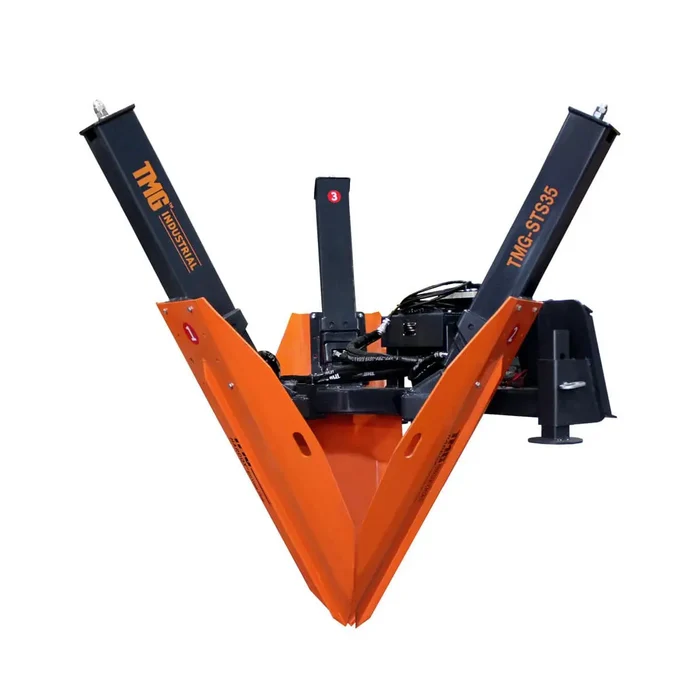
Three blades cut a cone the tree can travel in
The attachment carries three curved blades that close around the trunk and drive down into the ground, meeting beneath the tree to form a tapered cone of soil. That cone makes the move survivable. The roots stay inside their own soil rather than being shaken bare, so the tree arrives at its new hole with the growing medium and much of the fine root system still intact around it.
The receiving hole is cut with the same blades
The neatest part of the method is that the same attachment digs the new hole before it lifts the tree. Both openings are cut by identical blades, so the shapes match. A tree spade used that way leaves no gap to backfill around the sides and no risk of a hole too shallow or too wide, which is exactly where hand-dug transplants tend to go wrong and leave roots sitting in air pockets.
Not every tree is worth the machine time
The honest limit is trunk diameter. Each spade size handles trees up to a certain caliper, and pushing beyond it lifts a root ball too small for the crown it has to support, which produces an expensive failure. Species and health matter as much when judging what a tree spade should lift.
The move is a job of hours rather than days
Because the machine cuts, lifts, carries, and sets in one continuous operation, a tree can leave its old position and be standing in the new one inside an hour, with the roots covered the whole time. That speed is part of the survival story as much as the schedule. Every minute a root ball spends open to summer air is moisture leaving it, and a single unbroken pass keeps that exposure to a minimum.
The value shows up in the landscape, not just the ledger
Beyond the cost of nursery stock, an established tree is doing work a young one cannot. It is screening a neighbor, shading a west wall through July, and giving a new build the settled look that takes decades to grow. A developer outside Ottawa moved eleven mature spruce to the property line and had a finished screen on handover day rather than a row of stakes and a promise.
Deciding whether a tree is worth moving
• Check the caliper: match trunk size to the spade
• Judge the health: move vigorous trees only
• Price the alternative: nursery cost plus waiting
• Plan the new spot: dig the hole first
Where relocation pays and where it does not
• Strength: keeps years of growth on the property
• Strength: avoids buying and waiting for stock
• Limit: oversize trees outgrow any spade
• Limit: moved trees need real aftercare
Weighed against felling and replanting, moving a tree with a tree spade costs machine time and a season of careful watering, and it returns a mature specimen standing where it is wanted rather than a sapling standing in for one.
Established planting is becoming part of the build
Builders and landscapers increasingly treat the trees already on a site as an asset to be relocated rather than an obstacle to be cleared, because a finished property with grown trees is worth visibly more than one without them. A screen of grown spruce on handover day is worth more to a buyer than any planting schedule.
That change in how sites are planned is why the landscaping equipment that TMG Industrial supplies includes attachments built to move trees rather than only to remove them.
