
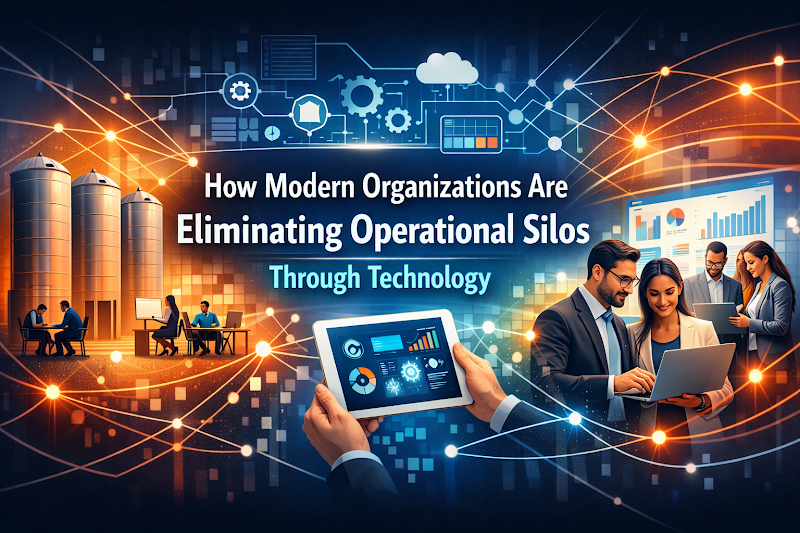
Walk into most growing organizations and you will find something curious. Marketing uses one platform to track campaigns. Sales lives inside a CRM that barely talks to it. Operations runs on spreadsheets exported from a legacy ERP. Customer support uses a ticketing system that nobody else logs into. Each tool works reasonably well on its own, yet the business as a whole feels slower, heavier, and harder to steer than it should.
This is the hidden tax of operational silos. Information gets trapped inside departments. Decisions get made on partial data. Customers repeat themselves across channels. Leadership lacks a unified picture of what is actually happening. The cost rarely shows up as a single line item, but it compounds daily through missed opportunities, duplicated effort, and slow responses to change.
Silos are not primarily a people problem. They are an architecture problem. When technology platforms are selected department by department, without a unifying strategy, fragmentation becomes the default state. Well-designed custom web application development services address this by creating connective tissue across systems, ensuring that data and workflows move fluidly between teams rather than piling up at departmental borders.
Breaking silos is not about forcing everyone onto one monolithic platform either. It is about designing an ecosystem where specialized tools communicate cleanly, share a common data layer, and serve a unified view of the customer and the business. Thoughtfully implemented custom software development services give organizations the flexibility to keep the tools their teams love while eliminating the friction between them.
Why Silos Form in the First Place
Silos rarely form through bad intent. They emerge naturally as companies grow. A scrappy startup picks tools that solve immediate problems. Each department gains autonomy to choose its own stack. IT focuses on keeping systems running rather than rearchitecting them. Before long, the organization has accumulated dozens of platforms, each optimized locally and none optimized globally.
Three patterns typically accelerate silo formation. The first is rapid growth, where speed of hiring outpaces the ability to standardize processes. The second is acquisitions, which bolt entirely new tech stacks onto the existing one. The third is well-meaning departmental autonomy, where individual leaders make sensible local choices that collectively create systemic fragmentation.
Recognizing how silos formed is the first step toward dismantling them without disrupting the work they support.
The Real Cost of Fragmented Systems
The consequences of silos extend far beyond inconvenience.
Customer experience suffers the most visibly. A customer who contacts support should not have to repeat their order history to three different agents. Yet without a unified data layer, that friction is unavoidable. Studies consistently show that inconsistent cross-channel experiences are among the top drivers of customer churn.
Decision-making slows down. When leaders need to combine data from five systems to answer a simple question, insights arrive too late to act on. Quarterly reviews replace real-time steering. Strategic agility erodes.
Employees lose time and motivation. Research suggests that knowledge workers spend a significant portion of their week searching for information across disconnected tools. That is not just wasted hours. It is cumulative frustration that drives disengagement and turnover.
Compliance and security risks multiply. Every disconnected system is another attack surface, another audit trail to maintain, another place where sensitive data might be mishandled. Fragmentation makes governance exponentially harder.
The Technology Shifts Making Integration Possible
Eliminating silos was historically a massive undertaking, requiring years of custom integration work. Several shifts have made the path considerably more accessible.
API-First Architectures
Modern platforms are built to communicate. Well-designed APIs allow systems to exchange data in near real time, enabling workflows that span multiple tools without manual intervention. Choosing platforms that take API design seriously is now a baseline requirement, not a nice-to-have.
Integration Platforms and iPaaS
Integration Platform as a Service solutions have matured dramatically. Tools like workflow automation platforms, event buses, and middleware layers let organizations connect dozens of systems without writing extensive custom code for each pairing. What once took a team of engineers can now be configured by technically capable operations staff.
Unified Data Layers
Rather than forcing every tool to talk to every other tool directly, forward-looking organizations are building centralized data layers. A cloud data warehouse or customer data platform becomes the single source of truth, with specialized applications reading from and writing to it. This hub-and-spoke model is far easier to maintain than point-to-point integrations.
Event-Driven Systems
Instead of batch processing data overnight, event-driven architectures propagate changes the moment they happen. When a customer updates their address in one system, every other relevant system knows within seconds. This real-time fabric is what makes truly unified experiences possible.
How Unified Systems Transform the Business
When silos come down, the effects ripple across every function.
Sales teams see the full customer context before every call. They know what the customer bought, what support issues they raised, what marketing emails they opened, and what their usage patterns look like. Conversations become meaningful instead of transactional.
Support agents resolve issues on first contact because they can see order history, account status, and prior interactions without switching tools. Average handling time drops, and customer satisfaction rises.
Marketing teams target with precision because they have access to actual behavioral and transactional data rather than just campaign analytics. Personalization becomes genuine rather than cosmetic.
Operations runs predictably because inventory, orders, logistics, and finance systems share a common understanding of reality. Exceptions surface immediately instead of festering until someone notices a spreadsheet anomaly.
Leadership steers with confidence because dashboards reflect unified data rather than reconciled guesses. Strategic decisions get made on facts, not on whichever department spoke loudest in the meeting.
Common Pitfalls on the Path to Integration
Breaking silos is rewarding, but it is rarely simple. A few patterns cause integration efforts to stall or backfire.
Trying to boil the ocean. Teams attempt to integrate everything at once, get overwhelmed, and end up with a half-finished project that nobody trusts. Successful integrations start with the highest-value workflows and expand from there.
Underestimating data quality issues. Connecting two systems with dirty data just moves the mess around faster. Data cleanup, deduplication, and governance need to run in parallel with integration work, not after it.
Neglecting change management. Employees who have used a particular tool for years will resist workflows that change how they operate, even when the new flow is objectively better. Bringing people along through training, clear communication, and involvement in design decisions matters as much as the technical work.
Choosing the wrong integration partner. Not every development partner understands the subtle art of systems integration. Look for teams with deep experience in your industry, proven track records with similar architectures, and a habit of asking hard questions early.
A Practical Path Forward
Organizations serious about eliminating silos typically follow a recognizable sequence.
They begin by mapping the current state honestly. Every system, every data flow, every workflow that crosses departmental boundaries gets documented. This alone often reveals surprising redundancies and gaps.
Next, they identify the handful of workflows where silos cause the most pain. Quote-to-cash, order-to-fulfillment, and lead-to-customer journeys are common starting points because they span multiple departments and directly impact revenue.
Then they architect a unified data foundation. This usually means selecting a central data platform, defining canonical data models, and establishing governance practices that keep the foundation clean over time.
Finally, they connect systems incrementally, prioritizing integrations that unlock the most value per unit of effort. Each integration is treated as a product, not a project, with ongoing monitoring and refinement.
Conclusion: Integration as a Competitive Advantage
In a market where customer expectations keep rising and operational margins keep tightening, fragmented technology is no longer a minor inefficiency. It is a structural disadvantage. Organizations that unify their data, connect their workflows, and give every team a complete view of the business simply move faster than those that do not.
The good news is that eliminating silos does not require tearing down everything you have built. It requires a strategy, a unifying architecture, and a willingness to treat integration as an ongoing discipline rather than a one-time project. Companies that commit to this approach consistently report faster decision-making, happier customers, more engaged employees, and healthier margins.
The businesses thriving a decade from now will not be the ones with the most tools. They will be the ones whose tools actually work together, creating experiences and insights that siloed organizations simply cannot match. The work of integration is not glamorous, but the competitive position it creates is difficult for anyone to replicate quickly.
If your organization is wrestling with the weight of disconnected systems, the right moment to start rethinking the architecture is before the next growth phase, not after it has already strained what you have.
