
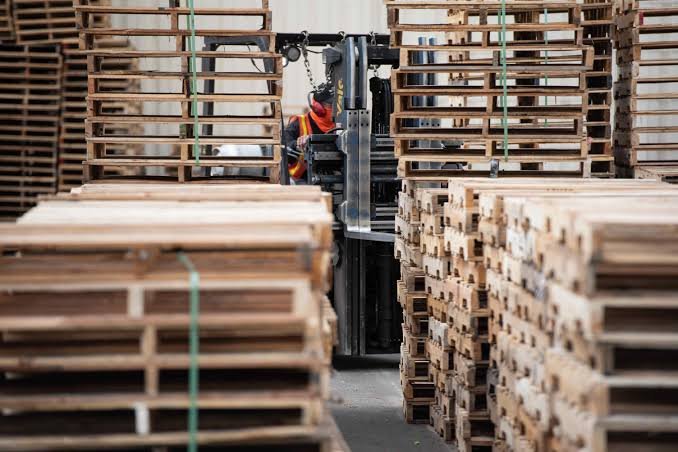
Every year, billions of pallets move through American supply chains. They carry raw materials into manufacturing facilities, finished goods into distribution centers, and consumer products onto retail floors. Most of that movement is invisible to anyone outside of logistics and operations — until a pallet fails, a shipment is delayed, or a procurement team starts questioning why pallet costs keep climbing quarter after quarter.
For warehouse managers, logistics coordinators, and operations directors, the question of what to do with damaged or end-of-life pallets is not a minor administrative task. It has real consequences for budget, efficiency, and consistency across the supply chain. Two options come up repeatedly in these conversations: recycling and remanufacturing. They are often treated as interchangeable, but they are not the same thing, and the financial implications of choosing one over the other are significant enough to warrant a clear-eyed comparison.
What Pallet Recycling Actually Involves
When most people talk about pallet recycling, they are referring to the process of collecting used or damaged pallets and breaking them down for raw material recovery. The wood is chipped, shredded, or repurposed into mulch, particleboard, animal bedding, or biomass fuel. The pallet, as a functional unit, no longer exists after the process is complete. Understanding what pallet recycling actually means in practice is essential before comparing it to remanufacturing, because many businesses assume that recycling returns value in the form of usable pallets — it does not.
Businesses that send pallets into a recycling stream are, in most cases, recovering a small fraction of the original asset value. They may receive a modest payment per unit from a recycling facility, or they may simply avoid disposal costs. Either way, the pallet is gone, and replacement inventory must be sourced separately. For operations that run on tight procurement schedules or maintain large standing pallet inventories, that replacement cycle adds cost at every turn.
That said, recycling does serve a legitimate purpose. When pallets are too structurally compromised to be repaired — broken beyond reasonable cost thresholds, contaminated, or made from non-standard configurations — recycling is often the appropriate and responsible end-of-life pathway. The question is not whether recycling has a role. It does. The question is whether it should be the default choice when other options exist.
The Hidden Cost of Recycling as a Default Strategy
Organizations that treat recycling as their primary pallet management strategy often absorb costs they do not fully track. The outflow of pallets into recycling streams means a constant need to replenish pallet stock, typically through new pallet purchases or spot market buys. New pallet pricing is sensitive to lumber market fluctuations, which have been volatile in recent years, making budget predictability difficult. Spot market sourcing introduces variability in pallet quality and dimensions, which creates downstream problems in automated warehousing environments where consistency is critical.
There is also the matter of time. Procurement cycles for replacement pallets involve lead times, vendor coordination, and receiving logistics. For high-volume operations, that administrative overhead accumulates. Recycling pallets and buying new ones at the same rate is not a neutral financial decision — it is a cycle that continuously drains capital from the pallet asset pool without rebuilding it.
What Pallet Remanufacturing Involves and Why It Operates Differently
Pallet remanufacturing is the process of taking damaged or structurally weakened pallets and restoring them to a functional, load-bearing condition. This is done by replacing broken boards, reinforcing weak joints, redriving fasteners, and inspecting the overall structure before the pallet re-enters active service. The result is a pallet that meets defined performance standards and can continue cycling through the supply chain. The pallet recycling conversation shifts meaningfully when businesses understand that remanufacturing preserves the pallet as an asset rather than converting it into raw material.
The economic logic of remanufacturing rests on one core principle: it is almost always less expensive to restore a pallet than to replace it. The structural components of most damaged pallets — the stringers, the deck boards, the overall frame — are largely intact even after significant wear. What fails first are usually specific boards or fastener connections, not the entire unit. Remanufacturing addresses those discrete failure points without discarding the value embedded in the rest of the pallet.
Consistency and Operational Reliability in Remanufactured Stock
One of the less discussed advantages of remanufacturing programs is the consistency they introduce into pallet inventory. When businesses source a mix of new pallets from varying suppliers, spot buys, and recycled-and-replaced units, they often end up with heterogeneous pallet stock. Slight differences in board thickness, stringer spacing, or overall dimensions may seem trivial in a manual handling environment but become problematic in facilities that use automated conveyors, racking systems, or robotic picking equipment.
Remanufacturing programs that operate within defined standards — such as those aligned with specifications developed by organizations like the National Wooden Pallet and Container Association — produce pallets that conform to predictable performance parameters. This consistency reduces equipment jams, limits product damage events, and creates more reliable throughput. For operations where downtime carries a measurable cost per hour, that kind of predictability has real financial value that does not always appear on a per-pallet cost comparison.
How Remanufacturing Affects Long-Term Pallet Asset Value
Every pallet in active circulation represents a capital investment. Whether a business owns its pallet pool outright or works through a managed inventory arrangement, the collective value of that pallet stock depreciates with each damage event and recovery cycle. Remanufacturing extends the usable life of that asset, compressing the effective per-cycle cost over time. A pallet that is remanufactured twice before reaching end-of-life delivers more total value from the original purchase than one that is cycled once and then sent to a recycling stream.
This compounding effect is particularly relevant for businesses that maintain large, captive pallet pools — manufacturers shipping to dedicated retail accounts, for example, or distributors running closed-loop delivery systems. In those contexts, the pallets circulating in the system are essentially a managed asset class, and remanufacturing is the maintenance strategy that keeps that asset class functional and financially efficient.
Comparing the Two Options Across Real Operational Scenarios
The financial comparison between recycling and remanufacturing is not the same for every business. Volume, pallet type, damage rates, and supply chain structure all influence which option delivers better returns. But several patterns emerge consistently across different operational contexts.
For businesses with high pallet throughput and significant damage rates, recycling pallets and replacing them with new units can cost several times more per pallet cycle than running a remanufacturing program. The per-unit cost of remanufacturing a damaged pallet is typically a fraction of new pallet pricing, and that gap widens when lumber prices rise. Remanufacturing also keeps procurement demand lower, which reduces exposure to supply variability.
Businesses operating open supply chains — where pallets are not returned, change hands frequently, or are used in one-way shipping — may find that recycling makes more practical sense for the pallets they do recover, since the economics of remanufacturing depend on capturing damaged pallets before they leave the system. In those cases, a hybrid approach often works best: remanufacturing pallets within controlled return loops and recycling those that cannot be economically recovered or are too damaged to repair.
• Remanufacturing consistently delivers lower per-cycle costs when damaged pallets can be captured and processed before replacement purchasing becomes necessary.
• Recycling remains the appropriate pathway for pallets that are structurally beyond repair, contaminated, or outside standard configurations that remanufacturing programs are designed to handle.
• Businesses with closed-loop or partially closed supply chains benefit most from remanufacturing programs, since pallet capture rates are higher and the asset pool is more controllable.
• High-throughput operations see the largest absolute savings from remanufacturing, because the cumulative cost difference across large pallet volumes compounds over time.
• Consistency in pallet dimensions and performance, delivered by structured remanufacturing programs, reduces secondary costs related to equipment wear, product damage, and operational delays.
What Decision-Makers Should Weigh Before Choosing a Strategy
Neither recycling nor remanufacturing is universally correct. The right approach depends on the specifics of how a business moves goods, what its pallet return rates look like, and how much variability it can absorb in pallet quality and availability. But the framing of the question matters. Businesses that treat pallet management as a disposal problem will default to recycling because it clears damaged inventory. Businesses that treat pallet management as an asset maintenance problem will look more carefully at remanufacturing because it preserves and recovers value.
The starting point for any serious evaluation is an accurate picture of current pallet costs — not just the purchase price of new pallets, but the full cycle cost including damage write-offs, procurement frequency, and any operational disruptions attributable to pallet quality. Without that baseline, it is difficult to make a well-grounded comparison between what recycling actually costs the business versus what a remanufacturing program would cost and return.
Conclusion
The distinction between pallet recycling and pallet remanufacturing is more consequential than it might appear from the outside. Recycling ends the life of a pallet asset and starts a replacement cost. Remanufacturing extends that asset’s productive life and defers the cost of replacement. For most businesses running moderate to high pallet volumes through partially or fully closed supply chains, remanufacturing offers a more cost-efficient path — not because it is the more technically sophisticated option, but because it is better aligned with how pallet costs actually accumulate over time.
That does not mean recycling has no place in a pallet management strategy. It does. But it should be a targeted, last-resort pathway for pallets that genuinely cannot be saved — not a default response to damage that could be addressed at lower cost through repair and restoration. Operations leaders who re-examine that default assumption and audit their actual pallet cycle costs often find that the financial case for remanufacturing is stronger than they initially assumed.
