
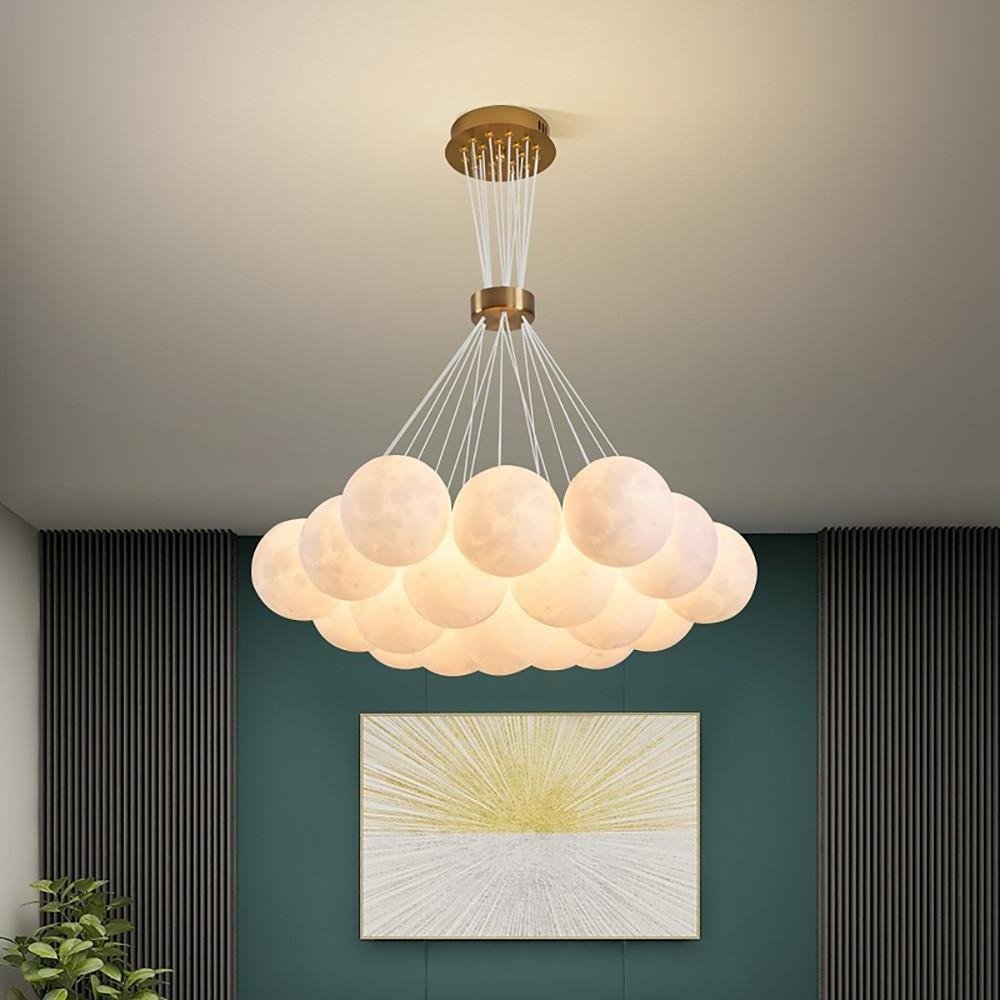
Modern homes are often built from rectangles. Cabinets, windows, doors, tables, rugs, and wall panels all create strong horizontal and vertical lines. This structure can make a room feel organised, but too many hard edges may also leave it looking rigid or unfinished. A rounded ceiling fixture offers a simple way to introduce contrast.
A globe chandelier adds curves without requiring new furniture or architectural work. Its spherical shades or circular arrangement can soften the view from across the room while preserving a clean, contemporary character. The effect is strongest when the fixture relates to the room’s scale, materials, and lighting needs rather than serving as an isolated decoration.
Why Curved Shapes Change the Mood
Curves encourage the eye to move more gently through a space. They break up repeated right angles and can make a room feel less formal, even when the colour palette remains neutral. Because globes have no obvious front or back, they also tend to look balanced from several viewpoints.
Choose the Right Globe Arrangement
A Globe Chandelier can take many forms. Some designs place several spherical shades around a central stem, while others suspend globes in a cluster or spread them along branching arms. A compact symmetrical arrangement feels orderly, whereas an irregular cluster introduces more movement and visual energy.
Choose according to what the room lacks. A minimal dining area may benefit from a sculptural cluster that creates a focal point. A busy living space may need a quieter, evenly balanced design. If the ceiling is tall, a vertical grouping can fill empty height without requiring a very wide fixture.
Match the Fixture to the Furniture Below
The chandelier should relate to the furniture zone it anchors. Above a rectangular dining table, a wide arrangement of globes can distribute visual weight across the length without copying the table’s shape exactly. Above a round table, a centred cluster reinforces the table’s symmetry and creates a more intimate composition.
In a living room, centre the chandelier over the seating group or coffee table rather than automatically using the middle of the entire ceiling. Open-plan layouts often contain several functional zones, and the fixture can help define one of them. This approach usually feels more intentional than centring it between unrelated walls.
Use Material to Control the Style
Clear glass globes feel light and allow the frame and bulbs to remain visible. They work well where the room needs openness, although fingerprints and dust may be easier to see. Frosted or opal glass creates a softer, more even glow and hides the bulb, making it comfortable for dining rooms, bedrooms, and living spaces.
Smoked, amber, or tinted globes introduce colour without relying on fabric or painted surfaces. Black frames create definition against pale ceilings, while brass and bronze add warmth. Chrome or nickel can suit cooler contemporary palettes. Repeating one finish already found in handles, furniture legs, or taps helps the chandelier belong to the room.
Get the Scale Right
Globe chandeliers can appear larger than expected because the empty space between shades becomes part of the overall silhouette. Check the fixture’s full width, depth, and height rather than focusing on the diameter of each globe. Marking the dimensions with removable tape can help you visualise its presence before ordering.
A small fixture may disappear beneath a broad ceiling, while an oversized cluster can obstruct sightlines or crowd nearby cabinetry. Over a table, keep the outer globes comfortably inside the furniture edges. In an open walkway, provide suitable head clearance below the lowest shade or decorative element.
Consider Light Distribution and Glare
Globe material strongly affects light quality. Clear shades allow more direct illumination and can produce sparkle, but exposed bulbs may cause glare when viewed at eye level. Frosted shades diffuse light more gently, although the room may need additional task lighting. Review total output, bulb direction, and dimming compatibility before buying.
Warm or soft white light often complements timber, fabric, brass, and neutral walls. A dimmer makes the fixture more flexible, providing brighter light for cleaning or serving and a calmer level for evenings. The chandelier does not need to handle every task; lamps, wall lights, or recessed fixtures can complete the lighting plan.
Balance Curves Without Repeating Them Everywhere
The chandelier can introduce the main rounded form without forcing every object to match. One or two subtle repetitions—such as a circular mirror, curved chair back, round vase, or softly shaped table lamp—are usually enough. Too many spheres and circles can make the design feel themed rather than balanced.
Contrast is often more interesting than perfect coordination. A globe fixture above a straight-edged table creates a clear relationship between soft and structured forms. The room can retain its modern geometry while gaining a more comfortable rhythm and a focal point that looks intentional from several directions.
A Softer Shape With a Clear Purpose
A globe chandelier works best when its curves solve a visual problem: balancing cabinetry, softening a rectangular room, or giving an open-plan zone a recognisable centre. Select the arrangement, material, scale, and light quality as carefully as the shape itself. Done well, one rounded fixture can make a highly structured interior feel calmer and more complete.
