
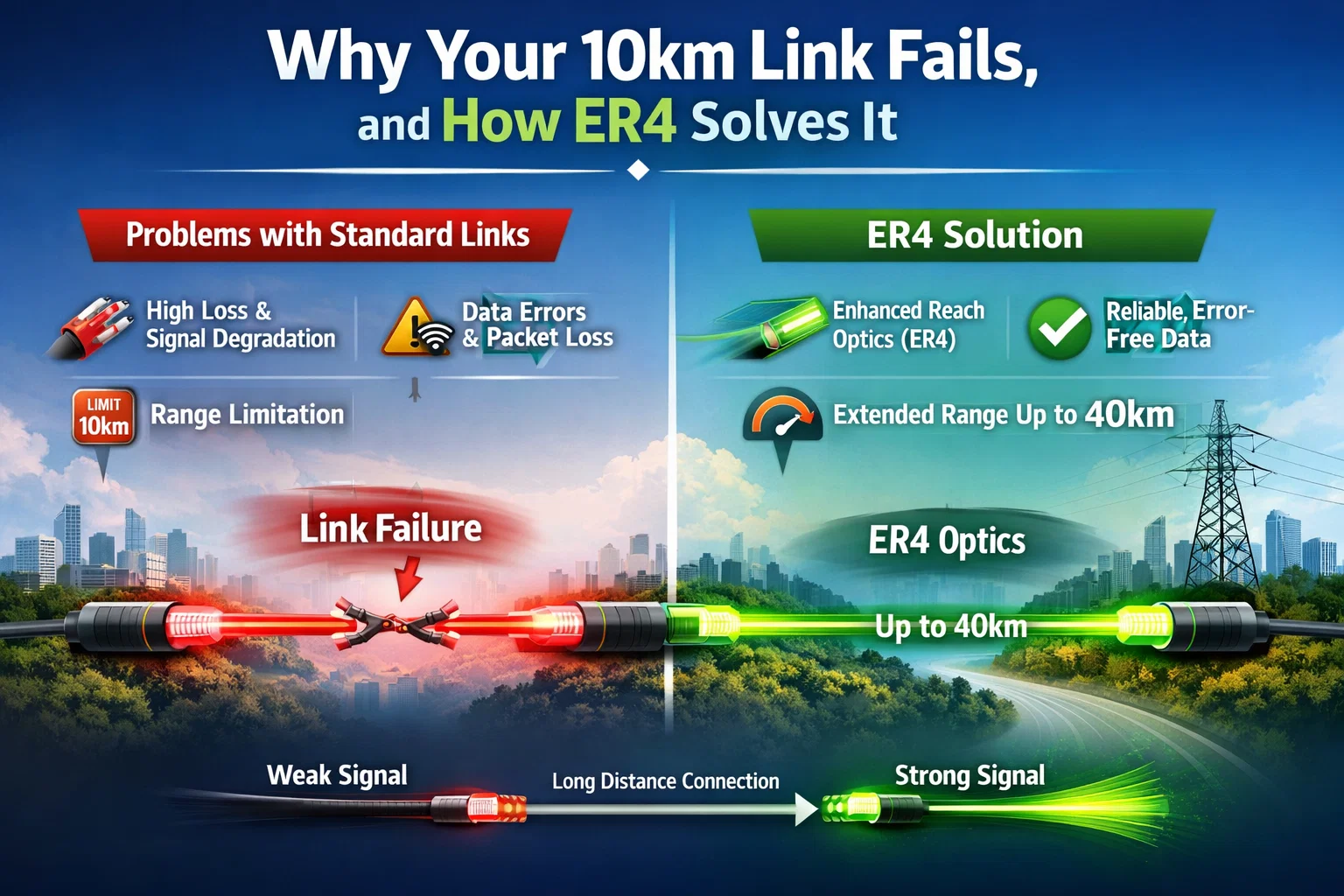
In modern network deployments, a 10km optical link is often treated as a safe and predictable standard. Engineers expect that as long as the transmission distance does not exceed the nominal specification, the link should operate smoothly. However, real-world experience frequently proves otherwise. Many 10km links suffer from instability, intermittent packet loss, or even complete failure to establish a connection, despite being theoretically within range.
This gap between expectation and reality highlights a critical truth: optical transmission performance is not determined by distance alone. While 40G QSFP+ modules such as LR4 are designed for 10km links, their performance heavily depends on ideal conditions that are rarely met in actual deployments. Understanding why these links fail is essential before exploring how a more robust solution like ER4 can address these challenges.
What Causes 10km Links to Fail?
Optical Power Budget Limitations
One of the most common reasons for failure in 10km links is the limitation of the optical power budget. Although LR4 modules are specified for 10km transmission, this specification assumes minimal loss across the link. In practice, every segment of fiber introduces attenuation, and each connector or splice adds insertion loss. Over long distances, these losses accumulate and can push the received optical signal below the sensitivity threshold of the receiver.
As a result, even if the physical distance remains within 10km, the effective signal strength may no longer be sufficient to maintain a stable link. This often leads to marginal performance, where the link may function intermittently but lacks reliability under varying conditions.
Fiber Infrastructure Issues
Another major factor is the quality and condition of the fiber infrastructure itself. Not all single-mode fibers perform equally. Variations in fiber type, age, and installation quality can significantly impact signal transmission. Older fibers may exhibit higher attenuation, while poorly managed cable routing can introduce bends and microbends that degrade signal integrity.
In many enterprise and campus environments, fiber paths are not newly deployed but reused from existing infrastructure. These legacy fibers often fail to meet the optimal conditions assumed by LR4 specifications, further contributing to unexpected link failures.
Multiple Patch Panels and Connectors
Real-world networks rarely consist of a single continuous fiber run. Instead, they include multiple patch panels, connectors, and intermediate distribution frames. Each connection point introduces additional insertion loss, which can quickly add up across the entire link.
For example, a link that includes several patch panels and jumpers may accumulate several dB of extra loss, effectively reducing the usable distance. In such scenarios, a “10km link” on paper may behave more like a significantly longer link in terms of optical loss, pushing LR4 modules beyond their operational limits.
Environmental and Deployment Factors
Environmental conditions also play a crucial role in link stability. Temperature fluctuations can affect the performance of optical components, including both transmitters and receivers. In addition, improper installation practices, such as excessive bending or inadequate cable management, can further degrade signal quality.
Over time, dust contamination on connectors and gradual wear can introduce additional loss. These factors are often overlooked during initial deployment but become significant contributors to long-term instability.
The Hidden Gap Between Theory and Reality
The root of the problem lies in the difference between theoretical specifications and real-world conditions. The 10km reach defined for LR4 modules is based on controlled environments with minimal loss and optimal fiber quality. However, actual deployments often operate much closer to the edge of the allowable optical budget.
Many 10km links fail not because they exceed the nominal distance, but because they exceed the total allowable loss. This distinction is critical. A link can be physically within 10km yet still fail due to accumulated attenuation and suboptimal conditions, leaving little to no performance margin.
How 40G QSFP+ ER4 Solves These Problems
Extended Reach up to 40km
40G ER4 modules are designed with significantly extended reach, supporting transmission distances of up to 40km over single-mode fiber. This extended capability provides a much larger operational margin, allowing the link to remain stable even when additional losses are present.
Instead of operating at the edge of the optical budget, ER4 enables networks to function comfortably within safe limits, reducing the risk of instability and failure.
Higher Optical Power Budget
A key advantage of ER4 lies in its higher optical power budget. With stronger transmit power and improved receiver sensitivity, ER4 modules can tolerate greater levels of attenuation. This makes them well-suited for links that include multiple connectors, older fiber infrastructure, or longer effective distances.
By providing additional headroom, ER4 ensures that signal integrity is maintained even under less-than-ideal conditions, significantly improving overall reliability.
Better Tolerance for Real-World Conditions
ER4 modules are inherently more resilient to the complexities of real-world deployments. Whether used in campus networks, metro connections, or data center interconnects, they can accommodate variations in fiber quality, environmental conditions, and network topology.
This adaptability makes ER4 a practical choice for scenarios where precise control over every aspect of the link is not feasible, which is often the case in large-scale or legacy environments.
ER4 vs LR4: When Should You Upgrade?
Choosing between LR4 and ER4 ultimately depends on how close your network operates to its limits. LR4 remains a cost-effective solution for clean, well-managed links that comfortably fall within the 10km range. However, when links approach this सीमा, or when additional losses are introduced through connectors and infrastructure, the risk of instability increases significantly.
In such cases, upgrading to ER4 provides a safer and more reliable alternative. It is particularly beneficial for links that already exhibit performance issues, as well as for new deployments where future scalability and reliability are priorities.
Deployment Tips for Stable Long-Distance Links
Ensuring stable optical performance requires more than just selecting the right module. Minimizing the number of connection points, maintaining clean connectors, and regularly testing link loss are all essential practices. Proper cable management and adherence to installation standards can also prevent unnecessary signal degradation.
While these measures can improve the performance of LR4 links, they cannot fully compensate for limited optical budgets. Incorporating ER4 into the network design adds an extra layer of assurance, allowing the link to maintain stability even when conditions are not ideal.
Conclusion: Stop Pushing LR4 to Its Limits
The assumption that a 10km link will always function reliably with LR4 modules is often flawed. Real-world conditions introduce a range of variables that can significantly impact performance, from accumulated insertion loss to environmental factors and aging infrastructure.
Rather than pushing LR4 to its limits, adopting ER4 provides a more robust and future-proof solution. By offering greater reach, higher optical power budget, and improved tolerance to real-world conditions, ER4 ensures that long-distance links remain stable, reliable, and ready to meet the demands of modern networks.
