
Most procurement conversations focus entirely on the buying side: how to structure requirements, how to evaluate suppliers, how to negotiate favorable terms. That perspective is natural. The organization issuing a request for quotation controls the timeline, the evaluation criteria, and ultimately the award decision. It makes sense to optimize for the buyer’s experience.
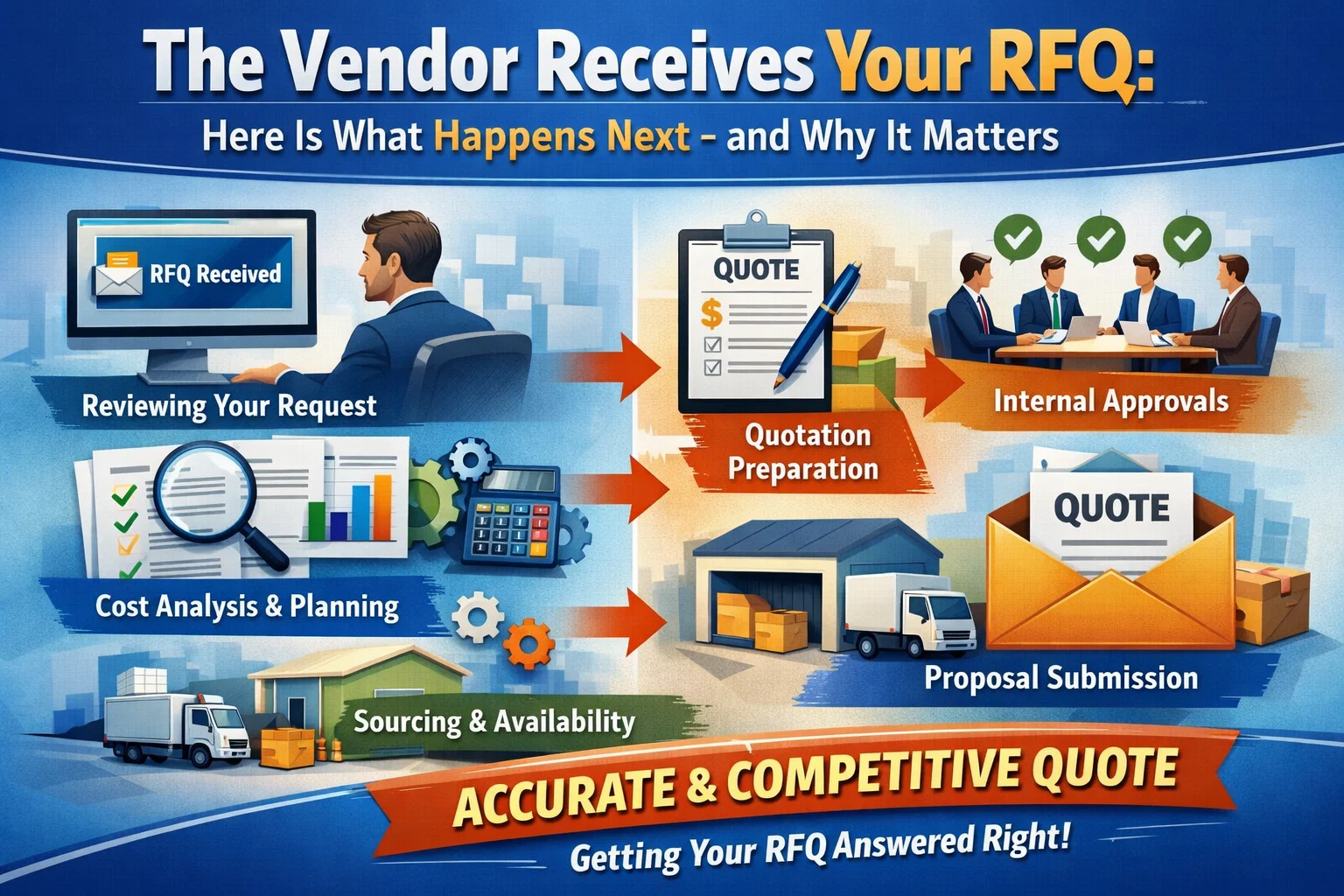
But there is a parallel story that rarely gets told, and it has significant implications for procurement outcomes. When an RFQ lands in a vendor’s inbox, it triggers a chain of internal events that directly affects the quality, accuracy, and competitiveness of the response the buyer eventually receives. Understanding that chain — what makes a vendor respond well, what causes delays and errors, and what separates a thoughtful reply from a rushed one makes procurement teams meaningfully better at their jobs.
Procurement and sales are two sides of the same transaction. The clarity of an rfq document determines not just how easily buyers can compare quotes, but how well vendors can actually price and commit to what is being asked. That connection between document quality and response quality is where most organizations leave significant value on the table.
What a Vendor Actually Sees When an RFQ Arrives
From the vendor’s perspective, an incoming RFQ is both an opportunity and a triage decision. Sales and presales teams the people typically responsible for preparing responses are usually managing multiple live opportunities simultaneously. The first question they ask when a new RFQ arrives is not “how do we respond?” It is “should we respond, and how much effort should we invest?”
That decision is shaped almost entirely by the quality and clarity of the document itself. An RFQ that clearly defines specifications, quantities, delivery expectations, and evaluation criteria signals that the issuing organization is serious, prepared, and worth engaging with fully. An RFQ that is vague, internally inconsistent, or missing critical information signals the opposite and often results in either a minimal response or no response at all.
This dynamic is particularly pronounced in competitive markets where qualified suppliers have more opportunities than they can fully pursue. The organizations that consistently receive high-quality, competitive vendor responses are usually the ones that invest in their procurement documentation — not just for compliance or auditing purposes, but because they understand that document quality drives response quality.
The Hidden Bottleneck on the Vendor Side
Once a vendor decides to respond to an RFQ, the process of actually preparing a response reveals a different set of challenges. The most common bottleneck is not technical capacity or pricing analysis it is information retrieval. Before a vendor can commit to specifications, confirm certifications, or price accurately, they need to locate the right internal information and verify that it is current.
This sounds straightforward, but in practice it is anything but. Product specifications live in engineering systems. Compliance certifications live in legal or quality management platforms. Pricing and margin data live in finance systems. Historical answers to similar procurement questions may exist somewhere in a shared drive or an email archive, but finding them quickly under deadline pressure is a different matter entirely.
The teams responsible for preparing vendor responses presales engineers, solutions consultants, bid managers spend a disproportionate amount of their time doing knowledge archaeology: searching through disconnected systems to find information that they know exists but cannot quickly locate. This inefficiency does not just slow response times. It introduces errors, because when the right source cannot be found, teams default to what they remember or what was used last time, which may no longer be accurate.
Why Specification Clarity Directly Affects Pricing Accuracy
One of the more counterintuitive dynamics in procurement is that vague specifications do not save vendors time — they create more work and less reliable pricing. When an RFQ asks for “high-quality industrial components meeting industry standards” without specifying which standards, tolerances, or testing protocols apply, vendors face a choice: request clarification (which takes time and risks missing the deadline) or make assumptions (which risks submitting a price that does not reflect actual requirements).
The practical consequence is that buyers who issue vague RFQs often receive a wide spread of quotes that are difficult to compare because each vendor made different assumptions. What looks like healthy competition is actually apples-to-oranges pricing that cannot be evaluated on a fair basis. The buyer then spends additional time going back to clarify, reissuing the RFQ, or making award decisions with incomplete information.
The most experienced procurement teams treat specification development as an investment. Time spent defining requirements precisely on the front end saves far more time during evaluation and negotiation. It also produces better outcomes: when vendors can price confidently against clear requirements, they compete on actual cost and capability rather than margin for ambiguity.
Deadlines, Volume, and the Vendor’s Prioritization Problem
Vendors responding to RFQs face a consistent challenge that buyers rarely think about: they are almost never responding to just one RFQ at a time. Enterprise sales and presales teams typically manage dozens of active opportunities simultaneously, each with its own documentation requirements, timelines, and stakeholder expectations.
When an RFQ deadline falls in a crowded period, the depth of response a vendor can provide is directly influenced by how much lead time the buyer built into the process. An RFQ issued with a 72-hour turnaround window may technically receive a response, but it will almost certainly be a shallower, less carefully considered response than one issued with two weeks of lead time.
This is not an excuse for slow vendor performance it is a procurement design insight. Buyers who build reasonable response windows into their RFQ timelines, who issue documents well before internal deadlines require an award decision, and who establish clear channels for vendor questions consistently receive better responses. The quality of the procurement process shapes the quality of the inputs to that process.
The Role of RFQ Documentation in Long-Term Supplier Relationships
There is a longer-arc dimension to RFQ quality that rarely appears in discussions of individual procurement transactions. Organizations that consistently issue clear, well-structured RFQs develop a reputation among suppliers and that reputation has tangible commercial consequences.
Preferred suppliers prioritize buyers who are easy to work with. When a procurement team is known for issuing precise, complete documentation, responding promptly to questions, and running fair evaluation processes, vendors allocate more senior resources to their responses. They are more likely to offer their best pricing and terms. They are more willing to flag potential issues proactively rather than waiting to see if the buyer notices.
Conversely, organizations known for issuing confusing or incomplete RFQs, changing requirements mid-process, or making award decisions that seem disconnected from stated criteria find that their supplier pool gradually shrinks. Qualified vendors quietly stop responding, leaving only those with fewer alternatives.
This reputational dynamic operates slowly and is therefore easy to ignore. But over a multi-year horizon, the procurement teams that treat their RFQ documentation as a reflection of organizational professionalism consistently outperform those that treat it as a bureaucratic checkbox.
When Vendors Push Back and What That Signals
A frequently misunderstood procurement signal is vendor pushback during the RFQ process. When a supplier asks for deadline extensions, requests clarification on specifications, or submits a response with notable caveats and assumptions, buyers often interpret this as a problem with the vendor. In many cases, it is a signal about the RFQ itself.
Requests for clarification almost always indicate that the documentation was ambiguous on a point that matters for accurate pricing. Requests for timeline extensions often indicate that the response is genuinely complex relative to the time provided. Caveats and assumptions in a submitted quote indicate that the vendor needed to fill in gaps that the RFQ left open.
Tracking these patterns across multiple procurement cycles is a valuable diagnostic. If the same clarification questions come up repeatedly from different vendors, that is a signal to improve the specification template. If timeline extension requests are common, that may indicate that internal approval processes are compressing the vendor response window to an unrealistic degree.
The best procurement teams treat vendor behavior during RFQ processes as feedback on their own documentation and process design not just as a reflection of supplier capability.
Technology and the Future of Vendor Response Quality
The gap between how procurement teams issue RFQs and how vendors respond to them is increasingly being bridged by technology. On the procurement side, tools that standardize templates, manage supplier communication, and track response quality over time are reducing the documentation inconsistencies that produce poor vendor responses.
On the vendor side, AI-powered platforms are changing the economics of response preparation. When solutions engineers can locate the right technical specifications, compliance certifications, and pricing data in seconds rather than hours, the bottleneck of information retrieval shrinks dramatically. Responses become faster, more accurate, and more tailored to the specific requirements in each document.
Understanding what constitutes a well-structured rfq document and what vendors need to see in order to respond confidently is becoming a shared competency between procurement and sales operations. The organizations on both sides of the transaction that develop this competency are finding that procurement cycles shorten, response quality improves, and supplier relationships become more productive over time.
The Symmetry of Good Procurement Practice
The most important insight from examining the vendor side of the RFQ process is that good procurement practice is symmetric. The same discipline that makes an issuing organization easier to work with clear specifications, realistic timelines, organized documentation, consistent communication also makes the vendor response process faster and more reliable.
This symmetry is not a coincidence. Procurement is fundamentally a communication process. The goal on both sides is to arrive at an accurate, complete picture of what is being requested and what can be delivered, at what cost and on what terms. Every element of an RFQ that introduces ambiguity, every deadline that compresses vendor response time unnecessarily, and every communication gap that prevents clarifying questions from being answered degrades that shared understanding.
Organizations that approach their procurement documentation with the vendor’s perspective in mind asking not just “does this meet our requirements” but “can a qualified supplier respond to this accurately and completely?” consistently generate better procurement outcomes than those that optimize purely for internal process compliance.
