
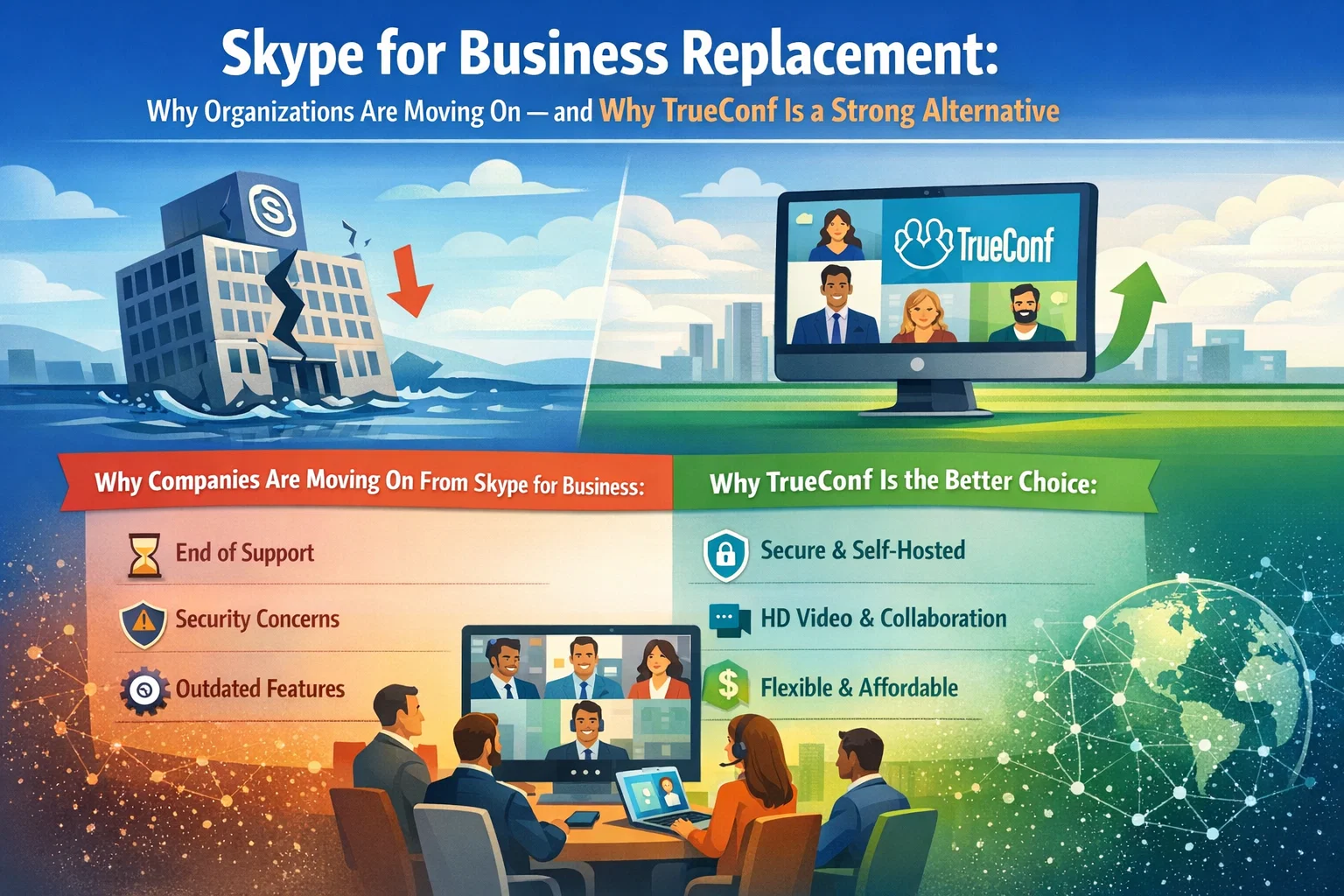
Skype for Business served enterprises well for years, but it is no longer the platform most organizations should build their future communications around. Microsoft retired Skype for Business Online on July 31, 2021. Support for Skype for Business Server 2019 ended on October 14, 2025, and Microsoft has positioned Skype for Business Server Subscription Edition as the supported on-premises continuation for customers who want to stay in that product family.
For many companies, that creates a practical question: what should replace Skype for Business now? If your priorities include secure communications, on-premises deployment, control over infrastructure, and support for business messaging plus video meetings in one platform, TrueConf is a compelling alternative. TrueConf Server is an on-premises collaboration platform that combines team messaging, video conferencing, and enterprise integrations, with a free edition available for up to 1,000 users.
Why companies are replacing Skype for Business
The replacement decision is not only about product retirement. It is also about changing business requirements.
Organizations today expect one communication platform to handle chat, voice and video meetings, file sharing, guest access, mobility, and integration with existing identity and telephony systems. Once Skype for Business Online was retired, businesses that had depended on it needed a migration path. And once Skype for Business Server 2019 reached end of support in October 2025, staying on older deployments became harder to justify from an operational and security perspective.
At the same time, not every organization wants to move fully into a cloud-first model. Many enterprises, public-sector teams, healthcare organizations, manufacturers, and companies with strict internal security policies still prefer communications systems they can deploy and manage inside their own infrastructure. That is where on-premises alternatives become especially relevant.
What to look for in a Skype for Business replacement
A good Skype for Business replacement should do more than replicate basic calling and meetings. It should help modernize communications without forcing a complete rebuild of your environment.
The most important criteria usually include:
- on-premises or private deployment options
- business chat and group messaging
- HD or 4K video meetings
- interoperability with existing SIP or H.323 equipment
- directory integration with Active Directory or LDAP
- centralized administration
- support for remote, office, and hybrid work
These requirements map closely to what organizations historically valued in Skype for Business Server: control, integration, and enterprise readiness.
Why TrueConf is a strong alternative
TrueConf stands out because it is built specifically for organizations that want a secure, self-hosted collaboration environment rather than a consumer-style communications app.
TrueConf Server is a software-based platform for video conferencing and team messaging that runs on-premises or in a private network. It supports personal and group chats, UltraHD video conferencing, collaboration tools, and enterprise deployment scenarios.
1. On-premises deployment and infrastructure control
One of the biggest reasons businesses replace Skype for Business with TrueConf is deployment control. TrueConf Server runs on company-owned infrastructure, which helps organizations keep communications within a closed corporate network rather than routing everything through a public cloud architecture.
For companies in regulated or security-sensitive environments, this can be a major advantage.
2. Built-in business messaging and conferencing
A Skype for Business replacement has to cover both real-time meetings and everyday internal communication. TrueConf supports personal and group chats, file sharing, collaboration features, and video conferencing in one environment.
That means teams do not have to split communication between one product for chat and another for meetings.
3. Active Directory and LDAP integration
For enterprises, user management matters just as much as meeting quality. TrueConf supports LDAP and Active Directory integration, including address book synchronization and centralized account management.
This makes migration easier for organizations that already rely on Microsoft directory services and want to keep familiar identity workflows.
4. SIP and H.323 interoperability
Many businesses replacing Skype for Business still have meeting room hardware, PBXs, or third-party endpoints that use SIP or H.323. TrueConf Server includes a built-in gateway for SIP 2.0, H.323, and RTSP, and supports integration scenarios such as Asterisk and Cisco UCM.
That can reduce disruption during migration and protect previous infrastructure investments.
5. A practical option for organizations that want self-hosted collaboration
TrueConf is especially relevant for organizations that are not simply looking for another meeting app, but for a replacement that preserves enterprise control. The platform combines messaging, conferencing, and modern collaboration capabilities, and also offers a free edition for up to 1,000 users.
For IT teams evaluating cost, deployment speed, and proof-of-concept options, that lowers the barrier to testing.
When TrueConf makes the most sense
TrueConf is particularly well suited to organizations that:
- want to replace Skype for Business with an on-premises platform
- need both messaging and video conferencing in one product
- use Active Directory or LDAP for identity management
- still depend on SIP/H.323 room systems, PBXs, or legacy endpoints
- need tighter control over data location and infrastructure
In those cases, TrueConf is not just an alternative in name. It aligns with the same enterprise-focused thinking that made Skype for Business attractive in the first place, while offering a more current collaboration model.
A practical migration approach
Replacing Skype for Business works best when handled in stages.
First, identify which workloads matter most: internal chat, scheduled meetings, ad hoc video calls, telephony, guest access, or conference room connectivity. Next, map those needs to the replacement platform. Then, test directory sync, endpoint interoperability, and user adoption with a pilot group before expanding company-wide.
For organizations moving toward a self-hosted architecture, TrueConf is attractive because the platform is built around server deployment, administrative control, LDAP/AD integration, and SIP/H.323 interoperability rather than treating those features as an afterthought.
Conclusion
Skype for Business is no longer the right long-term foundation for most organizations. Skype for Business Online has already been retired, and Skype for Business Server 2019 reached end of support in October 2025. While Microsoft offers Skype for Business Server Subscription Edition for supported on-premises continuity, many businesses evaluating their next step may prefer a platform designed around secure, self-hosted collaboration from the start.
If your organization needs an on-premises replacement with enterprise messaging, video conferencing, Active Directory integration, and SIP/H.323 interoperability, TrueConf is a strong alternative worth serious consideration.
