
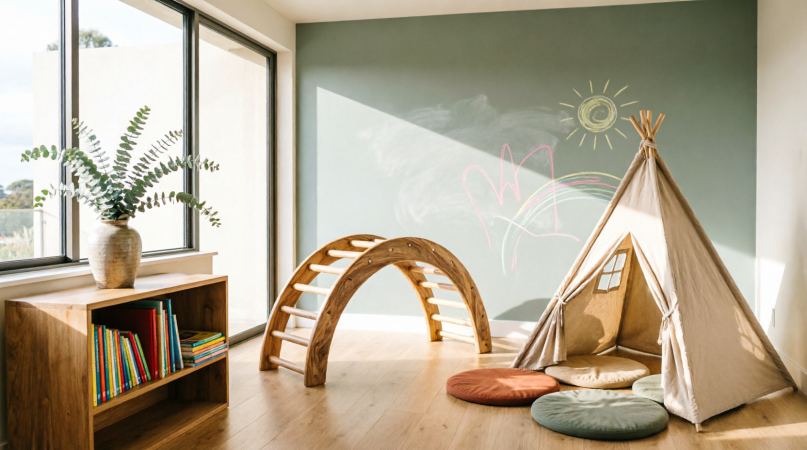
An indoor play area for children in the Australian family home is the dedicated physical environment where developmental play, creative exploration, and early learning take place during the years that directly shape school readiness and lifelong learning habits. For Australian families in a diverse range of housing configurations, from compact urban apartments to spacious suburban family homes, creating an effective indoor play area for children depends less on the total available space than on the quality of the furniture setup, the organisation system, and the intentional design of the play zones within whatever space is available.
Key Takeaways
- An effective Australian indoor play area can be created in any room size, from a corner of the living room to a full dedicated room, with quality furniture and thoughtful zone design.
- The three-zone approach, active play, creative learning, and quiet reading, provides the developmental framework for every Australian indoor play area regardless of its size.
- Furniture quality and scale are the primary determinants of the indoor play area’s developmental effectiveness, more so than the total floor area available.
- Australian safety requirements for the indoor play area include anti-tip anchoring, non-toxic finishes, appropriate floor cushioning, and age-appropriate access design.
- Natural light, acoustic management, and visual organisation together produce an Australian indoor play area that the child chooses over screen entertainment for extended independent play sessions.
Indoor Play Area Configurations for Australian Homes
| Home Configuration | Available Space | Recommended Setup | Priority Furniture |
| Apartment (60-90 sqm) | Corner of living area, approx 6-8 sqm | Compact zone with multipurpose pieces | Activity table + wall-mounted storage + rug |
| Townhouse (90-150 sqm) | Spare bedroom or living room zone | Single-room setup with three zones | Full furniture suite, compact dimensions |
| Family home (150-250 sqm) | Dedicated playroom or large family room zone | Complete three-zone playroom | Full furniture suite, standard dimensions |
| Large family home (250 sqm+) | Dedicated large playroom | Full expanded setup with multiple zones | Generous full suite with multiple pieces per zone |
Designing the Australian Indoor Play Area
The Zone-Based Approach for Any Australian Space
The most effective Australian indoor play area design applies the three-zone approach regardless of the total available space. Even a compact apartment corner can accommodate three micro-zones: an activity table with chairs for the creative and learning zone, a small open storage unit with accessible bins for the active play zone toy organisation, and a low bookshelf with a floor cushion for the quiet reading zone. The zone-based approach ensures that every developmental play function is physically represented in the indoor play area, whether the total space is six square metres or sixty, producing a more developmentally complete play environment than a larger but unplanned space with only one or two functional zones.
Furniture Choices for the Australian Indoor Play Area
Every furniture piece in the Australian indoor play area should be evaluated on three criteria before purchasing: is it the correct scale for the Australian children who will use it, ensuring independent access and correct seated posture; is it confirmed safe to Australian children’s furniture standards, including non-toxic finishes and structural stability; and does it serve a specific developmental function in the play area design, rather than being a decorative addition without functional play value. Applying these three criteria systematically produces an Australian indoor play area furniture selection that is entirely functional, appropriately safe, and developmentally rich without exceeding the available space or budget.
Making the Australian Indoor Play Area the First Choice for Independent Play
The ultimate measure of an Australian indoor play area’s success is whether the Australian child chooses it over screen entertainment for extended independent play sessions. A well-designed indoor play area achieves this through: accessible, visually interesting toy and material display that invites selection; a comfortable reading corner with engaging books that attracts quiet self-directed exploration; an activity table with art and craft materials that provides creative expression opportunities; and an organised, manageable space that the Australian child can navigate independently without adult mediation. These characteristics are produced by quality furniture in appropriate scale, effective organisation, and the three-zone design that provides something engaging at every corner of the play area.
Browse the complete range of furniture for the Australian indoor play area for children at the Boori Australia website.
Frequently Asked Questions
How do I create an Australian indoor play area without a dedicated room?
Define the play zone with a large play rug that clearly marks the play area boundary. Use furniture with compact footprints: an activity table rather than a large craft table, a tower storage unit rather than a wide cabinet, and a narrow forward-facing bookshelf rather than a wide display unit. Wall-mounted storage reduces the floor footprint while maximising the toy accessibility that the indoor play area requires for developmental function.
What is the minimum furniture needed for an effective Australian indoor play area?
The minimum effective Australian indoor play area consists of: one activity table at the correct height for the child’s age group, with two matching chairs; one accessible open storage unit with bins at child height; and one low forward-facing bookshelf with a floor cushion beside it. These three pieces, placed on a play rug, create the functional foundation of the three-zone Australian indoor play area in approximately six to eight square metres of floor space.
How do I keep an Australian indoor play area relevant for multiple children of different ages?
Organise the storage system by play category rather than by child, with each category accessible to the youngest child in the space. Choose furniture at the scale of the youngest Australian child using the area, as older children adapt more easily than younger children to slightly smaller furniture. Create a quiet reading zone with books at multiple levels, picture books at the lower shelf and chapter books at the upper shelf, that serves both the youngest and oldest Australian children using the space.
Does an Australian indoor play area need to be completely separate from the adult living area?
No. Many of the most effective Australian indoor play areas are defined zones within open-plan family living areas rather than completely separate rooms. The zone definition, through a large play rug, storage furniture arranged as zone boundaries, and the consistent association of the zone with play activity, provides the developmental benefits of the dedicated play space within the shared family living environment.
Final Thoughts
Creating an effective indoor play area for children in the Australian home is an investment in the most important developmental environment of the Australian childhood years, achievable in any housing configuration with quality furniture, thoughtful zone design, and appropriate safety measures. The quality of the furniture and the intentionality of the design matter far more than the total available floor space for the Australian family committed to their children’s developmental play environment. Browse the complete range at the Boori Australia website.
