
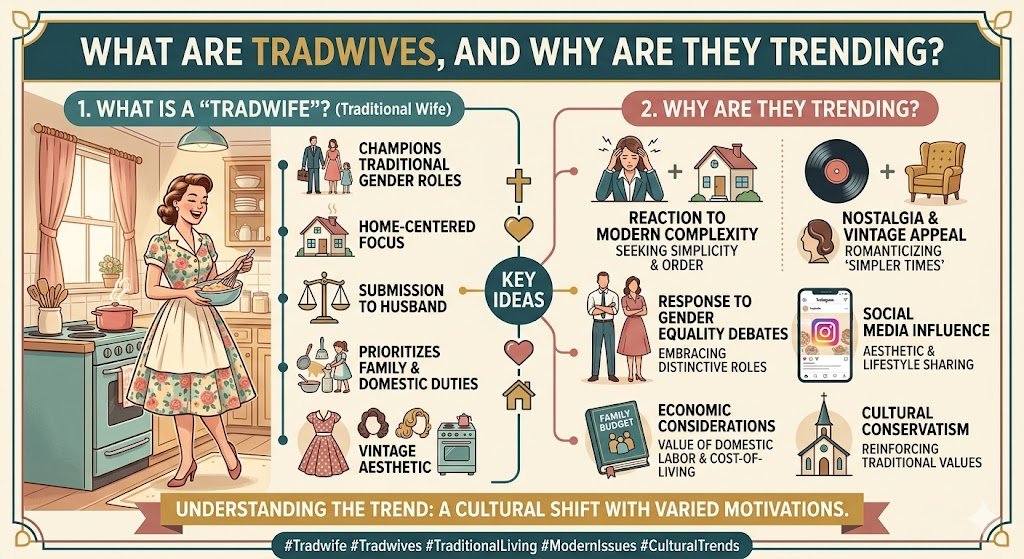
If you’ve spent any time on TikTok or Instagram over the past few years, you’ve almost certainly come across videos of impeccably dressed women kneading bread in pastel-colored kitchens, milking cows in linen dresses, or making breakfast cereal from scratch for their five children. They wear vintage aprons, speak in soft voices, and look like they walked straight out of a 1950s commercial. They’re called tradwives, and they’ve become one of the most talked-about and most polarizing cultural phenomena of the decade.
The term comes from “traditional wife,” and it describes women who voluntarily embrace classic gender roles: home, motherhood, raising children, and supporting a husband who serves as the family’s primary breadwinner. What began around 2018 as a niche subculture on blogs and forums has exploded into billions of views under the #tradwife hashtag, evolving from an internet curiosity into a serious conversation about feminism, capitalism, identity, and desire.
Where the term comes from
The word tradwife is a portmanteau of “traditional” and “wife.” Although women have always lived traditional lives, the term gained mainstream visibility in January 2020, when British blogger Alena Kate Pettitt founder of The Darling Academy sat down for a BBC interview in which she spoke openly about her desire to serve her husband and devote herself to homemaking. That conversation triggered a wave of reporting in The Guardian, the Sydney Morning Herald, and other major outlets.
From there, social media did the rest. The pandemic of 2020, with its lockdowns, layoffs, and forced slowdown, pushed millions of people to rethink what “success” actually meant. While office workers were rediscovering homemade sourdough and many working mothers were hitting the wall of exhaustion, a new generation of content creators began romanticizing domestic life as a quiet act of rebellion.
The aesthetic: what we see on screen
If someone asked you to close your eyes and picture a tradwife right now, you’d probably imagine pastel kitchens, jars filled with wildflowers, sourdough starters bubbling on the windowsill, long cotton dresses, and blond children playing barefoot on the grass. You wouldn’t be wrong: that aesthetic is real, and it’s a fundamental part of the phenomenon.
The style draws from several parallel aesthetics that have dominated social media in recent years: cottagecore (idealized country life), prairie fashion, the return of 1950s vintage clothing, and a broader nostalgia for a slower, more “authentic” past. Some tradwives lean into classic Hollywood glamour, with red lipstick and pin curls. Others prefer the American ranch look gingham dresses, homemade butter, golden-hour shots on the homestead. And some go for a much more urban, high-fashion version, with designer kitchens and luxury props.
But it’s worth not confusing the wrapping with the contents. The aesthetic is just that: aesthetic. The substance, according to the women in the movement themselves, lies in how you live: being present for your kids, cooking from scratch, building a home that feels like a sanctuary instead of a pit stop between obligations.
The faces of the movement
The movement has no single leader, but a few names have become unavoidable references.
Hannah Neeleman, a former Juilliard ballerina living with her husband and eight children on a Utah farm, is probably the best-known. Under the name Ballerina Farm, she has nearly ten million followers across social platforms and was crowned by the British press as “the queen of the tradwives.” Her content is full of fresh-baked loaves, home births, and idyllic mornings bathed in the golden light of the American West.
Nara Smith, a South African–German model based in the United States, has conquered TikTok with her from-scratch cooking videos she even makes her own breakfast cereal and gummy candies at home — filmed with a near-hypnotic calm. Her success matters for another reason, too: as a biracial woman, she has challenged the assumption that this aesthetic is exclusively white.
And then there’s the pioneer, Alena Kate Pettitt, author of two books on the subject and a critical voice from inside the movement: in a 2024 New Yorker profile, she warned that the movement she had helped popularize had “become its own monster,” hijacked by extremists and grifters. That nuance matters: not all tradwives think the same way far from it.
Why it’s trending right now
To understand the rise of tradwives, blaming the algorithm isn’t enough. There’s a very specific cultural context behind it.
Throughout the 2010s, girlboss culture the ideal of the woman who has it all: a stellar career, a six-figure salary, kids, a partner, and a six-pack was the dominant model. But by the end of that decade, many women started putting words to something they already knew in their bodies: the double shift was exhausting, the jobs weren’t as exciting as office TV shows had promised, and the promise of “having it all” actually meant “doing it all yourself.”
Tradwives offer the opposite imaginary: presence, slowness, purpose. A form of empowerment that doesn’t require climbing a ladder or proving anything to the labor market. For a generation raised on the message that success means going up, the idea of stepping off and pouring yourself into your home has obvious magnetic appeal. A 2025 University of Hawaiʻi study also found that roughly half of the tradwife influencers analyzed were not white, confirming that the movement’s pull cuts across race, religion, and class.
Layered on top of that is an economic crisis that has many young women looking at endless careers, unaffordable rents, and precarious jobs and asking whether any of it is really worth it — even if, paradoxically, living on a single income is a privilege very few families can actually afford today.
The debate: personal choice or step backward?
This is where the phenomenon gets uncomfortable. For its defenders, being a tradwife is exactly what feminism promised: the freedom to choose how you live. If some women want to be surgeons and others want to be full-time mothers, both choices deserve the same respect. End of story.
For its critics, the matter isn’t that simple. Journalists and researchers like Seyward Darby (author of Sisters in Hate) and Eviane Leidig (The Women of the Far Right, Columbia University Press, 2023) have documented troubling overlaps between the tradwife aesthetic and far-right discourse, white supremacy, and militant anti-feminism. A 2026 University of Nevada study concluded that men with high levels of “hostile sexism” are particularly likely to support the movement which puts its protagonists in a delicate position.
There’s also an economic contradiction the movement still hasn’t resolved: many of the biggest tradwife influencers earn millions through brand deals and their own businesses. Hannah Neeleman is co-CEO of Ballerina Farm. Nara Smith works as a professional model. The life they show isn’t directly replicable for a family that genuinely lives on one income, and that deserves to be said out loud.
And then there’s the silent risk: financial dependence. Any version of traditional living that leaves a woman without the means to support herself and her children if things go wrong isn’t traditional it’s dangerous. Financial literacy, transparency within a marriage, and an emergency fund are non-negotiable, whether or not they make it onto TikTok.
Beyond the feed
Maybe the most interesting thing about the tradwife phenomenon is that it has spilled beyond social media. Communities, books, podcasts, and platforms have emerged offering practical resources for women who want to explore this lifestyle honestly including conversations about budgeting, mental health, and the real division of labor inside a marriage. Spaces like Tradwife Club try to serve as a meeting point for women interested in family-centered living, offering guides, recipes, and discussions more open than what algorithms typically allow.
The existence of these spaces doesn’t make the debate any less complex, but it does offer an alternative to the passive consumption of aspirational content. It’s one thing to watch Hannah Neeleman knead bread at six in the morning on her perfect farm; it’s quite another to have a frank conversation with other women about how, in real life, you actually run a house, a marriage, and four kids.
So what now?
Tradwives aren’t a passing trend, a right-wing conspiracy, or a feminist manifesto. More than anything, they’re a symptom. A symptom of exhaustion, of a search for meaning, of mistrust toward a model of success that has left many women drained and empty. They’re also an uncomfortable reminder that the freedom to choose includes the freedom to choose things that to others may look regressive.
Looking at the phenomenon with curiosity rather than contempt or devotion is probably the only honest way to understand it. There are tradwives living luminous, healthy lives, and there are others repeating dynamics that hurt them. Some arrive at this lifestyle through faith, others through corporate burnout, and still others through an idealized nostalgia that has very little to do with how our grandmothers actually lived most of whom couldn’t even open a bank account in their own name.Maybe the most useful question isn’t “are tradwives good or bad?” but a much more personal one: what kind of life do I want to build, with whom, and for what reasons? Because in the end, whether you wear a linen apron or an office suit, what determines whether a life is worth living isn’t the wrapping. It’s what’s inside.
