
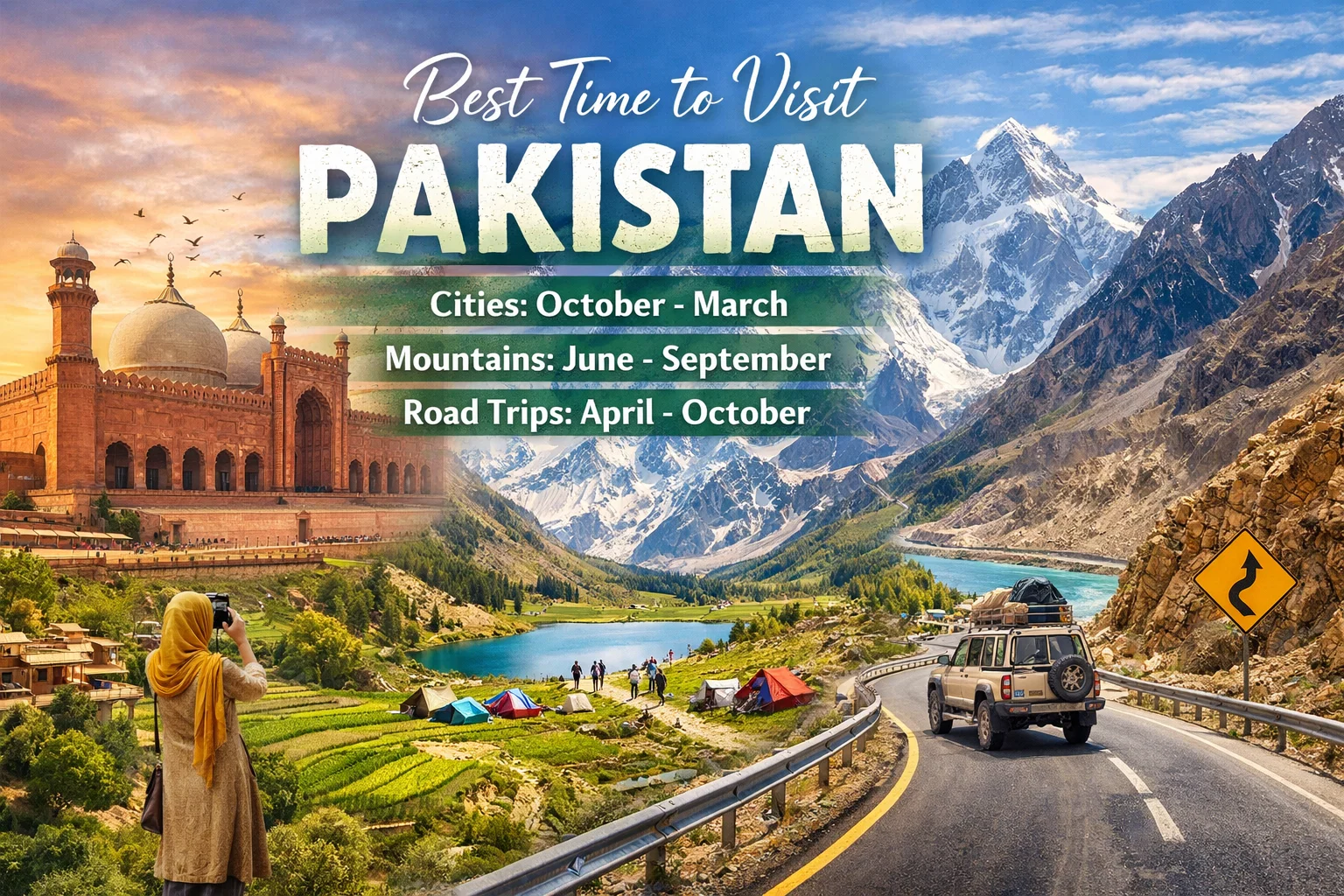
Choosing when to visit Pakistan depends very much on where you want to go. The country covers hot coastal cities, major cultural centres, and high mountain regions where the season can change the whole shape of a trip. For first-time travellers, the best approach is to think about the destination first, then choose the month. If you are already looking at tickets to Pakistan, it is worth deciding early whether your trip is mainly for cities such as Lahore and Karachi, or for mountain areas such as Hunza and Skardu, because the best timing is not the same.
This matters more in Pakistan than many travellers expect. A good month for Lahore may feel too hot for comfortable city walking in Karachi, while a good month for Hunza may be completely different again from the best window for Skardu. People often start with tickets to Pakistan and a rough list of places they would like to see, but the season should really shape the route from the start.
For a manageable trip, it helps to split Pakistan into two broad ideas: city travel and mountain travel. Cities are often easier in the cooler months, while mountain routes depend much more on snow, road access and local weather conditions. Once you look at it that way, planning becomes much simpler.
Spring: one of the most balanced times to travel
Spring is often one of the easiest seasons for a first trip, especially if you want a mix of cities and northern scenery without the extremes of high summer or deep winter. Roughly speaking, this means March to May, though conditions vary by region.
Lahore is usually pleasant in spring, especially in the earlier part of the season. March can be a good time for walking around the old city, visiting historical sites and moving around without the heavier heat that builds later. By May, temperatures can rise enough to make long afternoons more tiring, but spring is still generally more manageable than peak summer.
Karachi is warm for much of the year, but spring tends to be more comfortable than the hottest late summer periods. It is still a large, busy city where heat can shape the day, so it makes sense to plan around mornings and evenings where possible.
For Hunza, spring is appealing because the valley starts to open up visually after winter, and the landscapes begin to shift again. Blossoms in some parts of the north make this period especially attractive, though conditions can still be cool and some higher routes may not yet be fully straightforward.
Skardu in spring can be more uncertain than Hunza, especially earlier in the season. Access improves as temperatures rise, but mountain travel still needs checking carefully. This is a time when road conditions and local updates matter more than the calendar alone.
Summer: best for high mountains, harder for big cities
Summer is when Pakistan’s northern mountain regions are at their most accessible. For travellers heading to Hunza or Skardu, this is often the main season to consider. Broadly, this means June to August.
Hunza works well in summer because roads are generally easier to use, conditions are more predictable than in colder months, and the scenery is fully open for travellers who want long drives and mountain views. This is when northern road trips start to feel simpler to organise.
Skardu is also strongest in summer for access. If your trip is built around mountain scenery, high-altitude travel or longer overland routes, summer is usually the most practical choice. It is the season when the trip becomes easier to plan with confidence, especially compared with late winter or very early spring.
The trade-off is that summer is less comfortable for many city trips. Lahore can be very hot, and long sightseeing days in exposed areas can feel draining. Karachi also becomes difficult for some travellers during hotter stretches because of heat and humidity. If your trip is mainly urban and cultural rather than mountain-based, summer is often not the easiest time to go.
This is why it helps to be clear about priorities. If the point of the trip is the north, summer often makes sense. If the point is city travel, it may not.
Autumn: strong for both cities and northern scenery
Autumn is often one of the most useful travel seasons because it can work well for several different types of trip. September to November is generally the period travellers look at.
Lahore becomes easier again once the strongest summer heat fades. This can be a good time for travellers who want history, food and city exploration without the intensity of peak summer. It is often a more comfortable season for walking and day-to-day sightseeing.
Karachi also becomes more manageable later in the year, especially for travellers who prefer less oppressive heat. It remains warm, but not always in the same heavy way as the hotter months.
Hunza is a particularly good autumn choice. Road access is usually still workable, and the changing scenery makes this one of the most attractive seasons in the north. For many travellers, autumn gives the mountain trip they wanted, but without the pressure of peak summer timing.
Skardu can also work well in autumn, especially in the earlier part of the season. Later in autumn, conditions begin to tighten again, and this is where local timing starts to matter more. A trip in early October can feel very different from one later in November.
Winter: better for some cities than for mountain road trips
Winter is where planning needs a sharper regional focus. For cities, it can often be one of the better periods. For mountain areas, it can make access much more limited.
Lahore is usually easier in winter than in summer from a comfort point of view. Cooler temperatures make city sightseeing simpler, though some travellers may find mornings and evenings colder than expected. It is still one of the better seasons for an urban trip.
Karachi is often very workable in winter because the worst of the heat is behind it. For travellers focused on the city rather than the mountains, this can be one of the easier times to visit.
Hunza in winter is a very different kind of trip. Scenery can be striking, but conditions are much colder, and travel is less straightforward. Skardu is even more affected. Winter mountain travel is not impossible, but it is not the simplest choice for a first trip, especially if you want an easy road-based itinerary.
If your priority is smooth mountain access, winter is usually not the season to choose.
Mountain routes and local conditions
One of the most important practical points in Pakistan is that mountain travel depends on access, not just temperature. Roads into Hunza and Skardu are generally easier from late spring through early autumn. This is the window when road trips feel more realistic and less dependent on local disruption.
Even in the better months, local weather matters. Rain, landslides, snow at higher points and road maintenance can all affect timings. In mountain regions, a route that looks simple online may still need flexibility on the ground. That is why it is worth allowing extra time and checking local conditions close to travel.
Weather extremes matter more than averages
Pakistan is a country of weather extremes, and that matters for planning. Summer city heat can be tiring, while mountain cold in winter can affect access as much as comfort. It is usually more useful to think in terms of what the weather allows you to do than to focus on average temperatures.
For example, a summer city trip may still be possible, but it changes the pace of the day. A winter mountain trip may still be appealing, but it changes how far you can realistically travel by road. Those practical differences matter more than long climate detail.
Match the season to the trip
The easiest way to choose your timing is to match the season to the kind of trip you actually want. For Lahore and Karachi, spring, autumn and winter are usually more comfortable than high summer. For Hunza and Skardu, summer and early autumn are often the most reliable for access and road travel.
If you want cities, choose the cooler months. If you want mountain roads and open northern routes, aim for the warmer season. If you want a bit of both, spring or autumn usually gives you the best balance. That is the simplest way to turn a broad Pakistan idea into a trip that actually works.
